Learning Journey
Free preview · Lesson 1
Understanding Sustainable ecosystem[BIOLOGY]
Understanding Sustainable Ecosystems: Our Planet's Natural Balance
Imagine your home. It has furniture, food in the fridge, water flowing, and electricity. You, your family, and even a pet if you have one, live there. Now, imagine a much bigger "home" – one that includes all living things like plants, animals, and even tiny bacteria, plus all the non-living things like sunlight, water, air, and soil. This grand "home" is what we call an ecosystem.
What is an Ecosystem? A Giant Interconnected Puzzle!
An ecosystem is simply a community of living organisms (plants, animals, and microbes) interacting with each other and with their non-living environment (like air, water, and soil). Think of it like a giant, super-complex puzzle where every piece, living or non-living, fits together and affects all the other pieces.
- Biotic Components (The Living Pieces): These are all the living parts of an ecosystem.
- Producers: Imagine them as the "chefs" of the ecosystem. Like a chef who makes food from ingredients, producers (mostly plants, algae, and some bacteria) create their own food using sunlight (photosynthesis). They are the base of almost all food chains.
- Consumers: These are the "eaters" or "guests" at the ecosystem's table. They can't make their own food, so they eat other organisms.
- Herbivores: Eat plants (like a cow eating grass).
- Carnivores: Eat other animals (like a lion eating a zebra).
- Omnivores: Eat both plants and animals (like humans or bears).
- Decomposers: These are the "clean-up crew" or "recyclers" of the ecosystem. Organisms like bacteria and fungi break down dead plants and animals, returning valuable nutrients to the soil. Without them, the Earth would be buried in dead stuff, and new plants wouldn't have enough nutrients to grow!
- Abiotic Components (The Non-Living Pieces): These are all the non-living parts that influence the living things. Think of them as the "furniture" and "utilities" of our home analogy.
- Sunlight: The ultimate energy source for most ecosystems, powering producers. It's like the electricity that powers everything in your home.
- Water: Essential for all life processes. It's like the plumbing in your house – vital for drinking, cleaning, and cooking.
- Air: Provides gases like oxygen (for breathing) and carbon dioxide (for photosynthesis). It's like the air conditioning or heating system.
- Soil: Provides nutrients, anchors plants, and is home to many organisms. It's like the foundation and garden of your home.
- Temperature: Influences where different organisms can live.
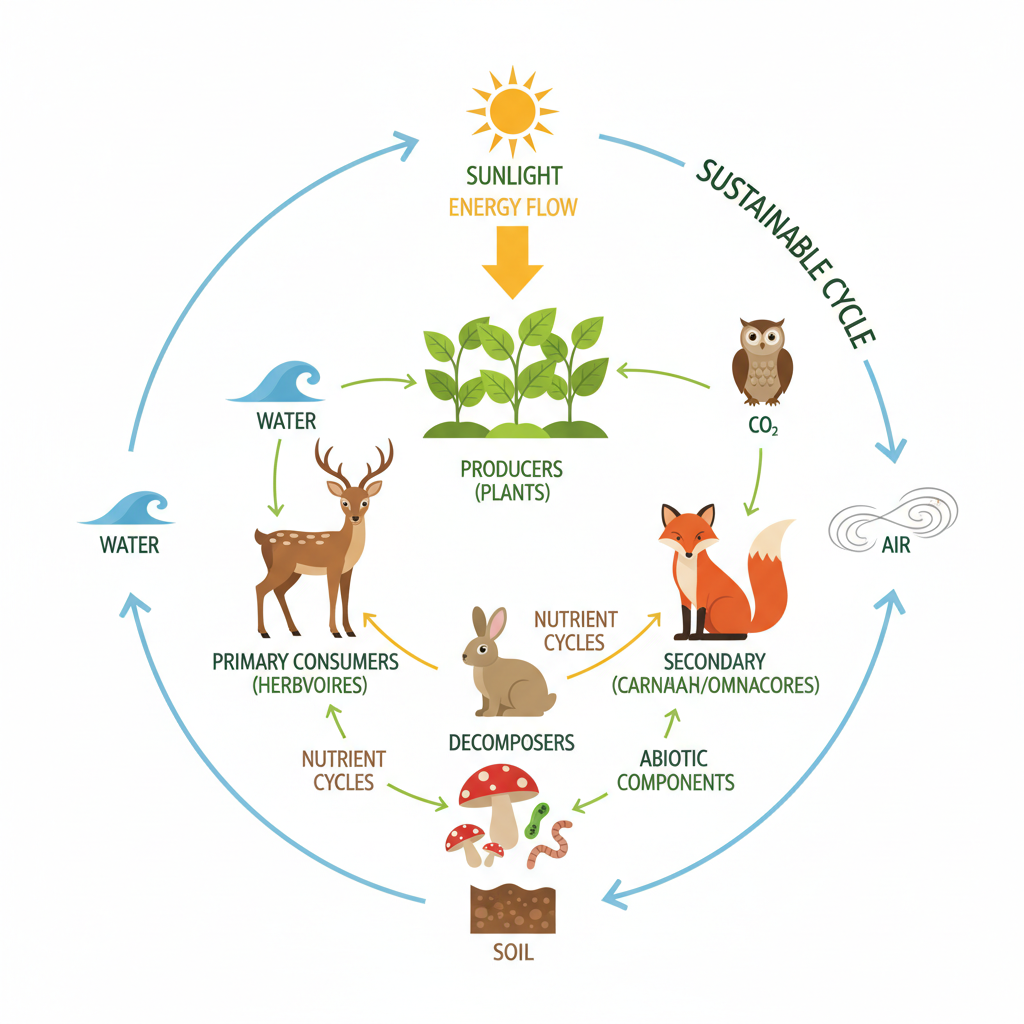 ⚠️ This picture may have spelling mistakes. Trust the words in the lesson.
What Does "Sustainable" Mean for an Ecosystem? Keeping the Balance!
Now, what about the "sustainable" part? Imagine your favorite toy or game. If you play with it carelessly, break parts, or lose pieces, it won't last long, right? A sustainable ecosystem is like a well-cared-for toy or a perfectly balanced seesaw. It means the ecosystem can continue to function, thrive, and support its living organisms indefinitely, without running out of resources or being permanently damaged.
It's all about balance and self-sufficiency. A sustainable ecosystem can:
- Regenerate Resources: It can naturally replenish its water, air, and soil nutrients. Think of a healthy forest that grows new trees as old ones die, instead of being completely cut down.
- Recycle Waste: The decomposers are constantly breaking down dead material and recycling its nutrients back into the soil, like a composting system in nature.
- Maintain Biodiversity: It has a good variety of different species. Think of a toolbox – if you only have one type of screwdriver, you can't fix everything. The more tools (species) you have, the better equipped the ecosystem is to handle changes and challenges.
- Resist and Recover: It can withstand disturbances (like a minor drought or a small fire) and bounce back. Imagine a springy mattress – if you push it down, it springs back up. A resilient ecosystem can do the same.
How Do Ecosystems Stay Sustainable? The Magic of Cycles!
Ecosystems stay sustainable through constant interactions and cycles. Here are a few key ones:
- Energy Flow (Food Chains & Webs): Energy flows from the sun, to producers (plants), to primary consumers (herbivores), to secondary consumers (carnivores/omnivores), and so on. When organisms die, decomposers return some energy and nutrients to the environment. This is like a constant flow of electricity through a circuit, powering different parts. A food web is like many interlocking food chains, making the ecosystem more stable – if one food source disappears, an animal might have others to rely on.
- Nutrient Cycles: Essential nutrients like carbon, nitrogen, and water are constantly recycled.
- Water Cycle: Water evaporates, forms clouds, rains down, and flows through rivers back to oceans.
- Carbon Cycle: Plants take in carbon dioxide, animals eat plants, release carbon dioxide, and decomposers break down dead organic matter, returning carbon to the soil and air. This is like a continuous loop!
Why is Sustainability Important? Our Future Depends on It!
The Earth's ecosystems provide us with everything we need to live: clean air to breathe, fresh water to drink, fertile soil to grow food, and a stable climate. When an ecosystem becomes unsustainable, these essential services start to break down. Imagine if your home's plumbing stopped working, or the electricity went out permanently – life would become very difficult.
Unfortunately, human activities are often the biggest threat to ecosystem sustainability:
- Pollution: Releasing harmful substances into the air, water, and soil (like throwing trash into a clean river).
- Deforestation: Cutting down too many trees (like tearing down the walls of our "home").
- Overfishing/Overhunting: Taking too many animals out of an ecosystem, disrupting food webs.
- Climate Change: Caused by too many greenhouse gases in the atmosphere, leading to extreme weather and changing conditions that many species can't adapt to.
What Can We Do? Be a Responsible Earth Citizen!
Just like we take care of our homes, we need to take care of our planet's ecosystems. Every small action helps:
- Reduce, Reuse, Recycle: Less waste means less pollution and less demand for new resources.
- Conserve Water and Energy: Turn off lights, take shorter showers.
- Support Sustainable Products: Choose products that are made in ways that don't harm the environment.
- Plant Trees: Help restore habitats and absorb carbon dioxide.
- Learn and Share: Understand how ecosystems work and teach others!
By understanding what makes an ecosystem sustainable and recognizing our role in maintaining that balance, we can ensure that our planet remains a healthy, thriving home for all living things for generations to come.
Keep learning, free
Create a free Syllabax account to unlock practice questions and games for this topic.
Visual Learning Enhanced! 🚀
To help you master this topic, we use Advanced Syllabax AI to generate detailed diagrams and visual models.
Note on Visuals: The AI sometimes makes spelling errors in image labels. Please refer to the lesson text for the correct terminology.