Multiplication (3-digit × 2-digit) [Fundamental Operations]
Watch this topic in 60 seconds
Free preview · Lesson 1
Understanding Multiplication (3-digit × 2-digit) [Fundamental Operations]
Mastering Multiplication: Multiplying Big Numbers! (3-digit × 2-digit)
Hello, super mathematicians! Today, we're going on an exciting adventure into the world of multiplying bigger numbers. We've already learned how to multiply smaller numbers, and now we're ready to tackle multiplying a 3-digit number (like 123) by a 2-digit number (like 45). Think of it like building with LEGOs – the more blocks you have, the bigger and more amazing your creation can be! Multiplication is just a super-fast way to add the same number over and over again.
Why Do We Multiply Big Numbers?
Imagine you're planning a huge party! You need to buy goodie bags for all your guests. If you have 135 guests and each guest gets 3 small toys in their bag, how many toys do you need in total? That's 135 groups of 3 toys. Instead of adding 3 + 3 + 3... 135 times (which would take forever!), we can multiply! 135 × 3 tells us the total number of toys instantly. Now, what if each guest gets 25 little treats? That's a much bigger number to multiply! This is where multiplying 3-digit by 2-digit numbers comes in handy. It helps us solve real-world problems involving large quantities quickly and efficiently.
Let's Break It Down: The "Area Model" Analogy
One of the best ways to understand multiplying bigger numbers is to imagine we're building a rectangular garden. The length of the garden is one number, and the width is the other. The total area of the garden is the answer when we multiply the length by the width.
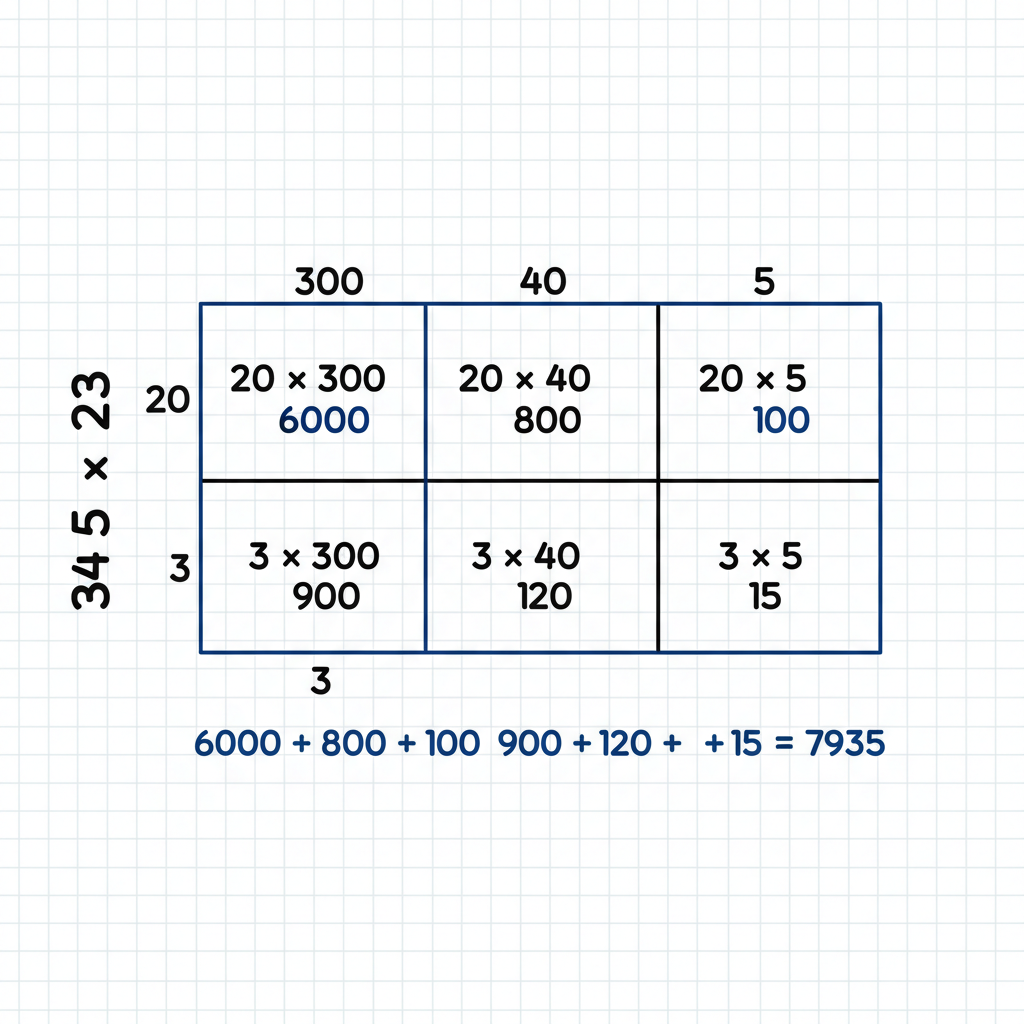
When we multiply a 3-digit number (like 345) by a 2-digit number (like 23), we can think of our garden as being divided into smaller sections.
- The 3-digit number (345) can be broken into hundreds, tens, and ones: 300, 40, and 5.
- The 2-digit number (23) can be broken into tens and ones: 20 and 3.
Now, we can draw a big rectangle and divide it into smaller rectangles based on these parts. We multiply each part of the first number by each part of the second number.
Example: 345 × 23
We can imagine a rectangle with a length of 345 (which is 300 + 40 + 5) and a width of 23 (which is 20 + 3).
This breaks our big rectangle into 3 columns (for 300, 40, 5) and 2 rows (for 20, 3), making a total of 6 smaller rectangles. We calculate the area of each small rectangle:
- 20 × 300 = 6000
- 20 × 40 = 800
- 20 × 5 = 100
- 3 × 300 = 900
- 3 × 40 = 120
- 3 × 5 = 15
Finally, we add up the areas of all these smaller rectangles to get our total answer: 6000 + 800 + 100 + 900 + 120 + 15 = 7935.
 ⚠️ This picture may have spelling mistakes. Trust the words in the lesson.
The "Standard Algorithm" Method: Step-by-Step!
While the area model is great for understanding, the standard algorithm is a quicker way to multiply. Think of it like a secret code or a special dance with numbers!
Let's use the same example: 345 × 23
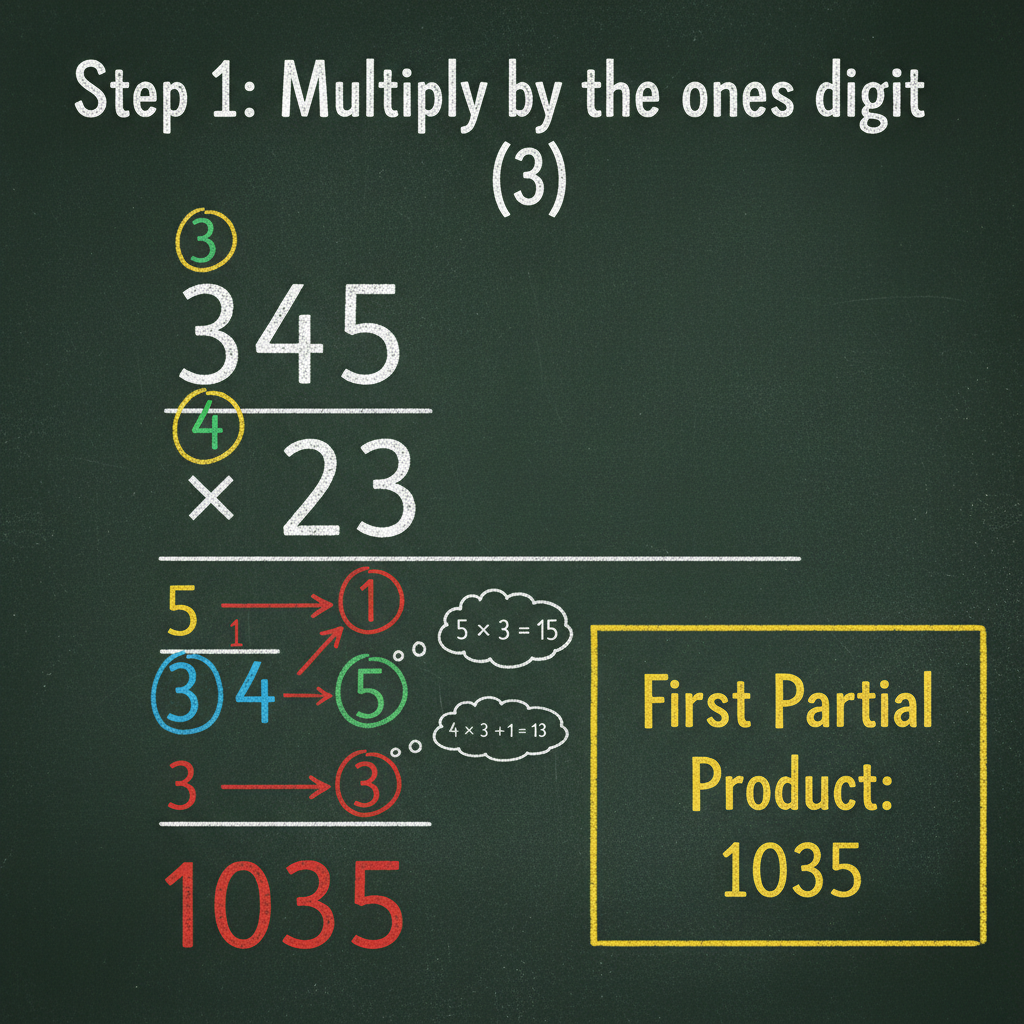
Step 1: Multiply by the Ones Digit of the Second Number.
Take the ones digit of the second number (which is 3 in 23) and multiply it by each digit in the first number (345), starting from the right (the ones place).
- 3 × 5 = 15. Write down the 5 and carry over the 1 to the tens place.
- 3 × 4 = 12. Add the carried-over 1: 12 + 1 = 13. Write down the 3 and carry over the 1 to the hundreds place.
- 3 × 3 = 9. Add the carried-over 1: 9 + 1 = 10. Write down 10.
So, 345 × 3 = 1035. This is like calculating the area of the '3' row in our garden model.
Step 2: Multiply by the Tens Digit of the Second Number.
Now, take the tens digit of the second number (which is 2 in 23). Since it's in the tens place, it really means 20. Before we multiply, we add a placeholder zero in the ones place of our answer. This is super important! It's like shifting our multiplication over one place to the left, just like we did with the '20' in the area model.
- Add a 0 in the ones place.
- 2 × 5 = 10. Write down the 0 next to the placeholder 0, and carry over the 1 to the hundreds place (above the 4).
- 2 × 4 = 8. Add the carried-over 1: 8 + 1 = 9. Write down the 9.
- 2 × 3 = 6. Write down the 6.
So, 345 × 20 = 6900. This is like calculating the area of the '20' row in our garden model.
Step 3: Add the Results Together.
Now we have two numbers: the result from Step 1 (1035) and the result from Step 2 (6900). We add these two numbers together, lining up the place values carefully.
1035
+ 6900
-------
7935
And there you have it! 345 × 23 = 7935.
 ⚠️ This picture may have spelling mistakes. Trust the words in the lesson.
Important Reminders:
- Place Value is Key: Always line up your numbers correctly. Think of it like building a tower – if the blocks aren't straight, the tower will fall!
- Carrying Over: When a product is 10 or more, remember to carry over to the next place value. It's like having extra coins you need to add to the next pile.
- Placeholder Zeros: Don't forget that placeholder zero when multiplying by the tens digit! It's crucial for getting the right answer.
- Check Your Work: If you have time, try estimating your answer. For 345 × 23, you could estimate with 300 × 20 = 6000. Your answer should be close to this estimate.
Let's Practice!
Now it's your turn to be the multiplication superstar! Grab your pencil and paper, and let's try some problems.
Keep learning, free
Create a free Syllabax account to unlock practice questions and games for this topic.
Visual Learning Enhanced! 🚀
To help you master this topic, we use Advanced Syllabax AI to generate detailed diagrams and visual models.
Note on Visuals: The AI sometimes makes spelling errors in image labels. Please refer to the lesson text for the correct terminology.