Learning Journey
Watch this topic in 60 seconds
Free preview · Lesson 1
Understanding Reversible vs irreversible[CHEMISTRY]
Reversible vs. Irreversible Changes in Chemistry (Grade 7)
Welcome, young scientists! Today, we're diving into the fascinating world of chemical changes. You've probably seen many things change around you – leaves turning brown, water freezing into ice, or a piece of paper burning. Some of these changes can be undone, while others are permanent. In chemistry, we call these reversible and irreversible changes.
What is a Chemical Change?
Before we talk about reversible and irreversible, let's quickly remember what a chemical change is. A chemical change happens when a substance transforms into a new substance with different properties. Think about baking a cake. You mix flour, eggs, sugar, and milk, but once baked, you can't easily turn that delicious cake back into its original ingredients. A new substance (the cake!) has been formed.
Reversible Changes: The "Can Be Undone" Kind
Imagine you have a rubber band. You can stretch it, and when you let go, it snaps back to its original shape. This is a lot like a reversible change in chemistry! A reversible change is a change that can be easily reversed, meaning you can get the original substance back.
Examples of Reversible Changes:
- Melting Ice Cream: When ice cream melts on a hot day, it turns into a liquid. If you put it back in the freezer, it will freeze again, turning back into solid ice cream. The water molecules just changed their arrangement, not their identity.
- Dissolving Sugar in Water: If you stir sugar into a glass of water, the sugar seems to disappear. It has dissolved. But if you let the water evaporate (like leaving a puddle in the sun), the sugar will be left behind, just as solid crystals. The sugar molecules are still there, just mixed in with the water.
- Boiling Water: When you boil water, it turns into steam (water vapor). If you hold a cool lid above the steam, you'll see water droplets form on the lid. This is the steam condensing back into liquid water. The water molecules are still H₂O!
- Inflating a Balloon: When you blow air into a balloon, it expands. If you let the air out, the balloon goes back to its flat state.
Think of reversible changes like playing with LEGO bricks. You can build a car, take it apart, and build a house. The individual bricks (the original substances) are still there, and you can rearrange them to make something new, and then rearrange them back.
In many reversible changes, the substance might change its state (solid, liquid, gas) or get mixed with something else, but the actual molecules or atoms that make up the substance remain the same. It's like shuffling a deck of cards – the cards are still the same cards, just in a different order.
Irreversible Changes: The "Permanent" Kind
Now, let's think about things that can't be undone. If you burn a piece of paper, you get ash, smoke, and gases. Can you take that ash and smoke and turn it back into the original paper? Nope! This is an irreversible change. Once it happens, the original substance is gone, and new substances have been formed.
Examples of Irreversible Changes:
- Burning Wood: When wood burns, it turns into ash, carbon dioxide gas, and water vapor. These are completely new substances, and you can't get the wood back.
- Cooking an Egg: Raw egg white is a clear liquid. When you cook it, it turns white and solid. Even if you cool it down, it won't go back to being a clear liquid. The proteins in the egg have changed permanently.
- Rusting Iron: When iron is exposed to air and water, it forms rust, which is a reddish-brown coating. Rust is a new substance (iron oxide) and is very different from shiny iron. You can't easily turn rust back into iron.
- Baking a Cake: As we mentioned before, once the ingredients are baked together, they form a new substance – cake! You can't un-bake a cake.
- Digesting Food: When you eat, your body breaks down food into simpler substances that it can use. This process is irreversible.
Think of irreversible changes like dropping a glass vase. It shatters into many pieces. You can try to glue the pieces back together, but it will never be the same perfect vase it was before. The original vase is gone, and you have fragments and dust.
In irreversible changes, chemical reactions occur. New chemical bonds are formed, and the atoms rearrange themselves to create entirely new molecules with different properties. It's like taking a LEGO car, breaking it down, and then melting all the bricks together to form a new, solid, un-buildable lump of plastic!
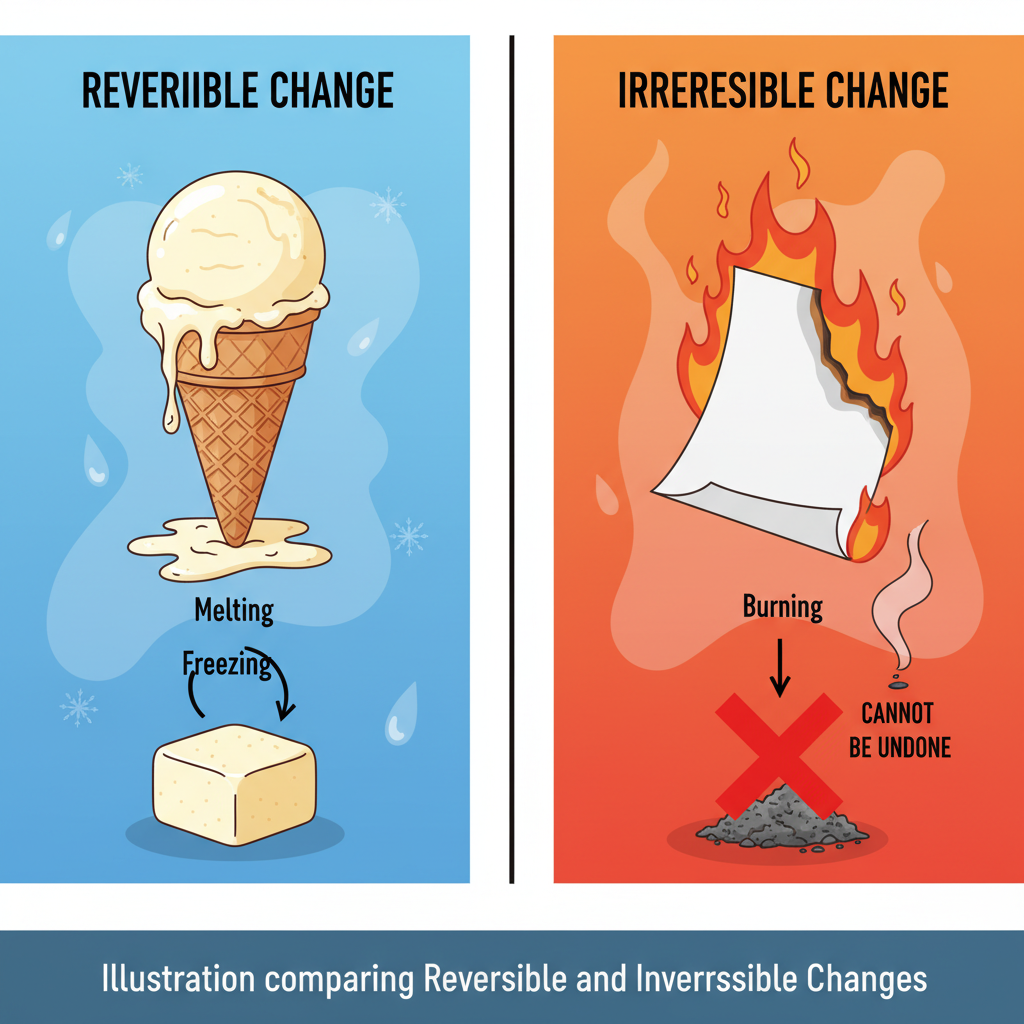 ⚠️ This picture may have spelling mistakes. Trust the words in the lesson.
Key Differences Summarized
Here's a simple way to remember the difference:
- Reversible: Can be undone. Original substance can be recovered. Often involves changes in state or physical mixing.
- Irreversible: Cannot be easily undone. Original substance is permanently changed into new substances. Involves chemical reactions where new substances are formed.
Why Does This Matter?
Understanding reversible and irreversible changes helps us understand how the world around us works. From cooking our food to how factories make new materials, chemistry is all about these transformations. Knowing whether a change can be reversed or not is crucial for scientists and engineers!
Keep learning, free
Create a free Syllabax account to unlock practice questions and games for this topic.
Visual Learning Enhanced! 🚀
To help you master this topic, we use Advanced Syllabax AI to generate detailed diagrams and visual models.
Note on Visuals: The AI sometimes makes spelling errors in image labels. Please refer to the lesson text for the correct terminology.