Quadrilaterals [Polygons & 2D Shapes]
Watch this topic in 60 seconds
Free preview · Lesson 1
Understanding Quadrilaterals [Polygons & 2D Shapes]
Quadrilaterals: Our Four-Sided Friends!
Hey there, young mathematicians! Today, we're going on an exciting adventure into the world of shapes, specifically, shapes with four sides. These special shapes have a super cool name: quadrilaterals. Think of them as the building blocks of so many things we see around us, from windows and doors to picture frames and even pizza boxes!
What Exactly is a Quadrilateral?
The word 'quadrilateral' might sound a bit fancy, but it's actually quite simple. 'Quad' means four, and 'lateral' means side. So, a quadrilateral is simply a polygon (a closed shape made of straight lines) with four sides and four corners (or angles).
Imagine you're drawing a shape with four straight lines that connect end-to-end and form a closed loop. If you end up with four sides and four corners, congratulations, you've drawn a quadrilateral! It's like connecting the dots four times to make a closed box.
Let's think about some real-world examples:
- A square table: It has four equal sides and four square corners.
- A rectangular window: It has four sides (two long, two short) and four square corners.
- A playing card: Think of a standard playing card, like an ace of spades. It has four sides.
- A stop sign: Most stop signs are octagons (8 sides), but imagine a simpler, flat-top stop sign shape – that's often a pentagon (5 sides). Let's stick to simpler things for now! How about a chess board square? Perfect!
- A slice of toast (before you cut it!): Many loaves of bread, when sliced, give you a piece that's roughly square or rectangular.
The Four Sides and Four Angles Rule
The most important rule for any quadrilateral is this: it must have exactly four straight sides and exactly four vertices (the fancy word for corners where the sides meet). No more, no less!
Think of it like a game:
- Game Rule 1: You must use exactly four line segments.
- Game Rule 2: These segments must connect end-to-end to form a closed shape.
- Game Rule 3: The shape must have four points where the lines meet (the corners).
If you follow these rules, you've got yourself a quadrilateral!
Types of Quadrilaterals: Meeting the Family!
Just like a family has different members with unique personalities, quadrilaterals also come in different types. They are all related because they have four sides, but they have special features that make them unique. Let's meet some of the most common members of the quadrilateral family:
1. The Square: The Perfect, Balanced One
Squares are the superstars of the quadrilateral world! They are super special because:
- All four sides are equal in length. Think of it like a perfectly balanced cookie cutter.
- All four angles are right angles (90 degrees). These are the perfectly square corners, like the corner of a book or a piece of paper.
A square is like a perfectly symmetrical person – everything is just right and balanced!
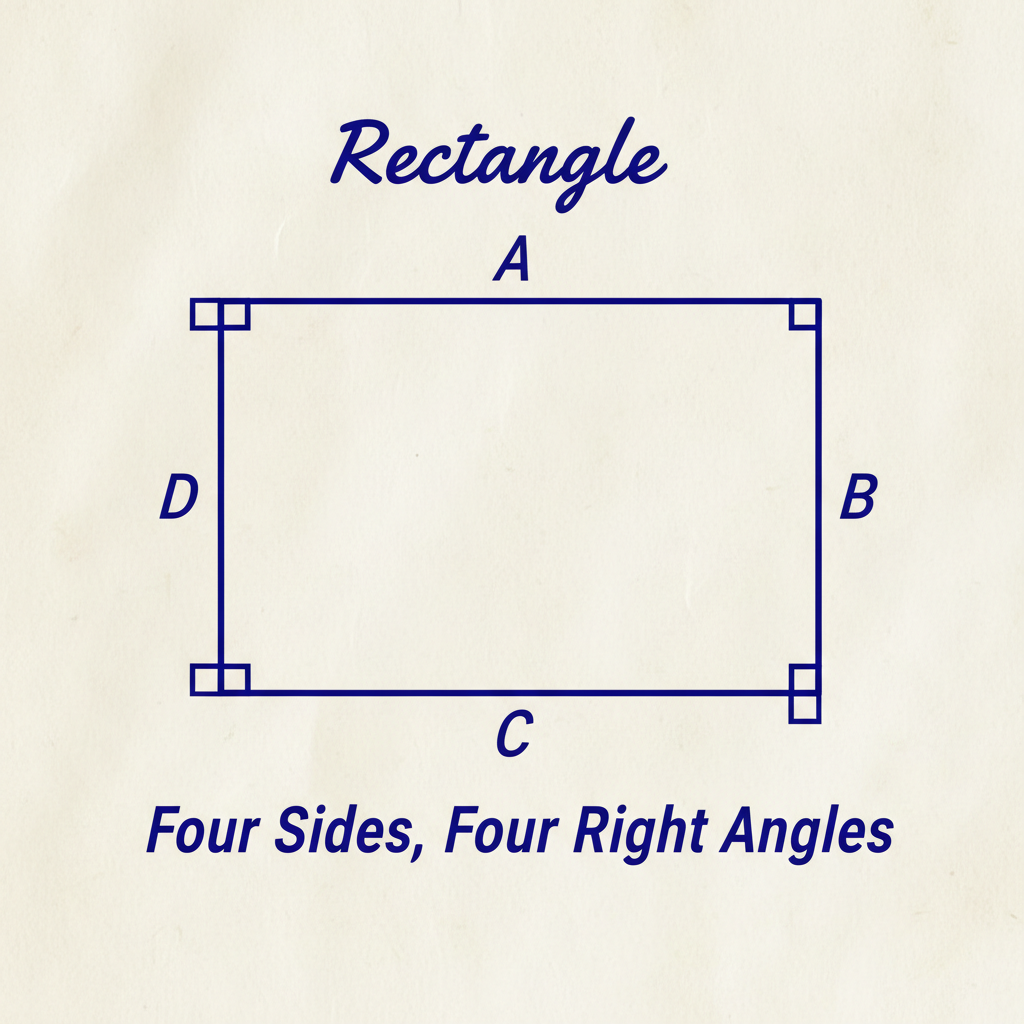
2. The Rectangle: The Stretchy Square
Rectangles are very close cousins to squares. They are:
- They have four sides and four right angles (like a square).
- BUT, their sides are not all equal. They have two pairs of equal sides. Two sides are longer, and two sides are shorter.
Think of a rectangle like a rectangle-shaped swimming pool or a door. It's like a square that got a little stretched out in one direction!
3. The Rhombus: The Tilted Square
Rhombuses are like squares that have been tilted over! They have:
- Four equal sides (just like a square!).
- BUT, their angles are not necessarily right angles. They have two pairs of equal opposite angles. Some angles might be wider (obtuse) and some might be narrower (acute).
Imagine a diamond shape, like the one on a playing card. That's a rhombus! It's like a square that decided to do a little dance and lean over.
4. The Parallelogram: The Sliding Rectangle
Parallelograms are a bit more general. They have:
- Four sides.
- Two pairs of parallel sides. Parallel lines are like train tracks – they run alongside each other and never touch, no matter how far you extend them.
- Opposite sides are equal in length.
- Opposite angles are equal.
A parallelogram is like a rectangle that has been pushed from the top or bottom, making it lean. The top and bottom sides stay parallel, and the left and right sides stay parallel. Think of a sliding door!
5. The Trapezoid (or Trapezium): The One-Pair Wonder
Trapezoids are quadrilaterals that have at least one pair of parallel sides. Some definitions say *exactly* one pair, while others say *at least* one pair (which would include parallelograms). For now, let's think of it as a shape with one pair of parallel sides, and the other two sides that meet at the top and bottom.
Imagine the shape of a tabletop that's wider at one end and narrower at the other, with two sides that slant inwards. Or think of the shape of a mail carrier's bag!
Putting it All Together: The Quadrilateral Family Tree!
It's helpful to remember that some shapes are special types of others! For example:
- A square is a special type of rectangle (because it has four right angles) AND a special type of rhombus (because it has four equal sides).
- A rectangle is a special type of parallelogram (because it has two pairs of parallel sides).
- A rhombus is also a special type of parallelogram (because it has two pairs of parallel sides).
So, while all squares, rectangles, rhombuses, and parallelograms are quadrilaterals, not all quadrilaterals are squares, rectangles, or rhombuses. It's like how all dogs are animals, but not all animals are dogs!
Why Are Quadrilaterals Important?
Quadrilaterals are everywhere! They help us:
- Build things: Windows, doors, walls, and even the frames of buildings often use rectangular or square shapes because they are strong and easy to build with.
- Design things: Think about the screen on a TV or tablet – it's a rectangle! Furniture, rugs, and even many books are rectangular.
- Understand patterns: Tessellations (patterns made of shapes that fit together without gaps) often use squares and rectangles.
- Play games: Chessboards and checkerboards are grids of squares.
Learning about quadrilaterals is like learning a secret code for understanding the shapes that make up our world. Keep an eye out for them – you'll be surprised how many you can find!
Keep learning, free
Create a free Syllabax account to unlock practice questions and games for this topic.
Visual Learning Enhanced! 🚀
To help you master this topic, we use Advanced Syllabax AI to generate detailed diagrams and visual models.
Note on Visuals: The AI sometimes makes spelling errors in image labels. Please refer to the lesson text for the correct terminology.