Planets, comets, meteors[PHYSICS]
Watch this topic in 60 seconds
Free preview · Lesson 1
Understanding Planets, comets, meteors[PHYSICS]
Our Amazing Solar System: Planets, Comets, and Meteors!
Welcome, space explorers! Today, we're going on an incredible journey through our solar system to learn about the amazing celestial bodies that travel around our Sun. We'll discover planets, comets, and meteors, and understand what makes them unique. Get ready to blast off with knowledge!
What is a Solar System?
Imagine our Sun as a giant, warm campfire in the middle of a vast playground. Around this campfire, many things are orbiting, or moving in a circular path. Our solar system is just that! It's a big family of the Sun and everything that travels around it. This includes planets, dwarf planets, moons, asteroids, comets, and even tiny dust particles. Gravity, like invisible strings, keeps everything from floating away and holds it all together in this cosmic dance.
Meet the Planets!
The most famous members of our solar system family are the planets. There are eight of them, and they are like the main attractions of our solar system circus. They all orbit the Sun, but they are very different from each other. Think of them as different kinds of balls rolling around the campfire – some are big and heavy, some are small and light, some are rocky, and some are made of gas!
Here they are, in order from the Sun:
The Inner, Rocky Planets:
- Mercury: The closest planet to the Sun. It's small and rocky, like a tiny pebble near the campfire. It gets very hot during the day and very cold at night because it doesn't have much of an atmosphere to keep the temperature steady.
- Venus: Often called Earth's "sister planet" because it's about the same size. However, Venus is covered in thick clouds that trap heat, making it the hottest planet in our solar system – even hotter than Mercury! It's like a planet with a super-thick blanket that traps all the warmth.
- Earth: Our beautiful home! Earth is special because it has liquid water and an atmosphere that supports life. It's just the right distance from the Sun – not too hot, not too cold – like the perfect spot in the playground where you can comfortably play.
- Mars: Known as the "Red Planet" because of its rusty, reddish surface. Mars is a rocky planet and scientists are very interested in it, wondering if life ever existed there or if it could in the future. It's like a dusty, red sandbox for scientists to explore.
The Outer, Gas Giants:
- Jupiter: The king of the planets! Jupiter is enormous, made mostly of gas, and is much, much bigger than Earth. It's like a giant beach ball compared to a small marble. It has a famous "Great Red Spot," which is a storm bigger than our entire planet!
- Saturn: Famous for its stunning rings! Saturn is also a gas giant and looks like a beautiful, cosmic hula-hoop dancer. The rings are made of ice and rock particles, like sparkly confetti orbiting the planet.
- Uranus: A unique gas giant that spins on its side, like a rolling barrel. It's an icy blue-green color and is quite tilted compared to the other planets.
- Neptune: The farthest planet from the Sun. It's a deep blue color and is a very cold, windy place. It's like the chilly, distant corner of the playground.
So, we have rocky planets closer to the Sun and giant gas/ice planets farther away. This is a common pattern in solar systems!
What are Comets?
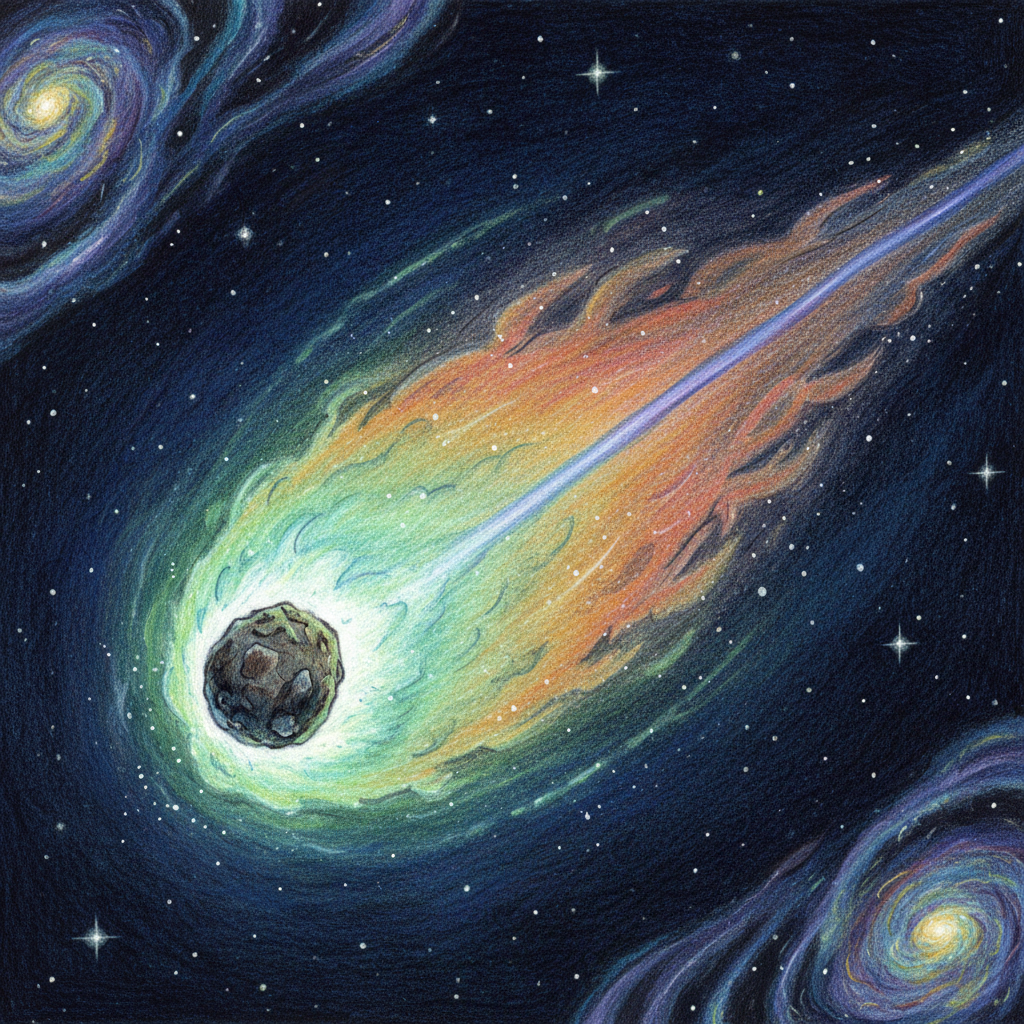
Now, let's talk about comets! Comets are often called "dirty snowballs" of space. They are made of ice, dust, and rock. They travel in very long, oval-shaped paths around the Sun. When a comet gets close to the Sun, the Sun's heat starts to melt the ice and vaporize the dust. This creates a glowing cloud around the comet called a "coma" and often a long, beautiful tail that streams behind it.
Think of a comet like a snowball you've thrown really hard. As it flies through the air (space), if it gets warm enough, some of the snow might melt and drip, leaving a trail behind it. The tail of a comet always points away from the Sun because of the solar wind and light pushing it.
 ⚠️ This picture may have spelling mistakes. Trust the words in the lesson.
What are Meteors, Meteoroids, and Meteorites?
These terms can be a bit confusing, but let's break them down. They are all related to small pieces of rock or metal in space.
- Meteoroid: This is the name for a small rocky or metallic body traveling through outer space. Think of them as tiny space pebbles or even dust grains floating around. They are much smaller than asteroids.
- Meteor: When a meteoroid enters Earth's atmosphere, it burns up due to friction with the air. This creates a bright streak of light across the sky, which we commonly call a "shooting star." It's like a tiny pebble hitting a very fast-moving fan – it gets hot and glows as it passes through!
- Meteorite: If a meteoroid is large enough that it doesn't completely burn up in the atmosphere and actually lands on Earth's surface, then it's called a meteorite. It's the leftover piece that made it all the way down.
So, a meteoroid is in space, a meteor is the streak of light in the sky, and a meteorite is what lands on the ground!
Why are these Objects Important?
Studying planets, comets, and meteors helps us understand how our solar system formed and evolved. They are like ancient history books written in space. By analyzing their composition, we can learn about the building blocks of planets and even the conditions that might lead to life. Comets and asteroids also deliver water and organic molecules to planets, which are essential for life as we know it. Understanding these objects also helps us protect our planet from potential impacts!
Key Concepts Recap
Remember these main ideas:
- Solar System: The Sun and everything that orbits it.
- Planets: Large celestial bodies that orbit the Sun, categorized as rocky inner planets and gas/ice giants outer planets.
- Comets: Icy, dusty bodies that orbit the Sun, often developing a tail as they approach it.
- Meteoroids, Meteors, Meteorites: Small space rocks; the streak of light when they burn up in the atmosphere; and the piece that lands on Earth, respectively.
Keep looking up at the sky, space explorers! There's a whole universe of wonders out there waiting to be discovered!
Keep learning, free
Create a free Syllabax account to unlock practice questions and games for this topic.
Visual Learning Enhanced! 🚀
To help you master this topic, we use Advanced Syllabax AI to generate detailed diagrams and visual models.
Note on Visuals: The AI sometimes makes spelling errors in image labels. Please refer to the lesson text for the correct terminology.