Solids & liquids (very basic understanding) (Matter)
Watch this topic in 60 seconds
Free preview · Lesson 1
Understanding Solids & liquids (very basic understanding) (Matter)
Exploring Solids and Liquids: The World Around Us!
Hello, young scientists! Have you ever looked around you and wondered what everything is made of? It's like asking what ingredients are in your favorite cookie! Well, everything you can see, touch, or even feel, is made of something called matter. Your toys, your food, your bed, even the air you breathe – it's all matter!
Today, we're going on an exciting adventure to learn about two super important kinds of matter: solids and liquids. Get ready to discover how they are different and why they act the way they do!
What is Matter? (A Quick Peek!)
Think about a fluffy cloud, a crunchy apple, or a glass of cold milk. All these things are different, right? But they all have one big thing in common: they are matter. Matter is anything that takes up space and has weight. Pretty cool, huh? It's like everything in the whole wide world is made of matter!
Meet the Solids!
What are Solids?
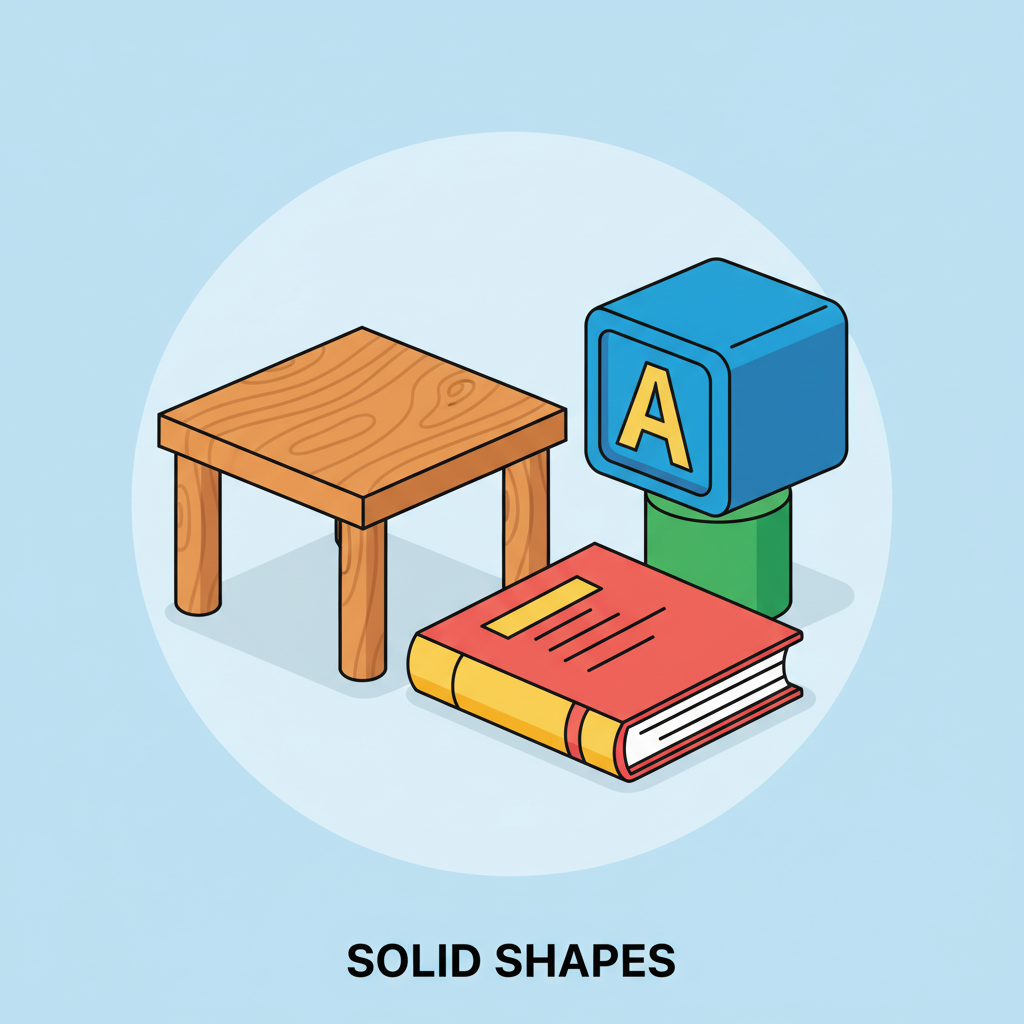
Let's start with solids! Imagine your favorite building block or a sturdy wooden table. If you push on it, does it change its shape easily? No! A solid is something that keeps its own shape. It doesn't need a container to hold its form.
Think about a rock. If you put a rock on the ground, it stays a rock. If you put it in a bucket, it's still a rock. It doesn't suddenly turn into a bucket-shaped rock, does it? That's because a rock is a solid!
Amazing Analogies for Solids:
- The Toy Block Tower: When you build a tower with toy blocks, each block stays square or rectangular. It doesn't melt or change shape just because it's part of a tower. Each block is a solid!
- Kids Holding Hands Tightly: Imagine a group of kids standing very, very close together, holding hands super tight. They can wiggle a little, but they pretty much stay in their own spots and keep their shape as a group. That's a bit like how the tiny, tiny pieces (called particles) inside a solid are packed. They are stuck close together and don't move much, making the solid strong and firm!
- Your Pencil: When you write with your pencil, it stays long and thin. It doesn't squish into a blob just because you're holding it. It keeps its shape!
Things We Know About Solids:
- They have a definite shape (they keep their shape).
- They have a definite size (they take up the same amount of space).
- They can often feel hard or firm.
- You can hold them in your hand easily.
Here are some examples of solids you see every day: your school chair, a book, your shoes, a tree, an ice cube (that's solid water!), and even a juicy apple!
 ⚠️ This picture may have spelling mistakes. Trust the words in the lesson.
Now, Let's Meet the Liquids!
What are Liquids?
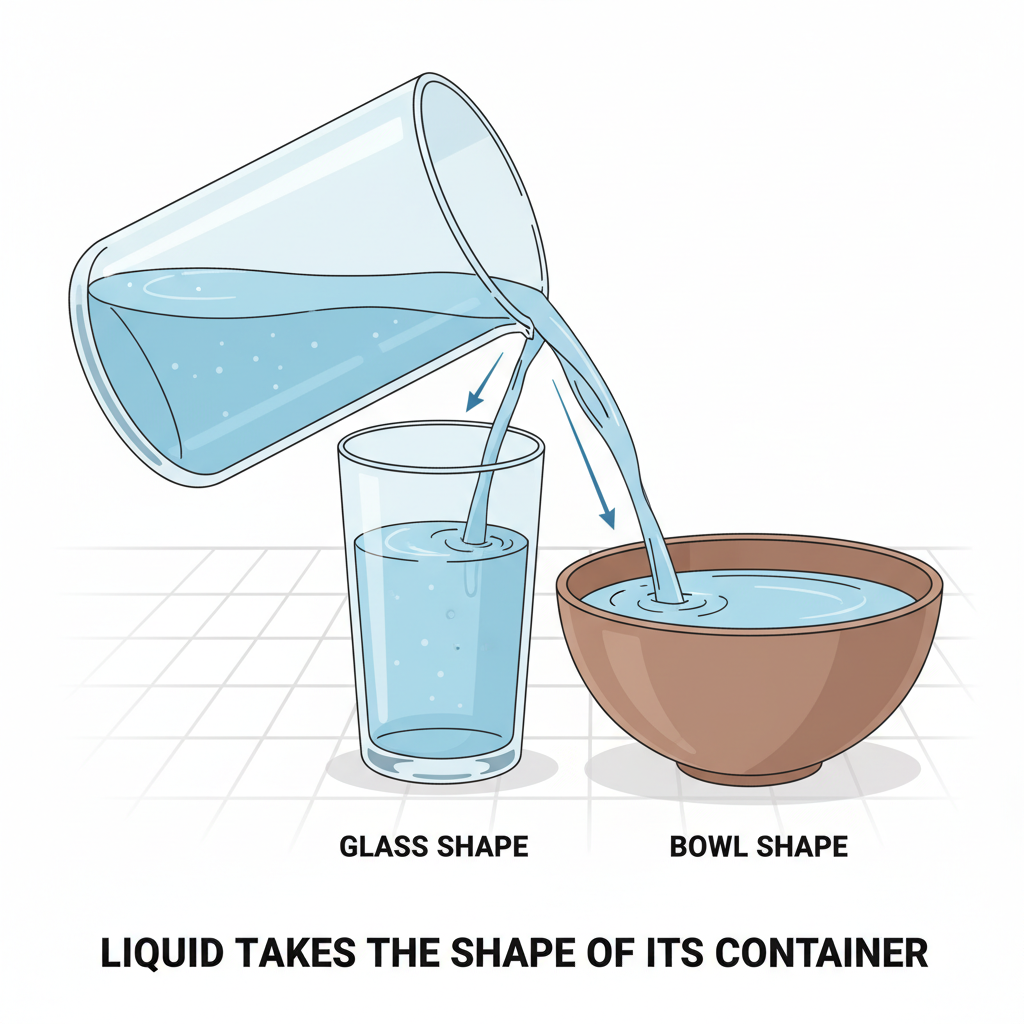
Now, let's think about liquids! Imagine pouring water from a pitcher into a glass. What happens? The water fills the glass and takes the shape of the glass, right? If you pour that same water into a bowl, it takes the shape of the bowl! A liquid is something that does NOT keep its own shape. Instead, it takes the shape of whatever container you put it in.
Liquids also love to flow and pour. That's why you can pour juice into your cup or watch water flow down a river.
Super Simple Analogies for Liquids:
- The Wiggle Worms: Imagine a group of tiny, tiny worms (our particles again!) that are still close to each other, but they are super wiggly! They can slide past each other easily. That's like the tiny pieces inside a liquid. They are not stuck in place like solids, so they can move around and let the liquid flow!
- Water in a Bottle vs. a Puddle: If you pour water into a tall, skinny bottle, it looks tall and skinny. If you spill that same water on the floor, it spreads out and forms a wide, flat puddle. The water changed its shape to fit the bottle, and then it changed its shape to fit the floor!
- Honey on a Spoon: When you scoop honey with a spoon, it gloops and drips. It doesn't hold a perfect spoon shape when you try to lift it. It wants to flow!
Things We Know About Liquids:
- They do NOT have a definite shape (they take the shape of their container).
- They DO have a definite size (they still take up a specific amount of space, even if their shape changes).
- They can be poured and they flow.
- They often feel wet (like water) or sometimes sticky (like honey).
Here are some examples of liquids you use and see all the time: water, milk, juice, oil, soda, and even the syrup you put on your pancakes!
Solids vs. Liquids: Can You Tell the Difference?
Now that you know about solids and liquids, let's play a game! Can you guess if something is a solid or a liquid?
| Feature | Solids | Liquids |
|---|---|---|
| Keeps its own shape? | YES! | NO (takes container's shape) |
| Can it be poured? | NO (unless it's in very small pieces like sand, but sand itself is a collection of tiny solids!) | YES! |
| Can you hold it easily? | YES! | Sometimes, but it will spill or drip! |
Remember: Everything around us is matter, and it's either a solid, a liquid, or sometimes even a gas (which we'll learn about another day!). Isn't science amazing?
Fun Challenge!
Look around your room right now. Can you point to three solids? Can you point to three liquids (maybe in your fridge or a glass)? Tell an adult what you found!
Great job, little scientists! You now know the super cool difference between solids and liquids!
Keep learning, free
Create a free Syllabax account to unlock practice questions and games for this topic.
Visual Learning Enhanced! 🚀
To help you master this topic, we use Advanced Syllabax AI to generate detailed diagrams and visual models.
Note on Visuals: The AI sometimes makes spelling errors in image labels. Please refer to the lesson text for the correct terminology.