Properties of multiplication (Multiplication)
Watch this topic in 60 seconds
Free preview · Lesson 1
Understanding Properties of multiplication (Multiplication)
Understanding Multiplication: The Amazing 'Groups Of' Game!
Welcome, super mathematicians! Today, we're going on an exciting adventure to explore the wonderful world of multiplication. Multiplication is like a super-fast way to add the same number over and over again. Think of it as a shortcut!
What is Multiplication? The "Groups Of" Idea
Imagine you have a bunch of friends coming over for a party. You want to give each friend a special goodie bag. Let's say you have 3 friends, and you want to put 2 yummy cookies in each goodie bag.
You could add: 2 cookies + 2 cookies + 2 cookies. That's 6 cookies in total!
But, multiplication has a faster way! We can say: 3 groups of 2 cookies. This means we have 3 bags, and each bag has 2 cookies inside.
The symbol for multiplication is an 'x', which we call the 'times' sign. So, instead of writing 2 + 2 + 2, we can write 3 x 2. And guess what? 3 x 2 also equals 6!
Let's look at some more examples:
- Example 1: Cars and Wheels
- Example 2: Pencils in a Box
Imagine you see 4 toy cars. Each toy car has 4 wheels. How many wheels are there in total?
We can add: 4 + 4 + 4 + 4 = 16 wheels.
Or, using multiplication: 4 groups of 4 wheels. This is written as 4 x 4, which equals 16.
Suppose you have 5 pencil boxes. Each box has 5 pencils inside. How many pencils do you have altogether?
Adding: 5 + 5 + 5 + 5 + 5 = 25 pencils.
Using multiplication: 5 groups of 5 pencils. This is written as 5 x 5, which equals 25.
The Parts of a Multiplication Sentence
Every multiplication sentence has special parts, just like a sentence in a book!
- Factor: These are the numbers you multiply together. In our '3 groups of 2' example (3 x 2 = 6), the numbers 3 and 2 are called factors. They tell us *how many groups* and *how many in each group*.
- Product: This is the answer you get when you multiply the factors. In 3 x 2 = 6, the number 6 is the product. It's the total number you end up with!
So, a multiplication sentence looks like this: Factor x Factor = Product
Let's Meet the Multiplication Properties!
Multiplication has some super cool properties, which are like special rules that always work!
1. The Commutative Property of Multiplication (Order Doesn't Matter!)
This property is like saying that it doesn't matter if you put on your socks first and then your shoes, or your shoes first and then your socks – you still end up with socks and shoes on your feet! For multiplication, it means you can switch the order of the factors, and the product (the answer) stays the same.
Remember our 3 groups of 2 cookies? That was 3 x 2 = 6.
What if we thought about it as 2 groups of 3 cookies? That would be 2 x 3. Let's see: 3 cookies + 3 cookies = 6 cookies. So, 2 x 3 = 6!
See? 3 x 2 gives the same answer as 2 x 3. The order of the factors changed, but the product stayed 6. This is the Commutative Property!
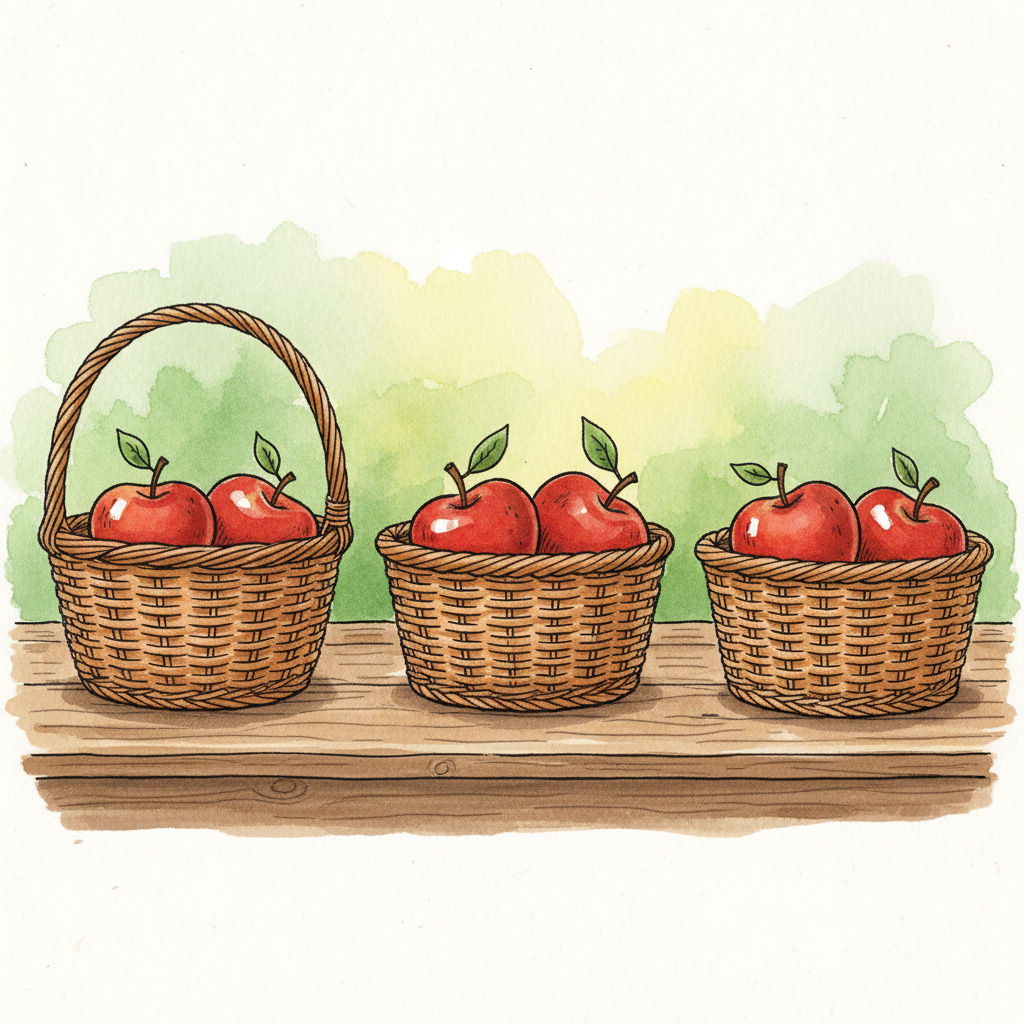
Analogy: Imagine you have 2 bags with 4 apples each (2 x 4 = 8). Now imagine you have 4 bags with 2 apples each (4 x 2 = 8). You still have the same total number of apples!
2. The Associative Property of Multiplication (Grouping Doesn't Matter!)
This property is like when you're playing with your friends. It doesn't matter if you team up with Sarah first and then play with Tom, or team up with Tom first and then play with Sarah. You're still playing with both friends! For multiplication, it means when you multiply three or more numbers, you can group them in any way you like, and the product will be the same.
Let's say we want to multiply 2 x 3 x 4.
We can group it like this: (2 x 3) x 4.
- First, we multiply the numbers in the parentheses: 2 x 3 = 6.
- Then, we multiply that answer by the last number: 6 x 4 = 24.
Now, let's group it differently: 2 x (3 x 4).
- First, we multiply the numbers in the parentheses: 3 x 4 = 12.
- Then, we multiply that answer by the first number: 2 x 12 = 24.
See? (2 x 3) x 4 gives the same answer as 2 x (3 x 4). Both equal 24! This is the Associative Property.
Analogy: Imagine you have three boxes of crayons. Box A has 2 crayons, Box B has 3 crayons, and Box C has 4 crayons. If you want to know the total number of crayons, you can count them by first putting crayons from A and B together (2+3=5) and then adding C (5+4=9), OR you can put crayons from B and C together (3+4=7) and then add A (2+7=9). The total is the same no matter how you group them!
3. The Identity Property of Multiplication (Multiplying by One!)
This property is super simple and very important! It says that any number multiplied by 1 is always that same number. It's like the number 1 is a superhero that doesn't change any number it touches!
For example:
- 5 x 1 = 5
- 1 x 7 = 7
- 100 x 1 = 100
No matter how big or small the number is, when you multiply it by 1, it stays exactly the same. That's why 1 is called the 'multiplicative identity'.
Analogy: Imagine you have a mirror. When you look in the mirror, you see yourself, right? The mirror doesn't change what you look like. Multiplying by 1 is like a mirror for numbers – it keeps them looking just like they were!
4. The Zero Property of Multiplication (Multiplying by Zero!)
This property is also very straightforward. Any number multiplied by 0 is always 0. Zero is like a magic wand that turns anything into nothing!
For example:
- 6 x 0 = 0
- 0 x 9 = 0
- 50 x 0 = 0
If you have 6 groups of 0 apples, you have no apples at all! It's always 0.
Analogy: Imagine you have 5 boxes, and you promise to put 0 cookies in each box. How many cookies do you have in total? Zero! Because each box is empty.
Why are these Properties Important?
These properties help us understand multiplication better and make solving problems much easier! They are like tools in our math toolbox that help us work faster and smarter.
Key Concepts Recap:
- Multiplication is a quick way to add the same number many times.
- We use the 'x' symbol for multiplication.
- Factors are the numbers we multiply.
- The Product is the answer to a multiplication problem.
- Commutative Property: Order of factors doesn't change the product (a x b = b x a).
- Associative Property: Grouping of factors doesn't change the product ((a x b) x c = a x (b x c)).
- Identity Property: Any number multiplied by 1 is the number itself (a x 1 = a).
- Zero Property: Any number multiplied by 0 is 0 (a x 0 = 0).
Keep practicing these ideas, and you'll become a multiplication superstar!
Keep learning, free
Create a free Syllabax account to unlock practice questions and games for this topic.
Visual Learning Enhanced! 🚀
To help you master this topic, we use Advanced Syllabax AI to generate detailed diagrams and visual models.
Note on Visuals: The AI sometimes makes spelling errors in image labels. Please refer to the lesson text for the correct terminology.