Multi-step reasoning word problems [HOTS (High Order Thinking Skills)]
Watch this topic in 60 seconds
Free preview · Lesson 1
Understanding Multi-step reasoning word problems [HOTS (High Order Thinking Skills)]
Mastering Multi-Step Reasoning Word Problems (HOTS) - Grade 5
Welcome, super problem solvers! Today, we're going on an adventure into the world of Multi-Step Reasoning Word Problems. These are like puzzles that need a few steps to solve, not just one quick answer. They also involve HOTS, which stands for High Order Thinking Skills. Don't worry, it just means we need to think a little harder, like a detective looking for clues!
What are Multi-Step Reasoning Word Problems?
Imagine you're baking cookies. You don't just throw everything in the bowl at once, right? You first need to preheat the oven, then measure the flour, then mix the ingredients, then bake them, and finally, let them cool. Each of these is a step that leads to your delicious cookies. Multi-step word problems are similar. They present a situation where you need to perform more than one mathematical operation (like adding, subtracting, multiplying, or dividing) to find the final answer. You can't get to the end by doing just one thing.
Why are they important?
These problems help us practice using our math brains in real-life situations. Think about planning a party: How much juice do you need? How many snacks? How many guests can sit at each table? All of these require multiple steps and thinking.
What are High Order Thinking Skills (HOTS)?
HOTS are like superpowers for your brain! Instead of just remembering facts (like "2 + 2 = 4"), HOTS involve deeper thinking:
- Understanding: Knowing what the problem is really asking.
- Applying: Using what you know (math rules) to solve the problem.
- Analyzing: Breaking down the problem into smaller, manageable parts.
- Evaluating: Deciding if your answer makes sense.
- Creating: Coming up with your own solutions.
For multi-step problems, we mainly use understanding, applying, and analyzing.
Our Detective Toolkit: Steps to Solve Multi-Step Problems
To become a master detective of word problems, we need a trusty toolkit. Here are the essential tools:
- Read Carefully: This is like putting on your detective glasses! Read the problem at least twice. What is the story? What information is given? What is the question asking for?
- Identify the Goal: What exactly do you need to find out? Sometimes the question is hidden, like finding the total cost of items *after* figuring out the price of individual items.
- Break It Down (Analyze!): Look for the smaller questions within the big question. What do you need to figure out *first*? What do you need to figure out *second*?
- Choose Your Tools (Operations!): Based on the smaller questions, decide which math operations (addition, subtraction, multiplication, division) you'll need.
- Solve Step-by-Step: Work through each smaller question one at a time. Write down your work clearly so you don't get lost.
- Check Your Work (Evaluate!): Does your final answer make sense in the story? If you bought 100 apples, would it make sense to have 2 apples left? Probably not!
Let's Practice with Analogies!
Analogy 1: The Shopping Trip
Problem: Sarah wants to buy 3 comic books that cost
Detective Steps:
- Read Carefully: Sarah is buying comic books and a toy car. She pays with $20. We need to find her change.
- Identify the Goal: The final goal is the amount of change Sarah gets.
- Break It Down:
- First, how much do the comic books cost in total?
- Second, what is the total cost of *everything* Sarah is buying?
- Third, how much change will she get from $20?
- Choose Your Tools:
- To find the total cost of comic books: Multiplication (
- To find the total cost of everything: Addition (cost of comics + cost of car)
- To find the change: Subtraction ($20 - total cost)
- To find the total cost of comic books: Multiplication (
- Solve Step-by-Step:
- Cost of comic books:
- Total cost of everything:
- Change:
- Cost of comic books:
- Check Your Work: If she spent
Answer: Sarah will get $1 back in change.
Analogy 2: Building with Blocks
Problem: John has 5 boxes of building blocks. Each box has 12 blocks. He uses 30 blocks to build a tower. How many blocks does he have left?
Detective Steps:
- Read Carefully: John starts with blocks in boxes, uses some, and we need to find what's left.
- Identify the Goal: How many blocks John has *left*.
- Break It Down:
- First, how many blocks does John have in total to start with?
- Second, how many blocks are remaining after he builds the tower?
- Choose Your Tools:
- To find the total blocks: Multiplication (5 boxes x 12 blocks/box)
- To find the blocks left: Subtraction (total blocks - blocks used)
- Solve Step-by-Step:
- Total blocks John has:
- Blocks left:
- Total blocks John has:
- Check Your Work: If he started with 60 blocks and used 30, having 30 left is logical.
Answer: John has 30 blocks left.
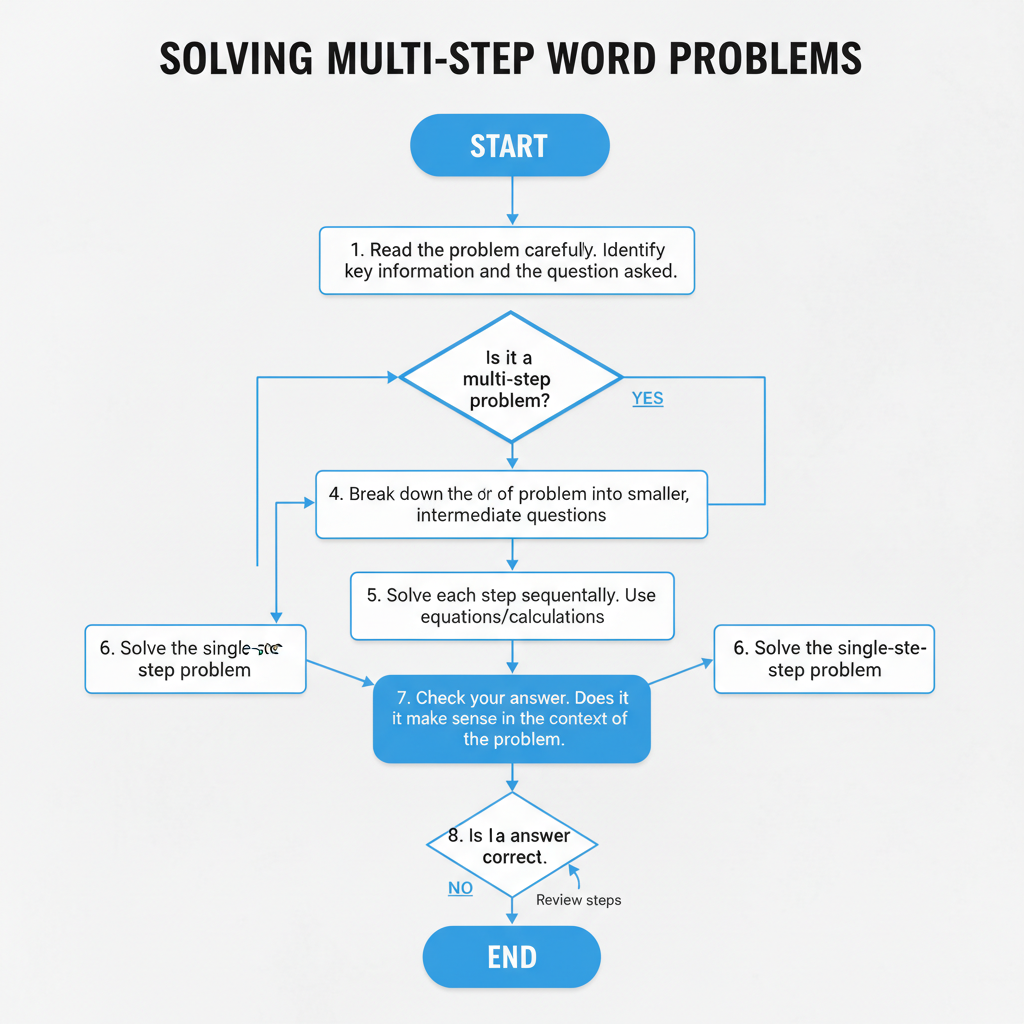 ⚠️ This picture may have spelling mistakes. Trust the words in the lesson.
Analogy 3: The Bake Sale
Problem: A class is having a bake sale. They baked 4 batches of cookies, with 10 cookies in each batch. They also baked 2 cakes, and each cake was cut into 8 slices. They sold 35 cookies and 5 slices of cake. How many total baked goods (cookies and cake slices) do they have left?
Detective Steps:
- Read Carefully: Class bakes cookies and cakes, sells some. Need to find remaining *total* baked goods.
- Identify the Goal: The total number of baked goods (cookies AND cake slices) *left*.
- Break It Down: This problem has several mini-questions!
- How many cookies were baked in total?
- How many cookies are left?
- How many cake slices were there in total?
- How many cake slices are left?
- Finally, how many total baked goods (remaining cookies + remaining cake slices) are left?
- Choose Your Tools:
- Total cookies: Multiplication (
- Cookies left: Subtraction (total cookies - cookies sold)
- Total cake slices: Multiplication (
- Cake slices left: Subtraction (total slices - slices sold)
- Total baked goods left: Addition (cookies left + cake slices left)
- Total cookies: Multiplication (
- Solve Step-by-Step:
- Total cookies baked:
- Cookies left:
- Total cake slices:
- Cake slices left:
- Total baked goods left:
- Total cookies baked:
- Check Your Work: They started with 40 cookies and 16 slices (total 56 items). They sold 35 cookies and 5 slices (total 40 items). 56 - 40 = 16 items left. The answer makes sense!
Answer: They have 16 total baked goods left.
Key Takeaways
- Multi-step word problems require more than one mathematical operation to solve.
- HOTS (High Order Thinking Skills) involve understanding, analyzing, and applying math concepts, not just memorizing.
- Always read the problem carefully, identify the final question, and break the problem into smaller, manageable steps.
- Use a variety of math operations (add, subtract, multiply, divide) as needed for each step.
- Checking your answer is crucial to ensure it makes sense in the context of the problem.
Keep learning, free
Create a free Syllabax account to unlock practice questions and games for this topic.
Visual Learning Enhanced! 🚀
To help you master this topic, we use Advanced Syllabax AI to generate detailed diagrams and visual models.
Note on Visuals: The AI sometimes makes spelling errors in image labels. Please refer to the lesson text for the correct terminology.