Learning Journey
Watch this topic in 60 seconds
Free preview · Lesson 1
Understanding Changes on heating and cooling (Matter Around Us)
Understanding Changes: What Happens When We Heat and Cool Things?
Hello, young scientists! Have you ever noticed how an ice cube turns into water on a warm day? Or how water in a pot turns into a misty cloud when it gets very hot? These are super cool changes happening all around us, and they are all about heating and cooling! Let's explore this amazing world together.
What is Matter? (Everything Around You!)
First, let's talk about 'matter.' Don't worry, it's not a difficult matter at all! Matter is simply everything that takes up space and has weight. Your desk, your pencil, the air you breathe, the water you drink, even you – all are made of matter! Matter can exist in different forms, which we call states of matter. For now, we'll focus on three main ones: solids, liquids, and gases.
- Solids: Think of a rock, a toy car, or an ice cube. Solids have a definite shape and size. They like to keep their form! Imagine everyone in your classroom standing still, holding hands tightly – that's like a solid!
- Liquids: Think of water, juice, or milk. Liquids don't have their own shape; they take the shape of the container you pour them into. If you pour water into a cup, it looks like a cup. If you pour it into a bowl, it looks like a bowl! Imagine everyone in your classroom still holding hands, but now they can slide and move around each other, taking the shape of the room.
- Gases: Think of the air around you, or the steam from a hot shower. Gases don't have a definite shape or size. They spread out to fill any space they are in. Imagine everyone in your classroom running all over the place, bumping into walls and each other, trying to fill the whole school!
Now, let's see how matter can change from one state to another, just by adding or taking away heat!
When We Heat Things Up! (Adding Energy)
Imagine you have a super cozy blanket on a cold day. When you put on the blanket, you feel warmer, right? Giving heat to matter is a bit like giving it energy. When matter gets hotter, its tiny particles (the super small building blocks it's made of) start to move faster and further apart!
1. Melting: Solid to Liquid
Have you ever seen an ice cream cone on a hot day? What happens? It starts to drip! This is called melting. When a solid like ice gets enough heat, its particles get so much energy that they start wiggling and moving past each other, turning into a liquid (water).
- Analogy: Imagine a chocolate bar. It's solid and holds its shape. If you leave it in the sun, it gets warm, and the chocolate starts to get soft and gooey, turning into a liquidy mess. The heat made the chocolate particles move around more freely!
2. Evaporation/Boiling: Liquid to Gas
What happens if you leave a puddle of water outside on a sunny day? After some time, it disappears! The water turns into an invisible gas called water vapor and mixes with the air. This is called evaporation.
If you heat water even more, like in a kettle on the stove, you'll see bubbles forming and steam rising. This is called boiling. Boiling is just fast evaporation. The water particles get so much energy from the heat that they break free from each other and float away as a gas.
- Analogy: Think of popcorn. The kernels are solid. When you heat them, the water inside turns into steam, which builds up pressure and makes the kernels 'pop' into fluffy popcorn. That steam is a gas trying to escape!
When We Cool Things Down! (Taking Away Energy)
Now, imagine you take off your cozy blanket. You start to feel cooler because the warmth is going away. When we cool matter, we take away its energy. This makes the tiny particles slow down and move closer together.
1. Freezing: Liquid to Solid
Remember that melted ice cream? What if you put it back in the freezer? It would turn solid again! This is called freezing. When a liquid like water gets cold enough (loses heat energy), its particles slow down and lock into place, turning back into a solid (ice).
- Analogy: Making ice cubes! You pour liquid water into an ice tray and put it in the freezer. The cold takes energy away from the water, and it becomes hard, solid ice.
2. Condensation: Gas to Liquid
Have you ever seen tiny water droplets form on the outside of a cold glass of juice on a hot day? That's condensation! The invisible water vapor (a gas) in the air touches the cold glass, loses energy, slows down, and turns back into tiny liquid water droplets.
Condensation is also how clouds are formed in the sky! Water vapor goes high up where it's cold, cools down, and turns into tiny water droplets or ice crystals that form clouds.
- Analogy: When you take a hot shower, the bathroom mirror gets foggy. That's because the warm steam (water vapor) touches the cooler mirror, cools down, and turns back into tiny liquid water droplets, making the mirror cloudy.
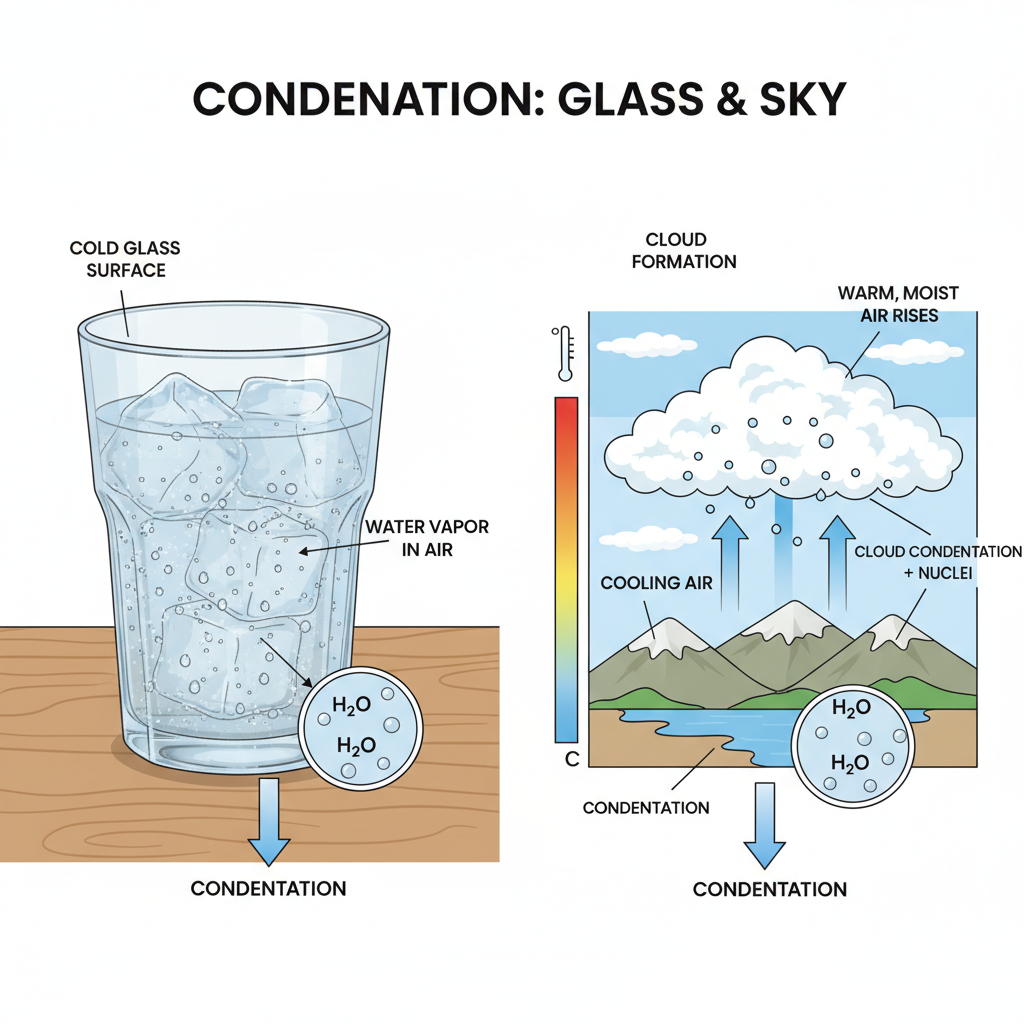 ⚠️ This picture may have spelling mistakes. Trust the words in the lesson.
It's Reversible! (We Can Go Back and Forth!)
The best part about these changes is that they are usually reversible! This means we can often go back and forth between the different states of matter.
- Ice (solid) melts into water (liquid) when heated.
- Water (liquid) freezes into ice (solid) when cooled.
- Water (liquid) evaporates into steam (gas) when heated.
- Steam (gas) condenses into water (liquid) when cooled.
Isn't that amazing? It's like a magical transformation that happens just by changing the temperature!
Everyday Examples:
- When you light a candle, the solid wax near the flame melts into liquid wax.
- When you breathe out on a very cold day, you might see tiny 'clouds' of your breath. That's the warm water vapor from your lungs condensing into tiny liquid droplets in the cold air.
- Rain is formed when water vapor in clouds cools down and condenses into liquid water droplets that fall to the earth.
Let's Review!
Matter is everything around us. It can be a solid, a liquid, or a gas. When we add heat, matter gains energy, its particles move faster, and it can melt (solid to liquid) or evaporate/boil (liquid to gas). When we take away heat, matter loses energy, its particles slow down, and it can freeze (liquid to solid) or condense (gas to liquid). These changes are happening all the time, right before our eyes!
Keep learning, free
Create a free Syllabax account to unlock practice questions and games for this topic.
Visual Learning Enhanced! 🚀
To help you master this topic, we use Advanced Syllabax AI to generate detailed diagrams and visual models.
Note on Visuals: The AI sometimes makes spelling errors in image labels. Please refer to the lesson text for the correct terminology.