Subtraction with borrowing (Subtraction)
Watch this topic in 60 seconds
Free preview · Lesson 1
Understanding Subtraction with borrowing (Subtraction)
Subtraction with Borrowing: The Amazing Trade-Up!
Hello young mathematicians! Today, we're going on an exciting adventure into the world of subtraction, specifically when we need to do a little bit of 'borrowing'. Don't worry, it's not like borrowing a toy from a friend and forgetting to give it back! This is a special kind of borrowing that helps us solve tricky subtraction problems. Let's dive in!
What is Subtraction?
First, let's remember what subtraction is all about. Subtraction is like taking away. Imagine you have a yummy bag of 5 cookies, and you eat 2 of them. How many cookies do you have left? You have 3 cookies left! That's subtraction: 5 - 2 = 3. We're finding the difference between two numbers.
Why Do We Need to Borrow?
Sometimes, when we subtract, we run into a little problem. Let's look at an example: 23 - 7.
We usually subtract numbers column by column, starting from the right side, which is the 'ones' column. In our example, we have 3 in the ones place in the top number (23) and 7 in the ones place in the bottom number (7). So, we need to figure out 3 - 7.
Now, here's the tricky part: Can you take away 7 cookies from a group of only 3 cookies? No, you can't! You don't have enough. This is when we need our super-secret weapon: Borrowing!
The Amazing Trade-Up: How Borrowing Works
Borrowing in subtraction is like trading a bigger thing for lots of smaller things. Think about this:
Imagine you have 1 ten-dollar bill. That's a lot of money, but it's just one bill. If you needed to buy 7 small candies that cost $1 each, you couldn't pay with just the ten-dollar bill (unless the shopkeeper could give you change). Instead, you might go to a bank or a friend and trade your one ten-dollar bill for ten $1 bills.
Now you have ten
Subtraction borrowing works the same way!
Let's go back to our problem: 23 - 7.
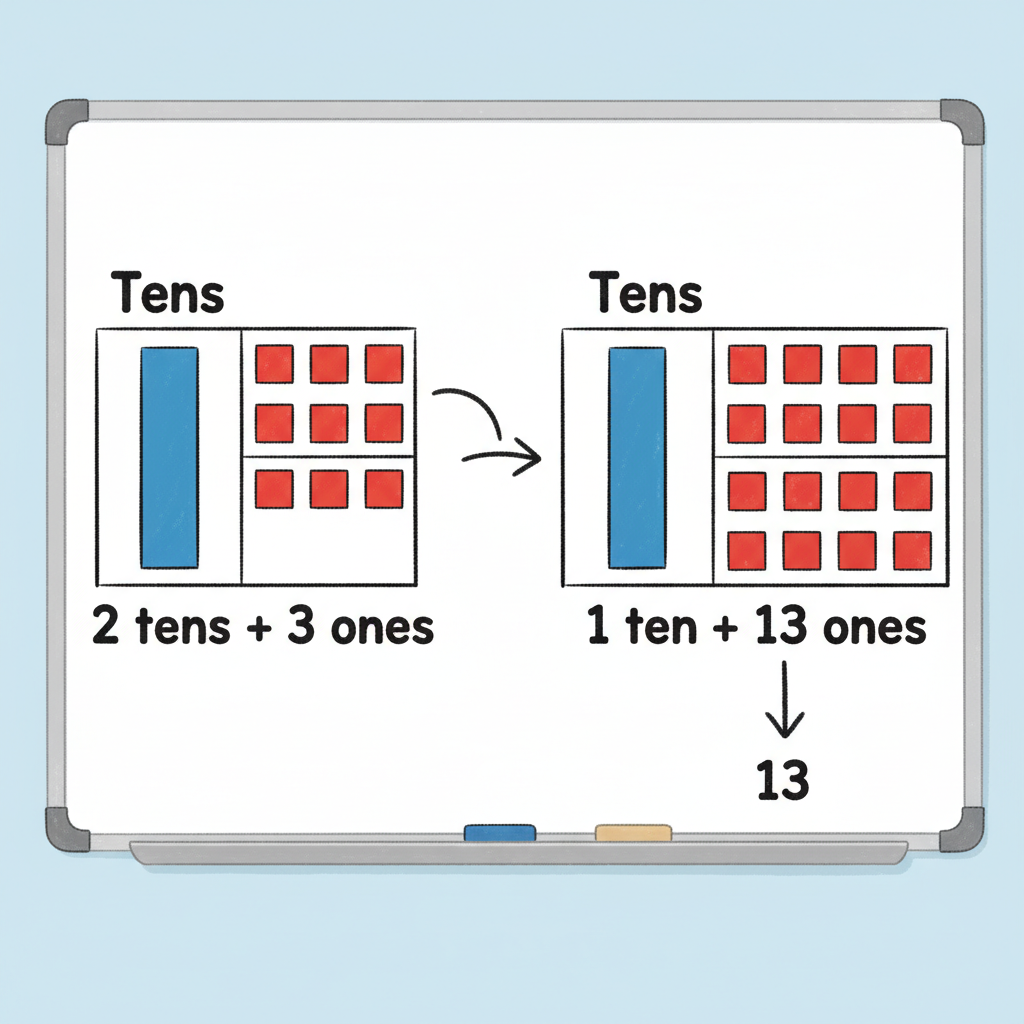
We have 2 tens and 3 ones (that's 23).
We need to subtract 7 ones. But we only have 3 ones.
So, we look at the tens column. We have 2 tens. We can 'borrow' one of those tens from the tens column and move it over to the ones column.
When we borrow one ten, it's like trading that one ten for ten ones. So, the 2 tens become 1 ten. And the 3 ones we already had, plus the 10 new ones we got from borrowing, makes a total of 13 ones!
Now our problem looks like this:
Instead of 2 tens and 3 ones, we have 1 ten and 13 ones.
Now, can we subtract 7 ones from 13 ones? Yes! 13 - 7 = 6.
And in the tens column, we only have 1 ten left (because we borrowed one). So, we just bring that 1 ten down.
Our answer is 1 ten and 6 ones, which is 16!
So, 23 - 7 = 16.
Step-by-Step Guide to Borrowing:
- Line Up Your Numbers: Make sure your ones are under ones, and your tens are under tens.
- Check the Ones Column: Can you subtract the bottom number from the top number in the ones column?
- Borrow if Needed: If you can't subtract (like 3 - 7), go to the tens column. Take 1 ten from the number in the tens column. Write down what's left of the tens.
- Trade for Ones: Add the 10 ones you borrowed to the ones you already have in the ones column.
- Subtract in the Ones Column: Now subtract using your new, bigger number of ones.
- Subtract in the Tens Column: Subtract the tens.
- Write Your Answer: Put your tens and ones together!
Another Example: 52 - 18
Let's try another one! 52 - 18.
Step 1: Line up the numbers.
  52
- 18
----
Step 2: Check the ones column. We have 2 - 8. Can we take 8 from 2? No, we don't have enough!
Step 3: Borrow! Go to the tens column. We have 5 tens. We borrow 1 ten. So, the 5 tens become 4 tens.
Step 4: Trade for ones. The 1 ten we borrowed becomes 10 ones. We add these 10 ones to the 2 ones we already had. So, 10 + 2 = 12 ones!
Now our problem looks like this (imagine we cross out the 5 and write a 4 above it, and cross out the 2 and write a 12 above it):
  4 12
  5  2
- 1  8
------
Step 5: Subtract in the ones column. Now we have 12 - 8. That equals 4!
Step 6: Subtract in the tens column. We have 4 - 1. That equals 3!
Step 7: Write your answer. We have 3 tens and 4 ones. The answer is 34!
So, 52 - 18 = 34.
Practice Time!
Remember, borrowing is just a smart way to rearrange numbers so we can subtract. It's like having a super-powered calculator in your brain!
When might you use subtraction with borrowing in real life?
- If you have 30 stickers and your friend has 15 stickers, how many more stickers do you have? (30 - 15)
- If you bake 25 cookies and your family eats 12, how many are left? (25 - 12)
- If you need 50 cents for a treat and you only have 25 cents, how much more do you need? (50 - 25)
Keep practicing, and you'll become a subtraction borrowing master in no time!
Keep learning, free
Create a free Syllabax account to unlock practice questions and games for this topic.
Visual Learning Enhanced! 🚀
To help you master this topic, we use Advanced Syllabax AI to generate detailed diagrams and visual models.
Note on Visuals: The AI sometimes makes spelling errors in image labels. Please refer to the lesson text for the correct terminology.