Equal sharing & grouping (Division)
Watch this topic in 60 seconds
Free preview · Lesson 1
Understanding Equal sharing & grouping (Division)
Understanding Equal Sharing and Grouping (Division)
Welcome, young mathematicians! Today, we're going on an exciting adventure into the world of Equal Sharing and Equal Grouping, which is all about division! Division is a super important math skill that helps us share fairly and organize things into equal piles. Think of it as the opposite of multiplication, where we combine equal groups. Division is about breaking things apart into equal groups.
What is Division?
Imagine you have a yummy pizza with 8 slices, and you want to share it equally with your best friend. How many slices does each person get? This is where division comes in! Division is like dividing a big number into smaller, equal parts.
We use a special symbol for division: ÷. So, 8 divided by 2 would be written as 8 ÷ 2.
Two Ways to Think About Division:
1. Equal Sharing (Partitive Division)
This is when you know the total number of items and the number of groups, and you want to find out how many items go into each group. It’s like sharing!
Analogy: Sharing Cookies
Let's say you baked 12 delicious cookies for your 3 friends. You want to give each friend the same number of cookies. You are sharing the cookies equally among your friends. You would have 12 cookies to share among 3 friends. So, 12 ÷ 3. You'd give one cookie to friend 1, one to friend 2, one to friend 3, then another round, until all cookies are gone. Each friend gets 4 cookies!
In this case:
- Total items: 12 cookies
- Number of groups (friends): 3
- Items per group (cookies per friend): 4
So, 12 ÷ 3 = 4.
2. Equal Grouping (Quotative Division)
This is when you know the total number of items and how many items you want in each group, and you want to find out how many groups you can make. It’s like making teams or putting things into boxes!
Analogy: Packing Lunchboxes
Imagine you have 15 juice boxes, and each lunchbox needs 3 juice boxes. How many lunchboxes can you fill? You are grouping the juice boxes into sets of 3. You would take 3 juice boxes and put them in one lunchbox, then another 3 for the next lunchbox, and so on, until you run out of juice boxes. You can fill 5 lunchboxes!
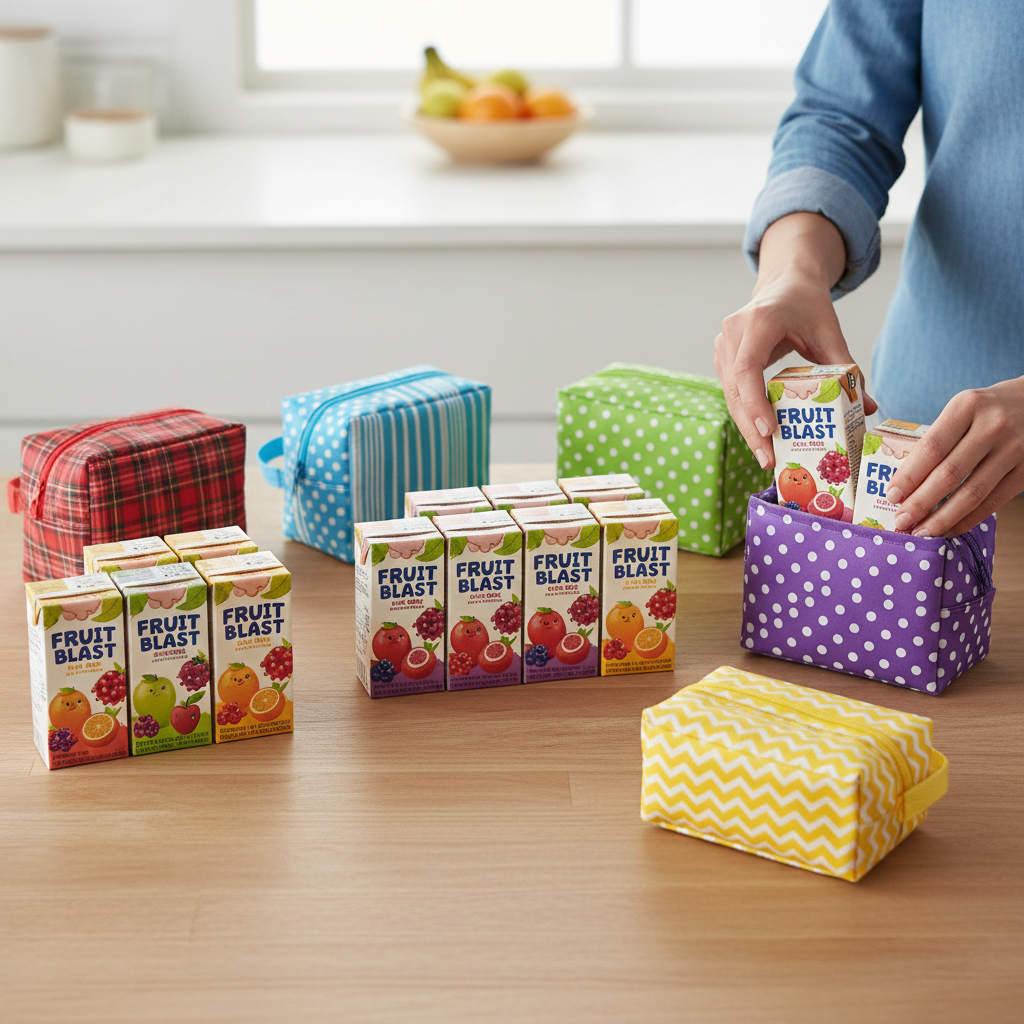
In this case:
- Total items: 15 juice boxes
- Items per group (juice boxes per lunchbox): 3
- Number of groups (lunchboxes): 5
So, 15 ÷ 3 = 5.
Key Terms in Division:
- Dividend: The total number you are dividing. (In 8 ÷ 2 = 4, the dividend is 8). Think of it as the whole pizza!
- Divisor: The number you are dividing by. It's either the number of groups or the number of items in each group. (In 8 ÷ 2 = 4, the divisor is 2). This is how many friends you're sharing with, or how many slices each friend gets.
- Quotient: The answer to a division problem. (In 8 ÷ 2 = 4, the quotient is 4). This is the number of slices each friend gets!
So, when we see 8 ÷ 2 = 4:
- 8 is the dividend (the total we start with).
- 2 is the divisor (how we are dividing it).
- 4 is the quotient (the result or answer).
Division and Multiplication are Friends!
Remember how we said division is the opposite of multiplication? They are like best buddies! If you know multiplication facts, division becomes much easier.
Example:
We know that 3 x 4 = 12.
This means 3 groups of 4 items make 12 items in total.
Using this, we can figure out division:
- 12 ÷ 3 = 4 (If you have 12 items and divide them into 3 equal groups, each group has 4.)
- 12 ÷ 4 = 3 (If you have 12 items and make groups of 4, you get 3 groups.)
It's like solving a puzzle! Knowing one helps you solve the other.
Why is Division Important?
Division helps us in many everyday situations:
- Sharing toys: If you have 10 cars and want to share them equally among 5 friends, division tells you each friend gets 2 cars (10 ÷ 5 = 2).
- Organizing school supplies: If you have 20 pencils and want to put 4 pencils in each pencil case, division tells you how many pencil cases you can fill (20 ÷ 4 = 5).
- Baking: If a recipe calls for 2 cups of flour per batch of cookies and you have 8 cups, division tells you how many batches you can make (8 ÷ 2 = 4).
Keep practicing, and you'll become a division superstar!
Keep learning, free
Create a free Syllabax account to unlock practice questions and games for this topic.
Visual Learning Enhanced! 🚀
To help you master this topic, we use Advanced Syllabax AI to generate detailed diagrams and visual models.
Note on Visuals: The AI sometimes makes spelling errors in image labels. Please refer to the lesson text for the correct terminology.