Learning Journey
Watch this topic in 60 seconds
Free preview · Lesson 1
Understanding Pollination, fertilization[BIOLOGY]
Pollination and Fertilization: Nature's Secret to Making Seeds!
Imagine a busy city where tiny workers are trying to deliver important messages to build new homes. That's a bit like what happens in the world of plants! Today, we're going to explore two super important jobs that plants do: pollination and fertilization. These jobs are like the plant world's secret handshake for making new baby plants, also known as seeds.
What is a Flower? A Plant's Special House!
Before we talk about pollination and fertilization, let's quickly look at a flower. Think of a flower as a plant's special house, built just for making seeds. Different parts of the flower have different jobs:
- Petals: These are often the colorful, pretty parts that attract visitors like bees and butterflies. They are like the welcoming signs on our houses.
- Sepals: These are usually green, leaf-like parts that protect the flower bud before it opens. They are like the shutters on our windows, keeping things safe.
- Stamen: This is the male part of the flower. It has two main parts:
- Anther: This is where the pollen is made. Pollen is like tiny, yellow dust or little packets of plant "sperm."
- Filament: This is a stalk that holds up the anther.
- Pistil (or Carpel): This is the female part of the flower. It also has a few parts:
- Stigma: This is the sticky top part of the pistil, like a landing pad for pollen.
- Style: This is a tube that connects the stigma to the ovary. It's like a hallway.
- Ovary: This is the swollen base of the pistil, where the ovules (tiny eggs) are waiting. This is where the seeds will eventually grow. It's like the nursery room.
Pollination: The Delivery Service!
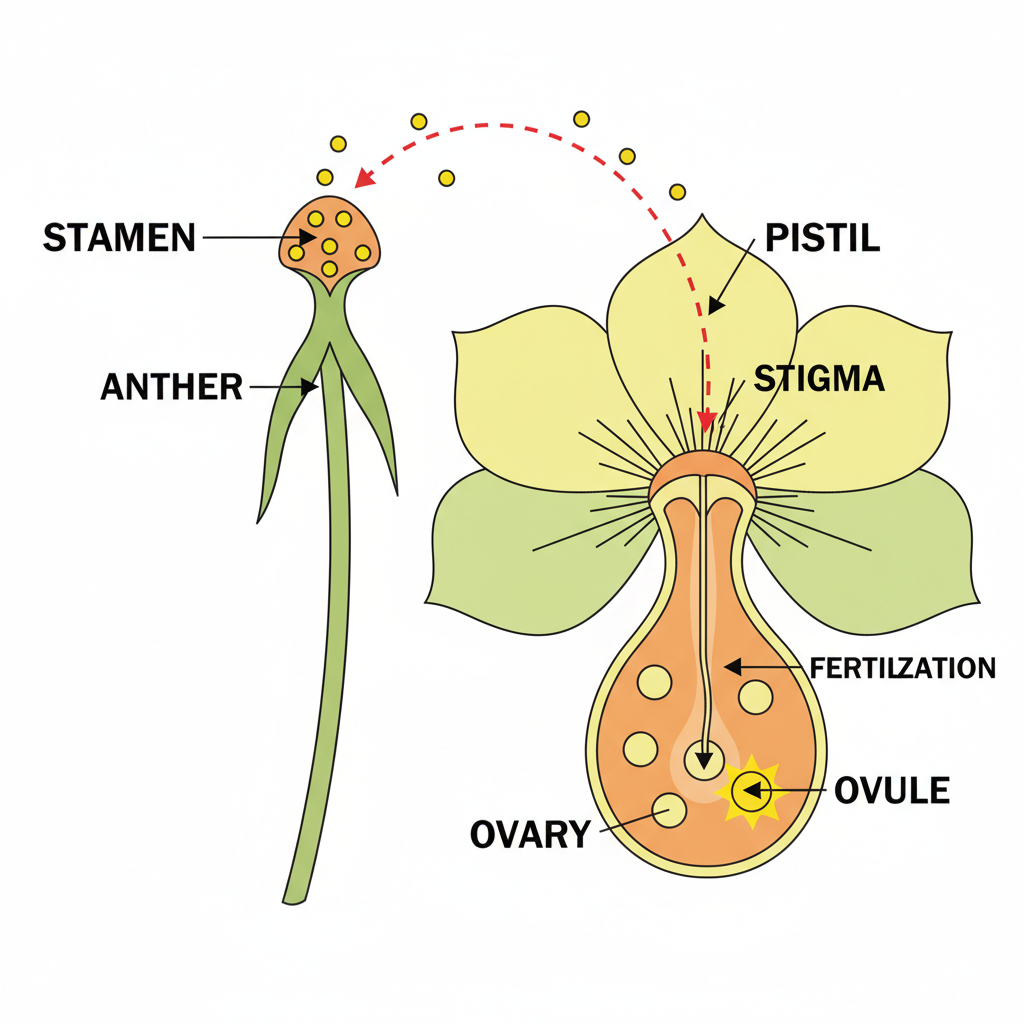
Pollination is the first big step. It's the process of moving pollen from the stamen (the male part) to the stigma (the female part) of a flower. Think of pollen as tiny messages, and the stigma as the mailbox. These messages need to get from one part of the flower (or sometimes to a different flower!) to start the seed-making process.
How Does Pollen Travel? The Pollination Delivery Crew!
Pollen can't just float around on its own very well. It needs help! Nature has a whole delivery service for pollen:
- Wind: Some plants, like grasses and oak trees, have very light pollen that the wind can carry easily. Imagine sending a tiny feather on the breeze – that’s how wind pollination works!
- Water: Some water plants release their pollen into the water, and it floats to other flowers. This is like sending a little message in a bottle downstream.
- Animals: This is a very common and important way for pollen to travel!
- Insects (like bees, butterflies, and moths): These are super pollinators! When a bee visits a flower for its sweet nectar (like a sugary drink), pollen grains stick to its fuzzy body. When the bee visits another flower, some of that pollen rubs off onto the sticky stigma. Bees are like busy delivery workers wearing fuzzy jackets, picking up and dropping off packages (pollen) as they go!
- Birds (like hummingbirds): Hummingbirds are also attracted to colorful flowers and their nectar. They can carry pollen on their beaks and heads.
- Bats: Some night-blooming flowers are pollinated by bats!
Self-Pollination vs. Cross-Pollination
There are two main ways pollination can happen:
- Self-Pollination: This happens when pollen from the stamen of a flower lands on the stigma of the same flower, or another flower on the same plant. It's like delivering a package from one room in your house to another.
- Cross-Pollination: This happens when pollen from one plant is transferred to the stigma of a flower on a different plant of the same species. This is like sending a package from your house to your neighbor's house. Cross-pollination is often better because it can lead to stronger, healthier offspring (seeds).
Fertilization: The Building Begins!
Once pollen lands on the stigma, the real magic of fertilization can begin. Fertilization is the process where the male part from the pollen joins with the female part (the ovule) inside the ovary to create a new life – the seed!
The Journey to the Ovule
When a pollen grain lands on a sticky stigma, it knows it's found the right place. It then:
- Grows a Pollen Tube: The pollen grain sprouts a tiny tube that grows down through the style (the hallway) towards the ovary. This tube is like a tiny straw or a delivery tunnel.
- Reaches the Ovule: The pollen tube reaches the ovary and enters an ovule (the tiny egg).
- Joins with the Egg: Inside the ovule, the male genetic material from the pollen joins with the female genetic material (the egg). This joining is fertilization! It's like when the two halves of a key finally fit together.
What Happens After Fertilization?
Once fertilization has occurred:
- The ovule inside the ovary develops into a seed. The seed contains a tiny baby plant (embryo) and food for it to grow.
- The ovary around the ovule begins to swell and ripen, eventually turning into a fruit. The fruit's job is to protect the seed and help it get to a new place to grow! Think of the fruit as a protective package for the seed, and it often helps spread the seeds around (like when animals eat the fruit and drop the seeds elsewhere).
Why are Pollination and Fertilization Important?
Without pollination and fertilization, plants wouldn't be able to make seeds. And without seeds, we wouldn't have new plants! This means:
- Food: Many of the fruits, vegetables, and grains we eat (like apples, corn, and wheat) come from plants that rely on pollination and fertilization.
- Oxygen: Plants produce the oxygen we breathe. More plants mean more oxygen.
- Habitats: Plants provide homes and food for many animals.
- Beauty: Flowers add beauty to our world!
So, the next time you see a bee buzzing around a flower or eat a juicy piece of fruit, remember the amazing journey of pollination and fertilization that made it all possible!
Here's a helpful diagram to visualize the process:
Keep learning, free
Create a free Syllabax account to unlock practice questions and games for this topic.
Visual Learning Enhanced! 🚀
To help you master this topic, we use Advanced Syllabax AI to generate detailed diagrams and visual models.
Note on Visuals: The AI sometimes makes spelling errors in image labels. Please refer to the lesson text for the correct terminology.