Magnetic poles (PHYSICS)
Watch this topic in 60 seconds
Free preview · Lesson 1
Understanding Magnetic poles (PHYSICS)
Understanding Magnetic Poles: The Invisible Forces
Have you ever played with magnets? You know how sometimes they stick together with a satisfying 'snap,' and other times they seem to push each other away? This magical push and pull is all thanks to something called magnetic poles. Think of poles as the 'hands' of a magnet, always reaching out and interacting with other magnets or magnetic materials.
What is a Magnet?
Before we dive into poles, let's quickly remember what a magnet is. A magnet is a special kind of material that creates an invisible force field around itself. This force field is called a magnetic field. This field is what allows magnets to attract or repel other magnetic objects.
Introducing the Poles: North and South
Every single magnet, no matter how big or small, has two special ends called poles. These poles are always found in pairs. You can never have just one pole on a magnet. These two poles are named the North Pole and the South Pole.
Imagine a magnet is like a tiny superhero with two different superpowers: a 'super-stick' power (attraction) and a 'super-push' power (repulsion). These superpowers are strongest at the ends, the poles.
The Golden Rule of Magnetism
Here’s the most important thing to remember about magnetic poles:
- Opposite poles attract: A North Pole and a South Pole are like best friends; they love to be together and will pull towards each other.
- Like poles repel: Two North Poles are like grumpy siblings; they don't want to be near each other and will push away. The same goes for two South Poles – they also push each other away.
Think of it like this: If you have a red toy car (North Pole) and a blue toy car (South Pole), they want to drive towards each other. But if you have two red toy cars, they'll bump into each other and try to get away!
We can represent North poles with an 'N' and South poles with an 'S'. So, N always attracts S, and S always attracts N. But N always repels N, and S always repels S.
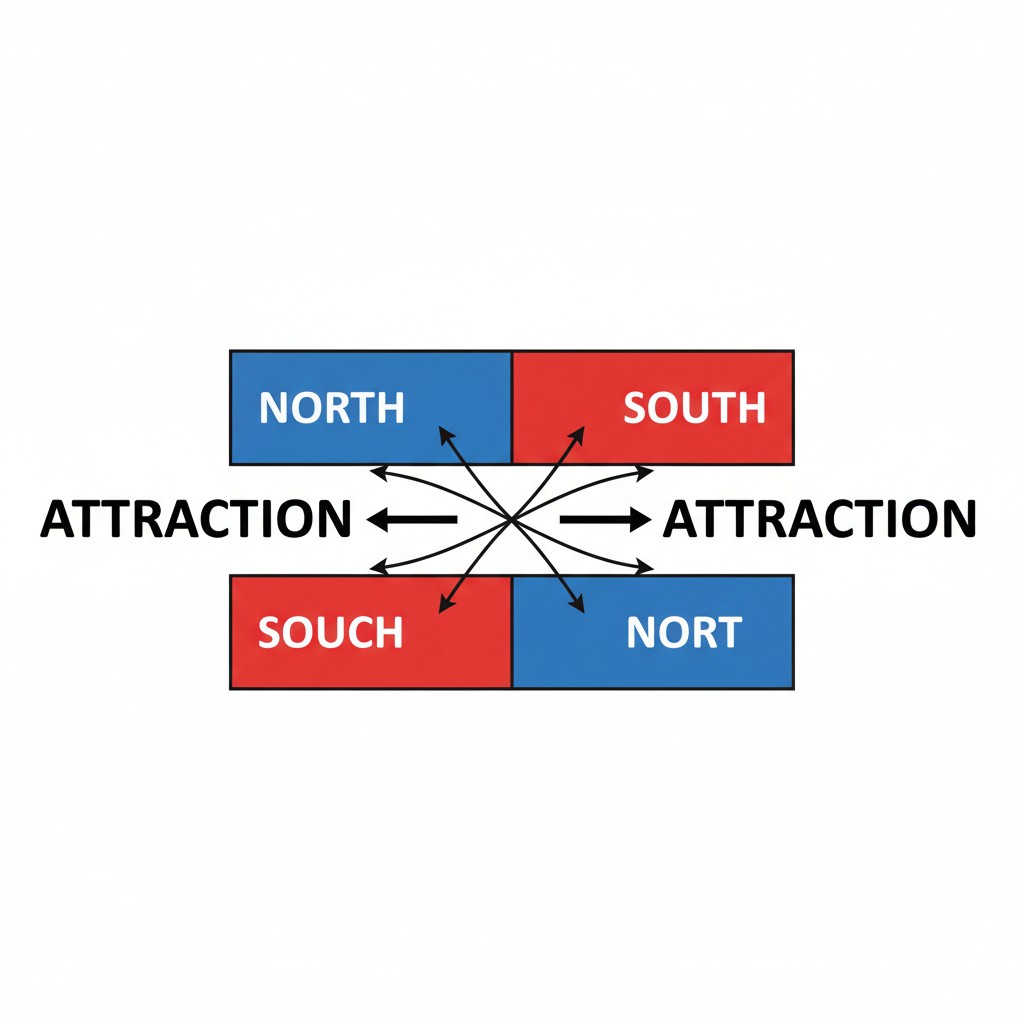 ⚠️ This picture may have spelling mistakes. Trust the words in the lesson.
Can We Separate the Poles?
This is a tricky but super interesting question! What happens if you try to break a magnet in half? Let's say you have a bar magnet with a North Pole on one end and a South Pole on the other. If you snap it in the middle, you might expect to get a separate North Pole piece and a separate South Pole piece, right?
Well, it doesn't work that way! When you break a magnet, each new piece you create will instantly become a whole new magnet, with its own North Pole and South Pole. It's like magic! No matter how many times you break a magnet, you will always end up with smaller magnets, each having both a North and a South Pole.
Imagine you had a cookie with chocolate chips (North) on one side and sprinkles (South) on the other. If you break it in half, you don't get a half with only chocolate chips and another half with only sprinkles. Instead, each half will have its own mix of chocolate chips and sprinkles!
Magnets and Our World
Magnetic poles are not just for fun science experiments. They are incredibly important in our everyday lives!
- Compasses: A compass is a small magnet that can spin freely. Its North Pole is attracted to the Earth's magnetic North Pole, helping us find our way. The Earth itself acts like a giant magnet with its own poles!
- Electric Motors: The machines that make fans spin, blenders whir, and electric cars move often use magnets and their poles to create motion.
- Speakers: The sound you hear from your TV or phone comes from a small magnet inside vibrating.
- Refrigerators: The strips that keep your fridge door shut tight are magnets!
Key Concepts to Remember
So, let's recap the most important things about magnetic poles:
- All magnets have two poles: a North Pole and a South Pole.
- These poles are always found in pairs.
- Opposite poles attract (N attracts S, S attracts N).
- Like poles repel (N repels N, S repels S).
- You can never isolate a single magnetic pole; breaking a magnet always creates new, smaller magnets with both poles.
Understanding magnetic poles is like learning the secret handshake of the universe for magnets. It explains why they dance together, push each other away, and how they power so many things around us!
Keep learning, free
Create a free Syllabax account to unlock practice questions and games for this topic.
Visual Learning Enhanced! 🚀
To help you master this topic, we use Advanced Syllabax AI to generate detailed diagrams and visual models.
Note on Visuals: The AI sometimes makes spelling errors in image labels. Please refer to the lesson text for the correct terminology.