Ohm’s law[PHYSICS]
Watch this topic in 60 seconds
Free preview · Lesson 1
Understanding Ohm’s law[PHYSICS]
Ohm's Law: Unlocking the Secrets of Electricity
Introduction to Electric Circuits
Have you ever wondered what makes your phone charge, your lights turn on, or your toaster toast? The answer is electricity! At its core, electricity is all about the movement of tiny particles called electrons. When these electrons flow in a controlled path, we call it an electric current. But what controls this flow? And how can we predict how much electricity will flow or how much 'push' it needs?
That's where Ohm's Law comes in! It's one of the most fundamental laws in physics, especially when dealing with electricity and electronic circuits. For 10th graders, understanding Ohm's Law is like learning to count before doing complicated math – it's the absolute basic building block for understanding how virtually all electrical devices work.
In simple terms, Ohm's Law describes the relationship between three key ingredients in any electrical circuit: Voltage, Current, and Resistance. Think of these three as a team working together (or sometimes against each other!) to make electricity do its job.
1. Voltage (V): The Electrical Push
Imagine you have a water hose. If you want water to come out of the hose, you need something to push it, right? That 'push' comes from the water pressure. The higher the pressure, the harder and faster the water comes out.
Analogy: Voltage is like Water Pressure. It's the 'push' or 'pressure' that makes electrons move through a wire. Without voltage, electrons would just sit there. The bigger the voltage, the more 'eager' the electrons are to move.
In electricity, this 'push' is called Voltage, and its symbol is V. It's measured in Volts (V). A car battery might provide 12 Volts, while a wall socket in your home typically provides around 120 or 240 Volts, depending on where you live. This higher voltage means a stronger push, making it more powerful (and potentially more dangerous!).
2. Current (I): The Flow of Electrons
Going back to our water hose analogy: once you apply pressure (voltage), water starts to flow through the hose. The amount of water flowing past a certain point in a given amount of time is the 'flow rate'.
Analogy: Current is like Water Flow Rate. It's the actual number of electrons flowing past a specific point in a circuit per second. A large current means many electrons are moving, while a small current means fewer electrons are moving.
In electricity, this 'flow' is called Current, and its symbol is I (from the French word 'intensité', meaning intensity). It's measured in Amperes (A), often shortened to 'amps'. If you plug in a powerful appliance like a hairdryer, it will draw a larger current (more amps) than a small phone charger because it needs more electrons flowing to do its work.
3. Resistance (R): The Obstacle to Flow
Now, imagine your water hose is very narrow, or perhaps it has some kinks in it, or even a sponge shoved inside. What happens to the water flow? It slows down, right? The hose is 'resisting' the flow of water.
Analogy: Resistance is like the Narrowness or Obstacles in a Hose. It's anything that opposes or restricts the flow of electrons (current) in a circuit. Wires themselves have some resistance, and components like light bulbs or heaters are designed to have specific resistances.
In electricity, this 'obstacle' is called Resistance, and its symbol is R. It's measured in Ohms (Ω), named after Georg Simon Ohm, the physicist who discovered this relationship. A component with high resistance will let very little current flow, even with a strong voltage push. A component with low resistance will allow a lot of current to flow easily.
Think of a light bulb: its filament (the thin wire inside) has resistance. When current flows through this resistance, the filament gets hot and glows, producing light. If it had no resistance, it wouldn't glow!
Putting It All Together: Ohm's Law
Georg Simon Ohm, a brilliant German physicist, discovered a simple, yet incredibly powerful relationship between Voltage, Current, and Resistance. He found that if you increase the voltage (the 'push'), the current (the 'flow') will also increase, assuming the resistance stays the same. Conversely, if you increase the resistance (the 'obstacle'), the current will decrease, even with the same voltage.
This fundamental relationship is expressed in what we now call Ohm's Law.
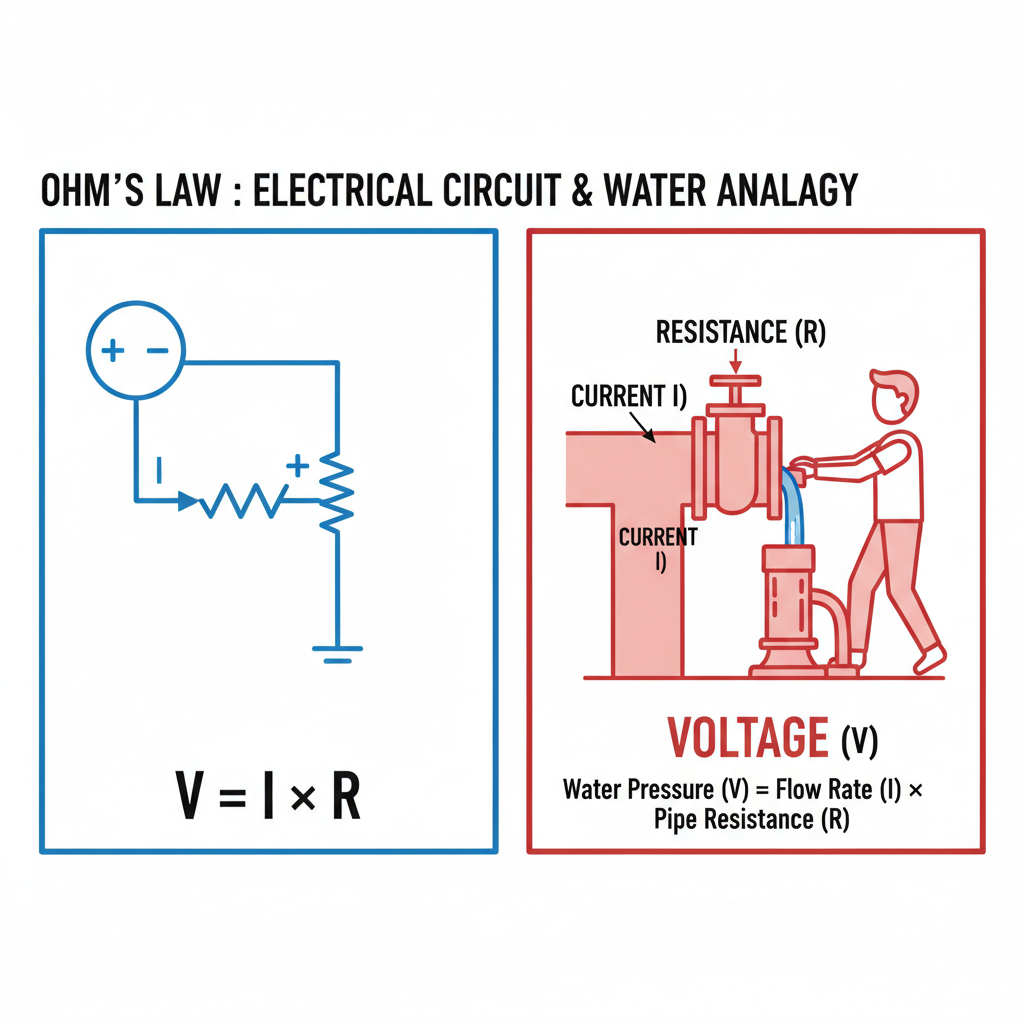 ⚠️ This picture may have spelling mistakes. Trust the words in the lesson.
The Core Formula: V = I × R
Where:
- V = Voltage (measured in Volts, V)
- I = Current (measured in Amperes, A)
- R = Resistance (measured in Ohms, Ω)
This formula is super important! It tells us that the voltage across a component is directly proportional to the current flowing through it and the resistance of the component.
Understanding the Formula with Our Analogies:
Imagine a water slide:
- Voltage (V) is like the height of the slide. A taller slide gives more 'push' (potential energy) to the water.
- Current (I) is like the amount of water flowing down the slide per second.
- Resistance (R) is like the roughness or narrowness of the slide. A rough, narrow slide resists the water flow.
So, a taller slide (higher V) will push more water (higher I), unless the slide is very rough/narrow (high R). If the slide is very rough (high R), even a tall slide (high V) might not result in much water flow (low I).
Manipulating Ohm's Law: Finding Any Missing Piece
The beauty of Ohm's Law is that if you know any two of the three values (V, I, or R), you can always find the third. It's like a puzzle where you always have enough information to solve it!
1. Finding Current (I):
If you know the Voltage (V) and Resistance (R), you can find the Current (I):
I = V / R
This makes sense: if you increase the 'push' (V), you get more 'flow' (I). If you increase the 'obstacle' (R), you get less 'flow' (I).
2. Finding Resistance (R):
If you know the Voltage (V) and Current (I), you can find the Resistance (R):
R = V / I
This tells you how much something is 'resisting' the flow. If a lot of 'push' (V) only results in a small 'flow' (I), then there must be a lot of 'obstacle' (R).
Why Ohm's Law Matters in the Real World
Ohm's Law isn't just a theoretical concept; it's used every single day by engineers, electricians, and anyone designing or repairing electrical equipment. Here's why it's so important:
- Designing Circuits: Engineers use Ohm's Law to choose the right components (resistors, wires, power sources) so that a device gets the correct amount of current to function safely and efficiently.
- Troubleshooting: If a device isn't working, an electrician can use Ohm's Law to measure voltage and current, calculate expected resistance, and identify if a component has too much or too little resistance (meaning it might be broken).
- Safety: Ohm's Law helps us understand why too much voltage can be dangerous. A high voltage can push a very large current through your body (which has some resistance), causing severe harm. It also helps in designing fuses and circuit breakers that protect circuits from dangerously high currents.
- Power Calculation: Later, you'll learn about electrical power (P), which is related to V and I (P = V × I). Since V and I are linked by Ohm's Law, this law forms the basis for understanding how much energy a device uses.
Summary: The Electric Trio
Remember the three amigos of electricity:
- Voltage (V): The electrical 'push' or pressure (measured in Volts).
- Current (I): The flow of electrons (measured in Amperes).
- Resistance (R): The opposition to electron flow (measured in Ohms).
And their unbreakable bond is Ohm's Law: V = I × R.
Mastering this relationship is your first big step into the fascinating world of electrical engineering and understanding how the modern world powers itself!
Keep learning, free
Create a free Syllabax account to unlock practice questions and games for this topic.
Visual Learning Enhanced! 🚀
To help you master this topic, we use Advanced Syllabax AI to generate detailed diagrams and visual models.
Note on Visuals: The AI sometimes makes spelling errors in image labels. Please refer to the lesson text for the correct terminology.