Time measurement devices[PHYSICS]
Watch this topic in 60 seconds
Free preview · Lesson 1
Understanding Time measurement devices[PHYSICS]
Measuring Time: From Sundials to Atomic Clocks!
Imagine a world without knowing what time it is! How would you know when to wake up, when to eat, or when school starts? For most of human history, people didn't have precise ways to measure time. They relied on the natural rhythms of the sun and moon. But as humans became more curious and developed more complex societies, they needed better ways to keep track of time. This is where time measurement devices come in!
What is Time Measurement?
Time measurement is simply the process of figuring out how much time has passed. Think of it like measuring the length of a race or the weight of an apple. We use specific tools to quantify 'how long' something took or 'when' something happened.
Early Methods: Nature's Clocks
Before fancy gadgets, people used the world around them:
1. The Sun: Our First Clock
Sundials: These are some of the oldest timekeeping devices. A sundial uses the sun's position in the sky to tell time. It has a flat surface with markings and a stick called a 'gnomon' that casts a shadow. As the sun moves across the sky, the shadow moves, pointing to different times on the markings.
Analogy: Think of a sundial like a giant shadow puppet show! The sun is the puppeteer, and the gnomon is the puppet, casting a shadow that moves across a stage (the dial) to tell us the story of the day.
Day and Night: The most basic way to measure time is the difference between day and night. A day is the time it takes for the Earth to spin around once. Night is the part of the day when our side of the Earth is facing away from the sun.
Seasons: The Earth also travels around the sun. This journey takes about 365 days and causes the seasons (spring, summer, autumn, winter). Observing the changing seasons was an early way to measure longer periods of time, like a year.
2. Water Clocks (Clepsydra)
When the sun isn't visible (like at night or on a cloudy day), sundials don't work. So, people invented other devices. Water clocks used the flow of water to measure time.
How they worked: Imagine two containers, one above the other. Water drips from the top container into the bottom one at a steady rate. You can mark the side of the bottom container to show how much time has passed as it fills up. Or, you could watch the water level drop in the top container.
Analogy: It's like watching a leaky faucet drip into a bucket with markings on the side. Each drip, or a certain amount of water, represents a unit of time.
3. Sandglasses (Hourglasses)
Similar to water clocks, sandglasses use the flow of sand to measure time. They have two glass bulbs connected by a narrow neck. Sand flows from the top bulb to the bottom one. When all the sand has fallen, you flip it over to start timing again.
Analogy: Think of an hourglass like a sand timer you might use for a board game or to time yourself brushing your teeth. It's a simple, predictable way to measure a fixed amount of time.
Mechanical Clocks: Gears and Springs!
These were a huge leap forward! Mechanical clocks use a system of gears, springs, and weights to keep time. The most important part is the 'escapement', which controls the release of energy from the spring or weight in regular ticks.
Early Mechanical Clocks:
The first mechanical clocks were large and kept in towers. They were not very accurate and often chimed the hour.
Pendulum Clocks:
Later, people discovered that a swinging pendulum could be used to make clocks much more accurate. The steady swing of the pendulum acts like a very precise metronome, controlling the clock's mechanism.
Analogy: A pendulum is like a perfectly steady drummer. It swings back and forth at a very regular beat, and this beat is used to control how fast the clock's gears turn, making the timekeeping very precise.
Modern Timekeeping: Precision and Power!
Today, we have incredibly accurate timekeeping devices.
1. Quartz Clocks and Watches
Most of the watches and clocks we use daily are quartz clocks. They use a tiny, vibrating quartz crystal. When electricity is passed through the crystal, it vibrates at an extremely precise frequency (a specific number of times per second). This vibration is used to control a small motor that moves the hands of the clock or displays the time digitally.
Analogy: Imagine a super-fast, super-consistent tiny tuning fork. When you 'pluck' it with electricity, it vibrates incredibly reliably, and this vibration is translated into the seconds ticking by on your watch.
2. Atomic Clocks
These are the most accurate timekeeping devices ever invented! Atomic clocks don't rely on mechanical parts or even quartz crystals. Instead, they use the natural vibrations of atoms. Atoms, like cesium atoms, vibrate at an incredibly stable and precise frequency. Atomic clocks count these vibrations to measure time. They are so accurate that they might only lose or gain one second in millions or even billions of years!
Analogy: Think of atomic clocks as using the universe's most perfect metronome. The tiny, natural 'heartbeat' of an atom is so regular and consistent that it's the ultimate way to keep time. It's like having a stopwatch that's so good, it wouldn't mess up even if you timed it for the entire age of the universe!
Why is Accurate Time Important?
Accurate timekeeping is crucial for many things:
- Navigation: GPS systems, which help us find our way, rely on extremely accurate time signals from satellites.
- Communication: The internet and phone networks need precise timing to send and receive information correctly.
- Science: Many scientific experiments, especially in physics and astronomy, require exact measurements of time.
- Daily Life: From catching a bus to meeting friends, our lives are organized around knowing the correct time.
So, the next time you check your watch or phone, remember the amazing journey of time measurement, from shadows on the ground to the vibrations of atoms!
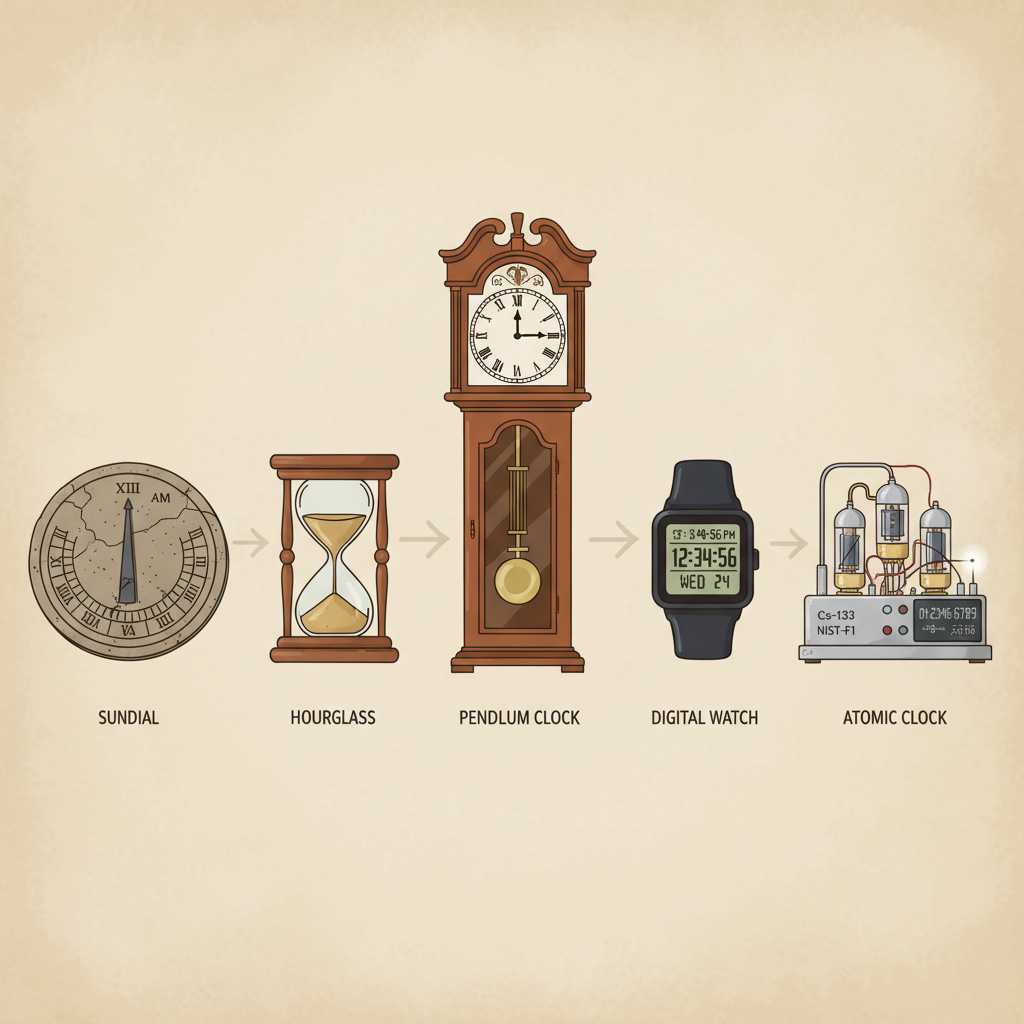 ⚠️ This picture may have spelling mistakes. Trust the words in the lesson.
Keep learning, free
Create a free Syllabax account to unlock practice questions and games for this topic.
Visual Learning Enhanced! 🚀
To help you master this topic, we use Advanced Syllabax AI to generate detailed diagrams and visual models.
Note on Visuals: The AI sometimes makes spelling errors in image labels. Please refer to the lesson text for the correct terminology.