Area theorems (Triangle)
Watch this topic in 60 seconds
Free preview · Lesson 1
Understanding Area theorems (Triangle)
Understanding Triangle Area: It's All About Space!
Imagine you're laying down a triangular picnic blanket. How much ground does it cover? Or think about a slice of pizza – how much cheese and toppings are on it? In geometry, we call this "how much space a flat shape covers" its area. For triangles, understanding area is fundamental, and it's built on a few simple, yet powerful ideas, often called "area theorems." Don't worry, we'll break them down into easy-to-understand chunks, like finding the perfect spot for your picnic!
The Golden Rule: Area = 1/2 × Base × Height
This is the absolute superstar formula for the area of any triangle. Think of it like a secret key that unlocks the area of every triangle. Let's understand what 'base' and 'height' mean:
- Base (b): The base of a triangle is simply one of its sides. You can choose any side to be the base. Imagine it as the 'floor' on which your triangle stands.
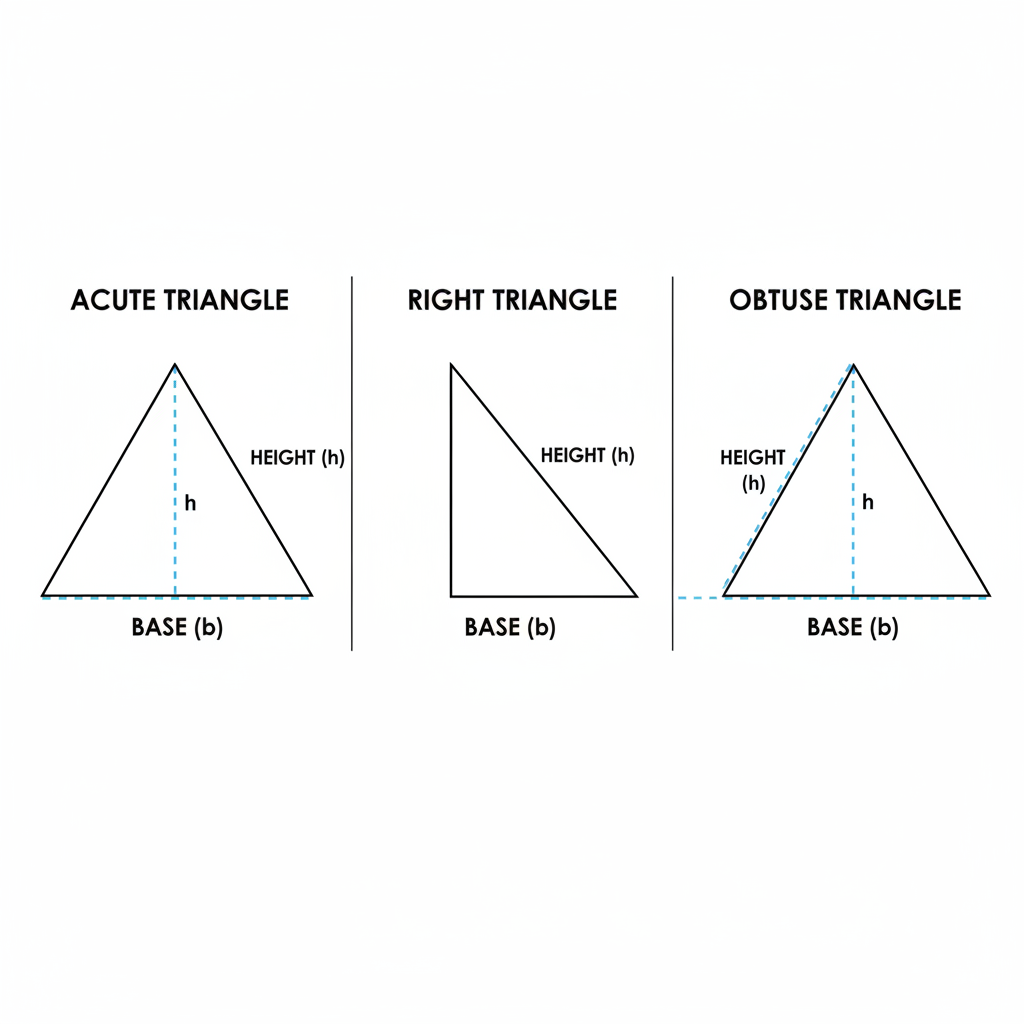
- Height (h): The height (or altitude) is the perpendicular distance from the opposite vertex (the corner not on the base) to the base. "Perpendicular" means it forms a perfect 90-degree angle with the base. Think of it like dropping a plumb line (a weight on a string) straight down from the top corner to the floor. That string shows you the height!
Analogy Time: The Skyscraper's Shadow
Imagine a skyscraper. Its base is the ground it sits on. Its height is how tall it is, measured straight up from the ground. Now, imagine a triangular roof on a building. If you pick one edge of the roof as the "base," the "height" would be how far up the peak of the roof is, measured straight down to that edge. It's never measured along a slanted side, but always a straight, perpendicular drop.
Finding Base and Height in Different Triangles:
The trickiest part for many students is identifying the height, especially when the triangle isn't a simple right-angled one. Let's look at the main types:
1. Right-Angled Triangles: The Easiest Case!
In a right-angled triangle, one of the legs (the sides that form the 90-degree angle) can be your base, and the other leg can be your height. It's like having a perfect corner where the floor meets the wall!
Analogy: Half a Rectangle
Imagine a rectangle. Its area is length × width. Now, draw a diagonal line across the rectangle. What do you get? Two identical right-angled triangles! Each triangle covers exactly half the area of the rectangle. So, if one side of the rectangle is the base and the other is the height, then the triangle's area is indeed half of base × height.
2. Acute Triangles: Height Stays Inside
In an acute triangle (all angles are less than 90 degrees), the height will always fall *inside* the triangle, just like a tent pole standing upright in the middle of a tent.
3. Obtuse Triangles: Height Can Go Outside!
This is where it gets a little mind-bending but makes perfect sense once you get it! In an obtuse triangle (one angle is greater than 90 degrees), if you choose a side adjacent to the obtuse angle as your base, the height from the opposite vertex might fall *outside* the triangle. To find it, you extend the base line, and then drop a perpendicular from the vertex to that extended line.
Analogy: The Leaning Tower of Pisa
Think of the Leaning Tower of Pisa. If you wanted to measure its true height from the ground, you wouldn't measure along its slanted side. You'd measure a straight, vertical line from the highest point down to the ground. The 'ground' here is your extended base line. Even though the measurement goes outside the physical building, it's still the true height for calculating its footprint or 'area coverage' if it were a flat shape.
Area Theorem 1: Congruent Triangles Have Equal Areas
This one is pretty straightforward. If two triangles are congruent, it means they are exact copies of each other – same size, same shape. Like two identical puzzle pieces. It makes perfect sense that if they are identical, they will cover the exact same amount of space!
Analogy: Identical Cookies
If you have two cookies cut from the exact same triangular cookie cutter, they are congruent. You wouldn't expect one to have more 'cookie' than the other, would you? Their areas are equal.
Area Theorem 2: Triangles on the Same Base and Between the Same Parallel Lines
This is a super important and cool theorem! If you have two triangles that share the same base (or bases of equal length) AND their opposite vertices (the corner not on the base) lie on a line that is parallel to the base, then their areas are equal.
Why is this true? Remember our golden rule: Area = 1/2 × Base × Height.
- If they share the same base, then 'Base' is the same for both.
- If their opposite vertices are on a line parallel to the base, it means the perpendicular distance between the parallel lines is the *same* everywhere. And what is that perpendicular distance? It's the 'Height'!
Since both 'Base' and 'Height' are the same for both triangles, their areas *must* be equal!
Analogy: The Moving Lighthouse
Imagine a straight coastline (your base) and a parallel line of buoys out in the sea. Now, imagine a lighthouse on the coastline. You can move the lighthouse along the line of buoys, keeping its base fixed on the coastline. No matter where you position the lighthouse along that parallel line, its "reach" (the triangular area formed with the coastline) will be the same, because its base length on the coast and its perpendicular distance to the line of buoys remain constant.
Area Theorem 3: A Median Divides a Triangle into Two Triangles of Equal Area
What's a median? A median of a triangle is a line segment drawn from one vertex to the midpoint of the opposite side. It basically cuts the opposite side exactly in half.
When you draw a median, it splits the original triangle into two smaller triangles. And here's the magic: these two smaller triangles will always have equal areas!
Why is this true? Let's say you have triangle ABC, and AD is a median, meaning D is the midpoint of BC. Now you have two triangles: ABD and ADC.
- Same Height: Both triangle ABD and triangle ADC share the *same height* from vertex A to the base BC (or its extension). Think of dropping a perpendicular from A down to BC. This height is common to both smaller triangles.
- Equal Bases: Since D is the midpoint of BC, the base BD of triangle ABD is equal to the base DC of triangle ADC. So, Base(ABD) = Base(ADC).
Since Area = 1/2 × Base × Height, and both triangles have the same height and equal bases, their areas must be equal!
Analogy: Cutting a Cake Precisely in Half
Imagine you have a triangular cake. If you cut it from one corner straight down to the *exact middle* of the opposite side, you've essentially drawn a median. You now have two pieces of cake. Even if they don't look exactly the same shape-wise (unless it's an isosceles triangle), they will have the exact same amount of cake, meaning equal area!
Summary: The Big Picture
Understanding these foundational area theorems for triangles isn't just about formulas; it's about seeing how shapes relate to each other and how small changes can impact the space they cover. Remember the golden rule of 1/2 × Base × Height, and how height is always perpendicular. From there, the other theorems build on this core idea, helping you quickly deduce areas without always needing to calculate every single dimension.
Keep learning, free
Create a free Syllabax account to unlock practice questions and games for this topic.
Visual Learning Enhanced! 🚀
To help you master this topic, we use Advanced Syllabax AI to generate detailed diagrams and visual models.
Note on Visuals: The AI sometimes makes spelling errors in image labels. Please refer to the lesson text for the correct terminology.