Learning Journey
Watch this topic in 60 seconds
Free preview · Lesson 1
Understanding Sorting shapes (Geometry)
Shape Detectives: Sorting Shapes!
Hello, young mathematicians! Get ready to become super shape detectives! Today, we’re going on an exciting adventure to explore the world of shapes and learn how to sort them. Sorting means putting things into groups based on what they have in common. Think about sorting your toys: you might put all your cars in one bin and all your stuffed animals in another. We’re going to do the same thing with shapes!
What is a Shape?
A shape is like the outline or the outside part of an object. It tells us about its form and how it looks. Shapes are everywhere around us! The plate you eat from is a circle. The screen of your tablet is a rectangle. Even the slice of pizza you love might be a triangle!
What Does it Mean to Sort?
Sorting is like being a super organizer. When we sort, we look for special features that shapes share. Imagine you have a big box of LEGOs. Some are red, some are blue. You could sort them by color! Some are big, some are small. You could sort them by size! We're going to sort shapes by their own special features, like the number of sides or corners they have.
Let's Meet Some Basic Shapes!
We’ll start with some of the most common shapes. These are like the VIPs of the shape world!
1. The Circle: The Smooth Roller!
A circle is a perfectly round shape. It has no straight sides and no corners. Think of a wheel on a car, a shiny coin, or the sun! They all look like circles. A circle is like a hula hoop – it just keeps going around and around without any sharp turns. It’s smooth and continuous.
2. The Square: The Perfectly Balanced Box!
A square is a very special shape. It has four straight sides, and all of those sides are exactly the same length! Imagine a perfect cracker or a window pane. A square also has four corners. These corners are like sharp little points where the sides meet. Think of a square as a perfectly balanced table with four legs of the same size and four corners.
3. The Rectangle: The Stretched Square!
A rectangle is a lot like a square, but it’s a bit stretched out. It also has four straight sides and four corners. The special thing about a rectangle is that it has two longer sides and two shorter sides. Think of a door or a book. They have four sides and four corners, but they aren't all the same length. It’s like a square that took a gentle stretch!
4. The Triangle: The Pointy Peak!
A triangle is a shape with three straight sides and three corners. Think of a slice of pizza, the roof of a small house, or a yield sign on the road. They all have that distinctive pointy shape. A triangle is like a little mountain with three sides leading up to a peak (the corners).
How to Sort Shapes: The Clues!
To sort shapes, we need to look for clues. The main clues we’ll use are:
- Number of Sides: How many straight lines make up the shape?
- Number of Corners: How many pointy bits does the shape have?
Let’s use these clues:
- Circles: 0 sides, 0 corners. (They are super smooth!)
- Squares: 4 sides, 4 corners. (All sides are the same length!)
- Rectangles: 4 sides, 4 corners. (Two sides are longer, two are shorter!)
- Triangles: 3 sides, 3 corners.
Let’s Sort! A Fun Activity
Imagine you have a collection of different shape cutouts. How would you sort them?
Scenario 1: Sorting by the Number of Sides
- Group 1: Shapes with 0 Sides. This group would only have the circles. They are the only ones with no straight lines.
- Group 2: Shapes with 3 Sides. This group would only have the triangles.
- Group 3: Shapes with 4 Sides. This group would have squares and rectangles. We’ll need another clue to separate these two!
Scenario 2: Sorting by the Number of Corners
- Group 1: Shapes with 0 Corners. Again, only the circles.
- Group 2: Shapes with 3 Corners. This group is for triangles.
- Group 3: Shapes with 4 Corners. This group will have squares and rectangles. We’re still needing more information to tell them apart in this group!
Scenario 3: Sorting Squares and Rectangles (The Trickiest Group!)
We know both squares and rectangles have 4 sides and 4 corners. How do we tell them apart? We look at the length of the sides!
- Squares: All 4 sides are the SAME length.
- Rectangles: 2 sides are LONG, and 2 sides are SHORT.
So, if we have a pile of shapes with 4 sides and 4 corners, we can then sort them further:
- Subgroup A: All sides equal. These are the squares!
- Subgroup B: Two long sides and two short sides. These are the rectangles!
This is like sorting your crayons: first, you put them all in a box (all shapes with 4 sides), then you might sort them by color or size!
Shapes in Our World
Shapes are not just in our math books; they are all around us, helping us describe things! When you want to describe a clock, you might say it’s a big circle. If you’re talking about a building block, you might say it’s a square. If you’re pointing out a road sign, you might say it’s a triangle. Learning to sort shapes helps us become better at observing and describing the world!
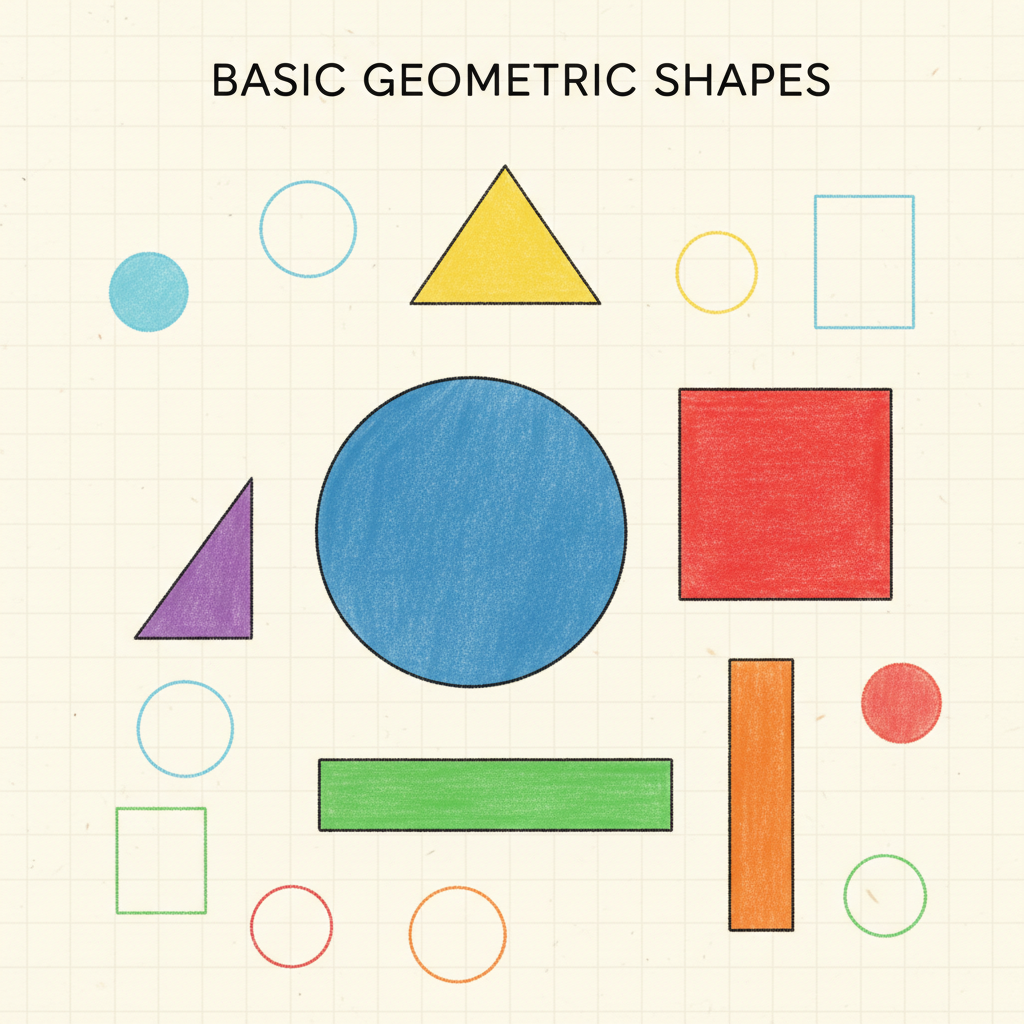
Look around your room right now! Can you spot a circle? How about a rectangle? Maybe a square or a triangle? Shapes are like hidden treasures waiting to be discovered and sorted!
Let's Recap!
We learned that sorting means putting things into groups. We met some amazing shapes: the round circle, the balanced square, the stretched rectangle, and the pointy triangle. We learned to sort them by their number of sides and corners, and even by the length of their sides for squares and rectangles.
Keep practicing your shape detective skills! The more you look, the more shapes you'll find and the better you'll become at sorting them. Remember, every shape has its own special features that help us understand and organize our world.
 ⚠️ This picture may have spelling mistakes. Trust the words in the lesson.
Keep learning, free
Create a free Syllabax account to unlock practice questions and games for this topic.
Visual Learning Enhanced! 🚀
To help you master this topic, we use Advanced Syllabax AI to generate detailed diagrams and visual models.
Note on Visuals: The AI sometimes makes spelling errors in image labels. Please refer to the lesson text for the correct terminology.