Learning Journey
Watch this topic in 60 seconds
Free preview · Lesson 1
Understanding Basic formula (Speed, Time & Distance)
Understanding Speed, Time, and Distance: Your Journey to Motion Math!
Hello, young explorers! Have you ever wondered how long it takes to get to school, or how fast a cheetah can run? What about how far your favorite team travels for an away game? All these questions are about three very important concepts in math and science: Speed, Time, and Distance. Don't worry if they sound tricky; we're going to break them down into super simple terms, just like building blocks!
1. What is Time? (How long?)
Let's start with Time. Time is simply a measure of 'how long' something takes. It tells us the duration of an event or journey.
- Analogy: Imagine reading a really good book. Time tells you how many minutes or hours you spent lost in its pages. Or, think about a clock on the wall – it's constantly ticking away, measuring how long each moment lasts.
- Units: We usually measure time in seconds (s), minutes (min), or hours (h). Sometimes we even use days, weeks, or years for longer periods!
2. What is Distance? (How far?)
Next up is Distance. Distance is a measure of 'how far' something travels or how far apart two points are. It's the total ground covered.
- Analogy: Think about walking from your bedroom to the kitchen. The number of steps you take, or the length of that path, is the distance. Or, if you're on a road trip, the numbers on the highway signs telling you how many miles are left to your destination? That's distance!
- Units: We measure distance in units like meters (m), kilometers (km), feet (ft), or miles (mi).
3. What is Speed? (How fast?)
Now for Speed! Speed tells us 'how fast' something is moving. It's about how much distance is covered in a certain amount of time.
- Analogy: Imagine two cars on a race track. The car that finishes first in the same amount of time is the one that moved faster. Its speed was higher! Or, think about a snail crawling versus a rabbit hopping. The rabbit covers much more distance in the same amount of time, so it has a higher speed. Your car's speedometer shows you its speed!
- Units: Speed combines distance and time units. Common units are kilometers per hour (km/h), meters per second (m/s), or miles per hour (mph).
The Magical Connection: The Speed, Time, Distance Formula!
These three concepts aren't just separate ideas; they are connected by a powerful formula. If you know any two of them, you can always find the third!
The main formula to remember is:
Distance = Speed × Time
Or, in shorthand:
D = S × T
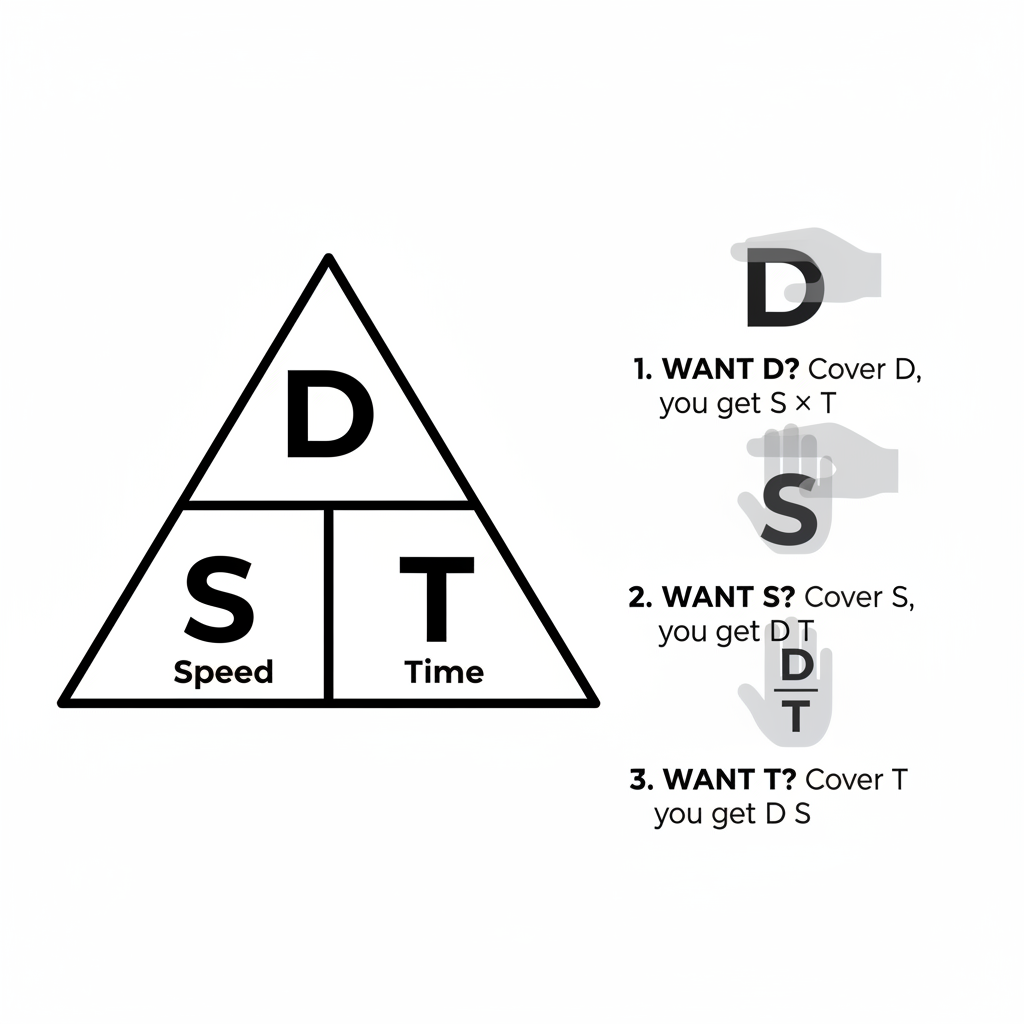
Think of it like a recipe! If you want to know the total 'distance' (like the total number of cookies), you need to know 'how fast' you're baking (speed of baking) and 'for how long' (time spent baking).
How to find Speed?
What if you know the distance and the time, but want to figure out the speed? We can rearrange our formula!
Speed = Distance ÷ Time
Or:
S = D / T
Analogy: Imagine you walked 10 kilometers in 2 hours. To find your speed, you'd divide the total distance (10 km) by the total time (2 hours). So, 10 km / 2 hours = 5 km/h. This tells you how fast you were walking on average.
How to find Time?
And what if you know the distance and the speed, but want to figure out how long it will take (the time)?
Time = Distance ÷ Speed
Or:
T = D / S
Analogy: Let's say you have a 100-kilometer road trip ahead, and you know you'll be driving at an average speed of 50 km/h. To find out how long the trip will take, you divide the total distance (100 km) by your speed (50 km/h). So, 100 km / 50 km/h = 2 hours. The trip will take 2 hours!
Let's Practice with Examples!
Example 1: Finding Distance
A bee flies at a speed of 5 meters per second (m/s) for 10 seconds. How far did the bee fly?
- Speed (S): 5 m/s
- Time (T): 10 s
- Formula: D = S × T
- Calculation: D = 5 m/s × 10 s = 50 meters
- Answer: The bee flew 50 meters.
Example 2: Finding Speed
A train travels 300 kilometers (km) in 3 hours (h). What is the average speed of the train?
- Distance (D): 300 km
- Time (T): 3 h
- Formula: S = D / T
- Calculation: S = 300 km / 3 h = 100 km/h
- Answer: The train's average speed is 100 kilometers per hour.
Example 3: Finding Time
A cyclist needs to cover a distance of 40 kilometers (km). If they cycle at an average speed of 20 kilometers per hour (km/h), how long will it take them?
- Distance (D): 40 km
- Speed (S): 20 km/h
- Formula: T = D / S
- Calculation: T = 40 km / 20 km/h = 2 hours
- Answer: It will take the cyclist 2 hours.
Important Tip: Units Matter!
Always make sure your units are consistent! If your speed is in 'kilometers per hour', then your time should be in 'hours' and your distance in 'kilometers'. If your speed is in 'meters per second', then your time should be in 'seconds' and your distance in 'meters'. Mixing them up will give you a wrong answer!
Conclusion: You've Got This!
Understanding speed, time, and distance is like having a superpower for understanding motion in the world around you. From planning a trip to understanding sports, these foundational concepts are everywhere. With a little practice, you'll be a master of motion math in no time!
Keep learning, free
Create a free Syllabax account to unlock practice questions and games for this topic.
Visual Learning Enhanced! 🚀
To help you master this topic, we use Advanced Syllabax AI to generate detailed diagrams and visual models.
Note on Visuals: The AI sometimes makes spelling errors in image labels. Please refer to the lesson text for the correct terminology.