Learning Journey
Watch this topic in 60 seconds
Free preview · Lesson 1
Understanding Chance of occurrence (Probability)
Understanding Chance: The World of Probability for 7th Graders
Have you ever tried to guess if it will rain tomorrow, or wondered if you'll win a game of rock-paper-scissors? When you do this, you're thinking about chance. Chance is simply how likely something is to happen. Some things are very likely, like the sun rising tomorrow. Other things are very unlikely, like finding a talking dinosaur in your backyard! In math, we have a special way to measure and describe chance, and we call it Probability.
What is Probability?
Imagine you have a bag of different colored candies, and you close your eyes and pick one. Can you say for sure which color you'll get? No, because there's an element of chance! Probability is the mathematical way of telling us how likely an event is to occur. It gives us a number that tells us the chance of something happening, from 'no chance at all' to 'definitely going to happen'.
Analogy Time: The Weather Forecaster
Think about a weather forecaster. When they say there's a '90% chance of rain', they're using probability! They've looked at lots of data (like temperature, wind, and clouds) and calculated that it's very, very likely to rain. If they say there's a '10% chance of rain', it means rain is unlikely, but still possible.
Key Words in Probability
To talk about probability like a pro, we need to understand a few important words:
- Experiment: This is an action or process that has a number of possible outcomes. It's something you do.
- Example: Flipping a coin.
- Example: Rolling a standard six-sided die.
- Example: Spinning a spinner.
- Outcome: This is a single possible result of an experiment. It's what happens.
- Example: When you flip a coin, the outcomes are 'Heads' or 'Tails'.
- Example: When you roll a die, the outcomes are '1', '2', '3', '4', '5', or '6'.
- Sample Space: This is the list of ALL the possible outcomes of an experiment.
- Example: For flipping a coin, the sample space is {Heads, Tails}.
- Example: For rolling a die, the sample space is {1, 2, 3, 4, 5, 6}.
- Event: This is a specific outcome or a set of specific outcomes that we are interested in.
- Example: Getting 'Heads' when flipping a coin is an event.
- Example: Rolling an 'even number' (2, 4, or 6) when rolling a die is an event.
- Example: Picking a red marble from a bag is an event.
Let's use an analogy for these terms. Imagine you're playing a board game. Rolling the die is the experiment. Whatever number comes up (like a 3) is an outcome. All the numbers that could possibly come up (1, 2, 3, 4, 5, 6) make up the sample space. And if you need to roll a '6' to win, then rolling a 6 is your important event!
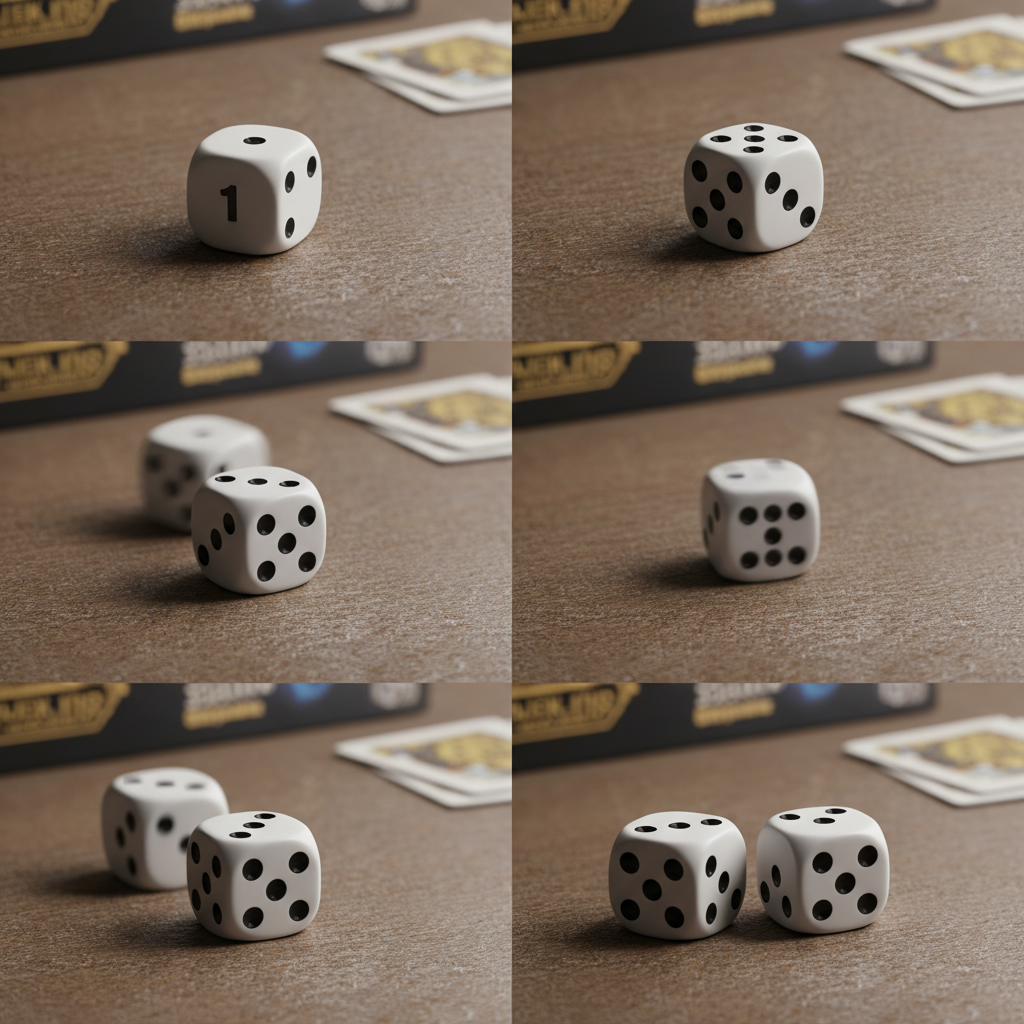 ⚠️ This picture may have spelling mistakes. Trust the words in the lesson.
How Do We Measure Probability?
We can describe chance using words like 'impossible' or 'certain', but in math, we like to use numbers! Probability is usually shown as a fraction, a decimal, or a percentage. The probability of any event will always be a number between 0 and 1 (or 0% and 100%).
- 0 (or 0%): Impossible! This means the event can never happen.
- Example: The probability of rolling a '7' on a standard six-sided die is 0. (It's impossible!)
- 1 (or 100%): Certain! This means the event will definitely happen.
- Example: The probability of the sun rising tomorrow is 1. (It's certain!)
- 0.5 (or 50%): Equally Likely! This means the event is just as likely to happen as it is not to happen.
- Example: The probability of getting 'Heads' when flipping a fair coin is 0.5.
Any probability between 0 and 0.5 means the event is unlikely. Any probability between 0.5 and 1 means the event is likely.
The Probability Formula
Here's the super important formula for calculating the probability of an event:
P(Event) = (Number of Favorable Outcomes) / (Total Number of Possible Outcomes)
Let's break this down:
- P(Event): This is just shorthand for 'The Probability of the Event'.
- Number of Favorable Outcomes: This is how many ways your specific event can happen.
- Total Number of Possible Outcomes: This is the total number of things that could happen (the size of your sample space).
Let's Try Some Examples!
Example 1: Flipping a Coin
What is the probability of getting 'Heads' when you flip a fair coin?
- Experiment: Flipping a coin.
- Sample Space: {Heads, Tails} (Total possible outcomes = 2)
- Event: Getting 'Heads'. (Favorable outcomes = 1, because 'Heads' appears only once)
- P(Heads) = 1 / 2
So, the probability of getting 'Heads' is 1/2, or 0.5, or 50%. This makes sense, right? It's equally likely to get heads or tails.
Example 2: Rolling a Die
What is the probability of rolling an 'even number' when you roll a standard six-sided die?
- Experiment: Rolling a die.
- Sample Space: {1, 2, 3, 4, 5, 6} (Total possible outcomes = 6)
- Event: Rolling an 'even number'. The even numbers in our sample space are {2, 4, 6}. (Favorable outcomes = 3)
- P(Even Number) = 3 / 6 = 1 / 2
Again, the probability is 1/2, or 0.5, or 50%. It's equally likely to roll an even or an odd number.
Example 3: Marbles in a Bag
You have a bag with 3 red marbles, 2 blue marbles, and 5 green marbles. What is the probability of picking a blue marble?
- Experiment: Picking a marble from the bag.
- Total Number of Marbles: 3 (red) + 2 (blue) + 5 (green) = 10 marbles. (Total possible outcomes = 10)
- Event: Picking a blue marble. (Number of blue marbles = 2) (Favorable outcomes = 2)
- P(Blue Marble) = 2 / 10 = 1 / 5
So, the probability of picking a blue marble is 1/5, or 0.2, or 20%. This tells us it's less likely to pick a blue marble than a red or green one.
Why is Probability Important?
Probability isn't just for math class or board games. It's used in many real-world situations:
- Science: Predicting genetic traits, understanding weather patterns.
- Games & Sports: Calculating the odds in card games, predicting team wins.
- Business: Assessing risks, making financial decisions.
- Daily Life: Deciding whether to carry an umbrella, choosing a lottery ticket (though the chances are usually very, very low!).
Understanding probability helps you make better decisions and understand the world around you a little bit more clearly. It teaches you to think about what could happen and how likely those things are.
Putting It All Together
Probability is the math of chance. It helps us quantify how likely an event is to happen. We use key terms like experiment, outcome, sample space, and event. The probability is always a number between 0 (impossible) and 1 (certain) and can be calculated by dividing the number of favorable outcomes by the total number of possible outcomes. Keep practicing, and you'll become a probability master in no time!
Keep learning, free
Create a free Syllabax account to unlock practice questions and games for this topic.
Visual Learning Enhanced! 🚀
To help you master this topic, we use Advanced Syllabax AI to generate detailed diagrams and visual models.
Note on Visuals: The AI sometimes makes spelling errors in image labels. Please refer to the lesson text for the correct terminology.