Learning Journey
Watch this topic in 60 seconds
Free preview · Lesson 1
Understanding Attraction & repulsion[PHYSICS]
Attraction and Repulsion: The Invisible Forces!
Have you ever wondered why some things stick together, while others push each other away? It's all thanks to invisible forces called attraction and repulsion! These forces are all around us, from the magnets on your refrigerator to the tiny particles that make up everything in the universe.
What are Forces?
A force is simply a push or a pull. Think about pushing a toy car across the floor or pulling a wagon. Those are forces in action! In physics, we talk about different kinds of forces. Today, we're focusing on two special types: attraction and repulsion.
Attraction: The "Come Here!" Force
Attraction is a force that pulls objects together. It's like a friendly hug that wants to bring things closer.
Magnets: Our Favorite Example
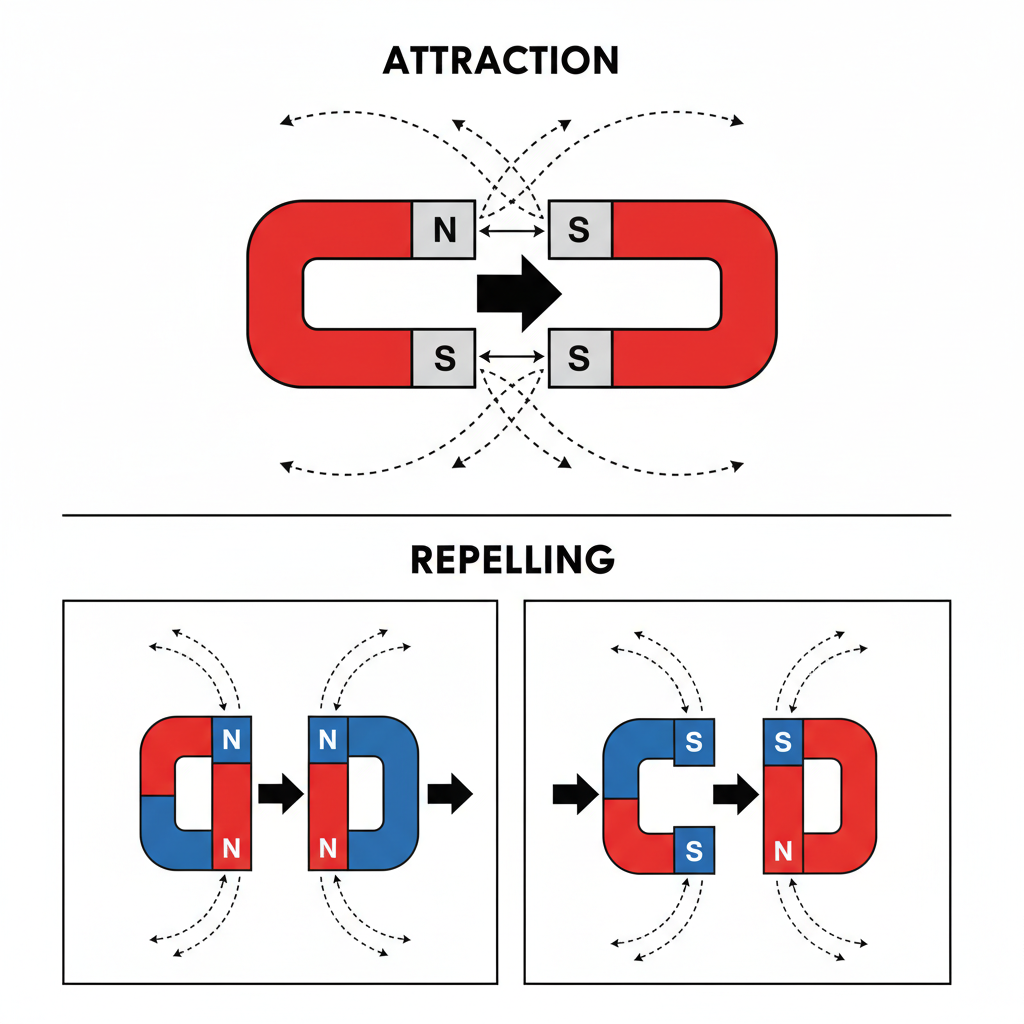
The most common example of attraction we see every day is with magnets. Magnets have two ends, called poles: a North pole (N) and a South pole (S).
Here's the rule for magnets:
- Opposites Attract: A North pole will be attracted to a South pole. They want to snap together! Imagine two friends who are very different but really enjoy each other's company – they are drawn to each other.
If you have a North pole and a South pole, they will pull towards each other. It feels like they are reaching out to grab each other!
Gravity: The Big Hugger
Gravity is another example of attraction, but it's a bit different. Gravity is the force that pulls everything with mass towards everything else with mass. The bigger an object is, the stronger its gravitational pull.
Think of the Earth. It's HUGE! That's why it has a strong gravitational pull. It's constantly pulling you, your chair, your house, and everything else down towards its center. This is why when you jump, you always come back down! It's the Earth giving you a gentle, constant hug. The moon is also pulled towards the Earth by gravity, which is why it orbits around us.
Static Electricity: The Tiny Huggers
Sometimes, tiny particles called electrons can move from one object to another. When objects gain or lose electrons, they get an electric charge. There are two types of charges:
- Positive Charge (+): Usually happens when an object loses electrons.
- Negative Charge (-): Usually happens when an object gains electrons.
Just like magnets, opposite charges attract! A positively charged object will be attracted to a negatively charged object. Imagine rubbing a balloon on your hair. Your hair has some of the balloon's electrons rubbed onto it, making your hair negatively charged. The balloon also becomes negatively charged. Now, if you bring two charged balloons close together (both negatively charged), they will push away! But if you rub one balloon on your hair and another on a different material (making it positively charged), they would attract!
The feeling of your hair standing on end after taking off a hat is also due to static electricity. The hat and your hair rub together, transferring electrons and causing both to become charged. Since like charges repel and opposite charges attract, your hair strands, which now have similar charges, push each other away, making them stand up!
Repulsion: The "Go Away!" Force
Repulsion is the opposite of attraction. It's a force that pushes objects apart. It's like saying, "Don't come any closer!"
Magnets Again!
Magnets also show us repulsion. Remember our magnet poles?
- Likes Repel: Two North poles will push each other away. Two South poles will also push each other away.
Try it yourself! If you have two bar magnets, hold them so that the two North poles are facing each other, or the two South poles are facing each other. You'll feel a force pushing them apart. It's like they are stubborn siblings who don't want to share a toy!
Static Electricity: The Pushy Particles
We saw this with the balloons! When two objects have the same type of electric charge (both positive or both negative), they repel each other.
Think about a thunderstorm. When clouds get very full of charged particles, the like charges within the cloud can push each other away with such force that it creates a massive electrical discharge – lightning! The same type of charges are trying to get away from each other, creating a huge push.
Atoms and Molecules: The Tiny Dancers
At a much smaller level, the tiny particles that make up everything – atoms and molecules – also experience attraction and repulsion. The positive parts of one atom might be attracted to the negative parts of another, helping them stick together to form substances. But if two parts have the same charge, they will push each other away.
This constant push and pull is what gives different materials their properties, like whether they are solid, liquid, or gas!
Putting It All Together
Attraction and repulsion are fundamental forces that shape our world. They are the invisible strings that connect or push apart objects, from the smallest atoms to the largest planets.
Key Rules to Remember:
- Opposites Attract: Opposite poles (N and S) attract. Opposite charges (+) and (-) attract.
- Likes Repel: Like poles (N and N, S and S) repel. Like charges (+ and +, - and -) repel.
Understanding these forces helps us understand how magnets work, why we stay on the ground, and even how electricity functions!
Keep learning, free
Create a free Syllabax account to unlock practice questions and games for this topic.
Visual Learning Enhanced! 🚀
To help you master this topic, we use Advanced Syllabax AI to generate detailed diagrams and visual models.
Note on Visuals: The AI sometimes makes spelling errors in image labels. Please refer to the lesson text for the correct terminology.