History of Computing
Watch this topic in 60 seconds
Free preview · Lesson 1
Understanding History of Computing
The Amazing Story of Computing: From Fingers to Future
Hey there, 8th graders! Ever wonder how your super-smart smartphone or lightning-fast laptop came to be? It didn't just appear out of nowhere! The story of computers is a fascinating adventure, full of brilliant minds, clever inventions, and a whole lot of trial and error. Think of it like a treasure hunt through history, where each discovery builds on the last, leading us to the incredible technology we use today. This journey isn't just about wires and screens; it's about how humans have always tried to make tasks easier, faster, and more accurate.
Chapter 1: Counting on Fingers and Beads – The Very Early Days (Ancient Times)
Before fancy calculators or even pen and paper, how do you think people counted? Yep, with their fingers and toes! But what if you had to count a lot of sheep, or measure a huge amount of grain? You'd need something more. This is where early tools came in.
The Abacus: The First 'Computer' (Thousands of Years Ago)
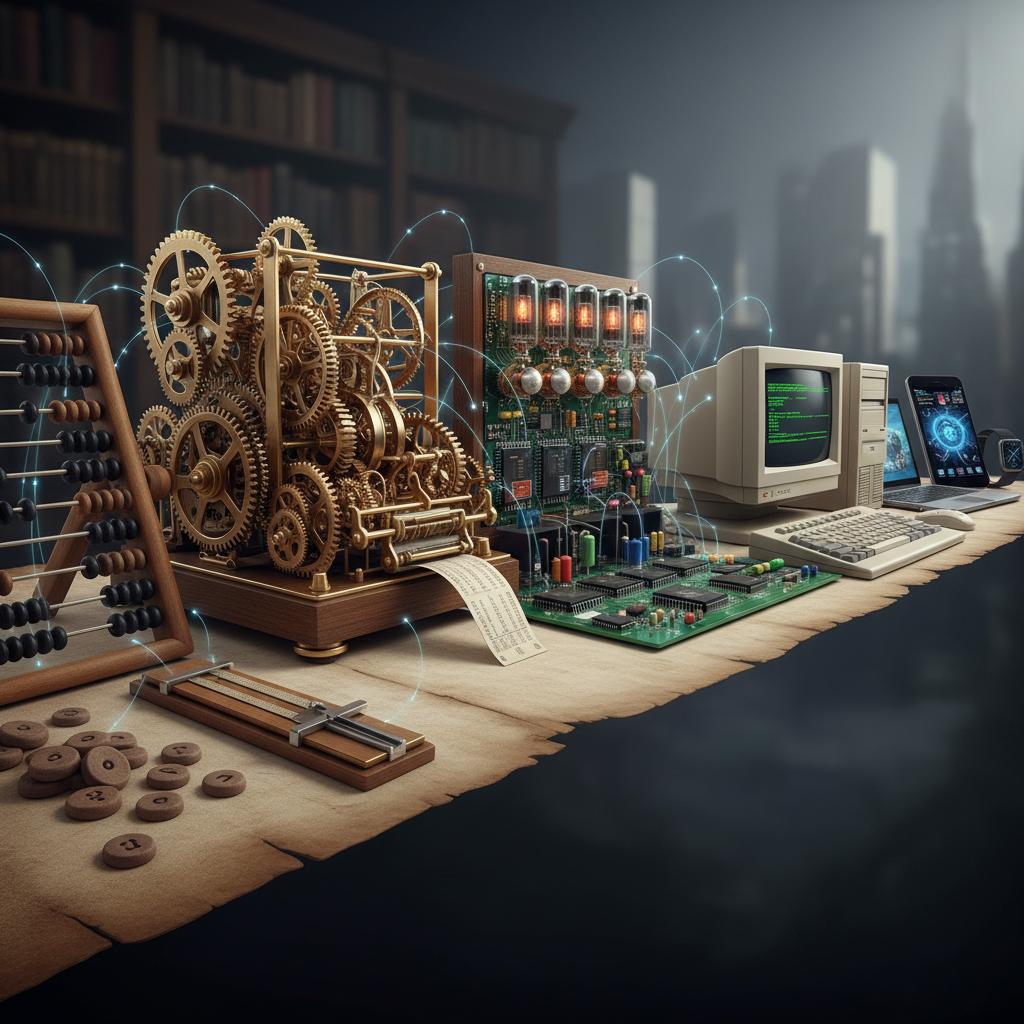
Imagine a frame with rods and beads, like a very simple toy. That's an abacus! It's one of the oldest known tools for counting and calculating, used by ancient civilizations like the Babylonians, Chinese, and Romans. Think of it as a super-organized way to keep track of numbers beyond your ten fingers. Each bead has a value, and by moving them, you can add and subtract large numbers. It's not electric, it doesn't have a screen, but it computes!
Analogy: The abacus is like a very basic scoreboard. Instead of keeping track of points in a game, it keeps track of numbers by sliding beads. It's manual, but incredibly effective for its time.
Chapter 2: Gears, Cranks, and Clever Math – The Mechanical Age Begins (17th & 19th Centuries)
As the world got more complex, people needed faster and more accurate ways to do calculations, especially in science, engineering, and business. This led to inventors creating machines that could crunch numbers mechanically.
Napier's Bones and the Slide Rule (Early 1600s)
A Scottish mathematician named John Napier invented a clever tool called "Napier's Bones." These were rods marked with numbers that could be used to multiply and divide. It was like having a shortcut for multiplication tables! Later, the slide rule came along, which was essentially a ruler you could slide to quickly perform multiplications, divisions, and even more complex calculations. Engineers and scientists used slide rules for centuries!
Analogy: Think of Napier's Bones as a set of LEGO bricks, where each brick helps you solve a specific math puzzle. The slide rule is like a super-smart measuring tape that can multiply numbers just by lining them up!
Pascaline (1642) – The First True Calculator?
A brilliant French teenager named Blaise Pascal (yes, a teenager!) got tired of watching his father, a tax collector, struggle with long calculations. So, he invented the Pascaline, a mechanical calculator that could add and subtract using gears and wheels. It was revolutionary!
Analogy: The Pascaline was like an early version of your car's odometer, which uses gears to count how many miles you've driven. Except Pascal's machine counted numbers for calculations instead of miles.
Leibniz's Stepped Reckoner (Late 1600s)
Not long after Pascal, a German mathematician named Gottfried Wilhelm Leibniz improved on the Pascaline. His machine, the Stepped Reckoner, could not only add and subtract but also multiply, divide, and even find square roots! It was much more complex.
Analogy: If Pascal's machine was a simple bicycle, Leibniz's was like the first car – capable of doing more with more moving parts, even if it still needed a lot of manual effort.
Chapter 3: The Weaving Wonder and the Analytical Dream – The Birth of Programming (19th Century)
The biggest leap towards modern computing came when people realized that machines could not just do calculations, but also follow a sequence of instructions – a program!
The Jacquard Loom (1801) – Punch Cards!
A French weaver named Joseph Marie Jacquard invented a loom that used special wooden cards with holes punched in them to create intricate patterns in fabric. Different hole patterns meant different weaving instructions. This was a huge deal because it showed how a machine could be programmed using these cards to do complex, repetitive tasks automatically!
Analogy: The Jacquard Loom's punch cards were like the sheet music for a player piano or a music box. The holes in the paper/metal tell the machine exactly which notes to play in what order, creating a song. Here, the holes told the loom exactly which threads to move to create a pattern.
Charles Babbage: The Father of the Computer (Early 1800s)
An incredibly visionary British mathematician, Charles Babbage, is often called the "Father of the Computer." He designed two amazing machines:
- Difference Engine: Designed to calculate polynomial equations and print the results, which would help create accurate mathematical tables for navigation and engineering. It was purely mechanical, like a giant, super-precise clockwork calculator.
- Analytical Engine: This was Babbage's most groundbreaking idea. It was designed to be a general-purpose computer! It had all the main parts of a modern computer: an 'input' (punch cards), a 'mill' (like a CPU, for calculations), a 'store' (memory), and 'output' (a printer). While never fully built in his lifetime, its design was centuries ahead of its time.
Analogy: Babbage's Analytical Engine was like drawing up the plans for a skyscraper when everyone else was still building single-story houses. It was a complete vision for a machine that could do almost anything, not just one specific calculation.
Ada Lovelace: The First Programmer (Mid-1800s)
The daughter of the famous poet Lord Byron, Ada Lovelace was a brilliant mathematician who worked with Charles Babbage. She realized that the Analytical Engine could do more than just crunch numbers; it could manipulate symbols and follow a sequence of operations to solve complex problems. She wrote what is considered the first computer program – an algorithm specifically for Babbage's Analytical Engine! Because of this, she is known as the "First Programmer."
Analogy: If Babbage designed the amazing kitchen of the future (the Analytical Engine), Ada Lovelace wrote the very first, incredibly detailed recipe book for it, showing how to cook up many different kinds of "data dishes."
Chapter 4: The Punch Card Powerhouse (Late 19th & Early 20th Centuries)
The idea of using punch cards to program machines resurfaced with great success in the late 1800s.
Herman Hollerith and the Census Tabulator (1890s)
The US Census in 1880 took seven years to count and process all the data by hand! A brilliant engineer named Herman Hollerith developed an electric tabulating machine that used punch cards to record and sort census data much faster. For the 1890 census, his machines processed the data in just six years, despite a much larger population!
Hollerith's company eventually became part of a little company you might have heard of: IBM (International Business Machines), which played a huge role in the history of computing.
Analogy: Hollerith's tabulating machine was like a super-fast librarian who could sort thousands of books (data) by looking at holes punched in their library cards (punch cards) with special sensors. It was still mechanical but used electricity to make things faster.
Chapter 5: The Electronic Revolution – From Giants to Desktops (Mid-20th Century)
The 20th century brought the biggest transformation: the shift from mechanical parts to electronics. This made computers incredibly fast and powerful, though they started out absolutely enormous!
Early Electronic Computers: The Room-Sized Brains
- Atanasoff-Berry Computer (ABC, 1937-1942): Built by John Atanasoff and Clifford Berry, this is considered the first electronic digital computing device. It used vacuum tubes instead of mechanical switches and operated using binary code (0s and 1s), which is how modern computers still work!
- ENIAC (Electronic Numerical Integrator and Computer, 1946): This was the first general-purpose electronic digital computer. It was a massive machine, weighing 30 tons, taking up an entire room (1,800 square feet!), and using over 17,000 vacuum tubes. It consumed enough electricity to power a small town! It was used by the US Army for calculating artillery firing tables.
- UNIVAC I (Universal Automatic Computer I, 1951): This was the first commercial computer produced in the United States. It famously predicted the outcome of the 1952 presidential election on live television, astonishing everyone!
Analogy: Imagine a giant wall covered with thousands of old-fashioned light bulbs (vacuum tubes). When you turn certain bulbs on or off, you're performing calculations! ENIAC was like a colossal light-switch puzzle that could solve incredibly complex math problems very, very quickly.
Chapter 6: The Generations of Computers – Getting Smaller, Faster, Cheaper!
Since the 1940s, computers have gone through several "generations," each marked by a major technological leap that made them smaller, faster, cheaper, and more powerful.
First Generation (1940s-1950s): Vacuum Tubes
These were the ENIAC and UNIVAC machines. They were huge, hot, and broke down often.
Analogy: Like old-fashioned incandescent light bulbs – they're big, they get hot, and they burn out eventually.
Second Generation (Late 1950s-Mid 1960s): Transistors
Invented at Bell Labs, transistors replaced bulky vacuum tubes. They were tiny, used less power, generated less heat, and were much more reliable. Computers got smaller and faster.
Analogy: Transistors were like replacing those big, hot light bulbs with tiny, super-efficient LED lights. They do the same job but are much better!
Third Generation (Mid 1960s-Early 1970s): Integrated Circuits (Microchips)
Engineers learned to put many transistors (and other components) onto a single, small silicon chip called an integrated circuit (IC) or microchip. This was a massive step! Computers became even smaller, faster, and much more affordable, leading to their use in more businesses.
Analogy: If a transistor is an LED light, an integrated circuit is like putting an entire city of thousands of tiny LED lights on a single, fingernail-sized postage stamp. Incredible density and power!
Fourth Generation (Early 1970s-Present): Microprocessors and Personal Computers
The biggest breakthrough of this generation was the microprocessor – an entire computer's central processing unit (CPU) on a single microchip! This innovation led directly to the invention of personal computers (PCs) like the Apple II and the IBM PC, putting computing power directly into homes and offices. This generation also saw the development of computer networks, graphical user interfaces (what you see on your screen!), and the internet.
Analogy: The microprocessor is the ultimate brain-on-a-chip. It's like taking the entire command center of a large city and shrinking it down to the size of a tiny bug, capable of controlling everything. This is what made your laptop and phone possible!
Chapter 7: The Modern Era – Connectivity and Beyond (Late 20th Century - Today)
From the fourth generation, we continued to innovate at breakneck speed:
- The Internet: Connecting computers globally, sharing information instantly.
- Mobile Computing: Smartphones and tablets, putting powerful computers in our pockets.
- Artificial Intelligence (AI): Computers that can learn, understand, and even make decisions.
- Cloud Computing: Storing and accessing data and programs over the internet, not just on your local device.
Conclusion: An Unfinished Story
The history of computing is a story of human ingenuity, from simple counting tools to machines that can simulate complex worlds and help us explore space. Each invention built upon the last, driven by the desire to solve problems and make life easier. And guess what? The story isn't over! You, the next generation, will be the ones to write the next chapters in this amazing tale. Who knows what incredible computing advancements you'll witness or even help create!
Keep learning, free
Create a free Syllabax account to unlock practice questions and games for this topic.
Visual Learning Enhanced! 🚀
To help you master this topic, we use Advanced Syllabax AI to generate detailed diagrams and visual models.
Note on Visuals: The AI sometimes makes spelling errors in image labels. Please refer to the lesson text for the correct terminology.