How Many More or Less?
Watch this topic in 60 seconds
Free preview · Lesson 1
Understanding How Many More or Less?
Understanding 'How Many More or Less?' – A Fun Adventure in Numbers!
Hello, amazing mathematicians! Today, we're going on a super fun adventure to explore some very important questions about numbers: 'How many more?' and 'How many less?' These questions might sound a little tricky at first, but don't worry! We're going to break them down with lots of examples and make them as easy as pie. By the end of this, you'll be a pro at comparing numbers!
What Do 'More' and 'Less' Really Mean?
Before we jump into the 'how many' part, let's make sure we understand 'more' and 'less'.
- More: When you have 'more' of something, it means you have a bigger amount or a larger number. Think about having more cookies than your friend – that means you have a bigger pile of cookies!
- Less: When you have 'less' of something, it means you have a smaller amount or a smaller number. If you have less juice in your cup, it means there's a smaller amount of juice than before.
These words help us compare different amounts of things. Now, let's see how we use them in number questions!
The 'How Many More?' Question: Finding the Difference!
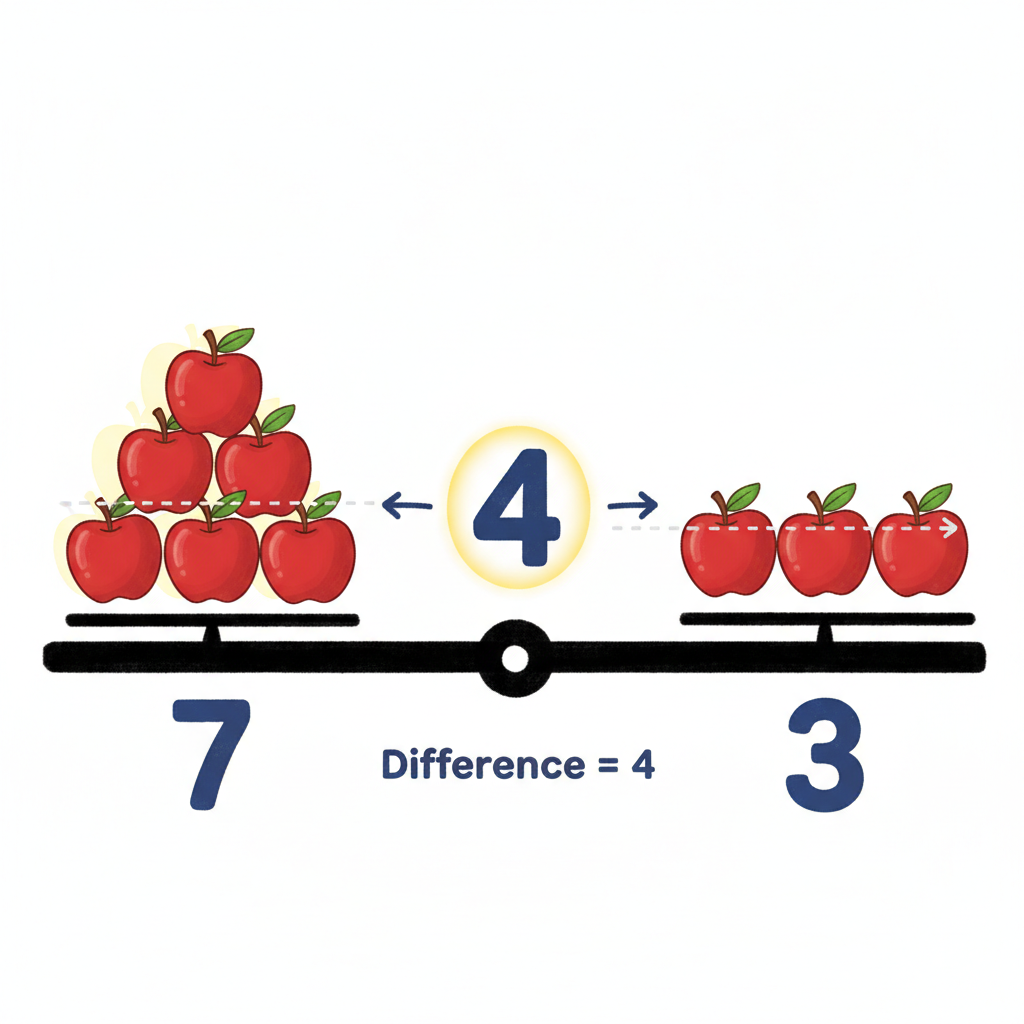
Imagine your friend, Lily, has 7 sparkly stickers. You, on the other hand, have 3 sparkly stickers. You might wonder, "Hmm, how many more stickers does Lily have than me?" This is a classic 'how many more' question!
Think of it like a Gap!
When someone asks "How many more?", they want to know the 'gap' or the 'distance' between two numbers. It's like measuring how much extra one number has compared to the other. Let's use our stickers example:
- Lily has 7 stickers.
- You have 3 stickers.
To find out how many more Lily has, we need to find the difference between 7 and 3. What math operation do we use to find the difference between two numbers? That's right, subtraction!
Let's Subtract!
To solve 'how many more', we always take the bigger number and subtract the smaller number from it.
Bigger Number - Smaller Number = How Many More!
For Lily's stickers:
- Find the bigger number: Lily's 7 stickers.
- Find the smaller number: Your 3 stickers.
- Subtract: 7 - 3 = ?
When you count back from 7 by 3, you get 4! So, Lily has 4 more stickers than you.
Another Analogy: Building Towers!
Imagine you and your friend are building block towers. You build a tower with 8 blocks. Your friend builds a tower with 5 blocks. How many more blocks did you use than your friend?
- Your tower: 8 blocks
- Friend's tower: 5 blocks
We subtract the smaller number (5) from the bigger number (8):
8 - 5 = 3
You used 3 more blocks! See? We are just finding the piece that makes them equal.
The 'How Many Less?' Question: The Same Math!
Now, let's flip our sticker story. You have 3 stickers, and Lily has 7 stickers. If someone asks, "How many less stickers do you have than Lily?" It might sound like a different question, but guess what? We use the exact same math!
It's Still About the Gap!
Whether you're asking "how many more" or "how many less," you are always trying to find the difference between the two numbers. The gap between 3 and 7 is the same no matter which direction you look at it!
Think about walking on a path. If you are 3 steps from a tree, and your friend is 7 steps from the tree, the 'gap' between you and your friend is still the same 4 steps, no matter if you ask "How many more steps does your friend have to go to reach the tree than you?" or "How many less steps do you have to go to reach the tree than your friend?" The distance is 4 steps!
Let's Subtract Again!
Just like with 'how many more', to solve 'how many less', we take the bigger number and subtract the smaller number from it.
Bigger Number - Smaller Number = How Many Less!
For your stickers:
- Find the bigger number: Lily's 7 stickers.
- Find the smaller number: Your 3 stickers.
- Subtract: 7 - 3 = ?
The answer is still 4! So, you have 4 less stickers than Lily. See how the answer is the same?
The Big Secret: They Both Ask for the DIFFERENCE!
This is the most important thing to remember:
Whether the question is "How many more?" or "How many less?"
You always use SUBTRACTION to find the answer!
You are always looking for the gap, the amount that separates the two numbers.
Let's Review the Steps to Solve:
- Read the problem carefully: Understand what numbers you are comparing.
- Identify the two numbers: What are the two amounts you are working with?
- Find the bigger number: This is important for subtraction!
- Subtract the smaller number from the bigger number: This will give you the difference.
- State your answer clearly: Make sure your answer makes sense for the question asked (e.g., "X more" or "X less").
Practice Makes Perfect!
Let's try a few more together to make sure you've got it down.
Example 1: There are 10 red balloons and 6 blue balloons. How many more red balloons are there than blue balloons?
- Numbers: 10 (red), 6 (blue)
- Bigger number: 10
- Smaller number: 6
- Subtract: 10 - 6 = 4
- Answer: There are 4 more red balloons.
Example 2: Sarah has 12 apples. Mark has 8 apples. How many less apples does Mark have than Sarah?
- Numbers: 12 (Sarah), 8 (Mark)
- Bigger number: 12
- Smaller number: 8
- Subtract: 12 - 8 = 4
- Answer: Mark has 4 less apples.
Notice how both questions used subtraction to find the difference, and the process was the same! You are now equipped with a powerful tool to compare numbers and find those sneaky differences.
Keep Practicing!
The more you practice, the easier it will become. Look for opportunities in your daily life to ask 'how many more' or 'how many less'. For instance, if you have 5 cookies and your sibling has 2, ask yourself how many more you have! Or if a bird feeder has 9 birds and another has 4, think about how many less birds are at the second feeder. Numbers are everywhere, and now you have a new way to understand them!
Keep learning, free
Create a free Syllabax account to unlock practice questions and games for this topic.
Visual Learning Enhanced! 🚀
To help you master this topic, we use Advanced Syllabax AI to generate detailed diagrams and visual models.
Note on Visuals: The AI sometimes makes spelling errors in image labels. Please refer to the lesson text for the correct terminology.