3D Figures & Cube Problems – Non -Verbal Reasoning
Watch this topic in 60 seconds
Free preview · Lesson 1
3D Figures & Cube Problems – Non -Verbal Reasoning (Foundational)
3D Figures & Cube Problems – Non-Verbal Reasoning (Foundational)
Welcome to the foundational lesson on 3D Figures and Cube Problems in Non-Verbal Reasoning. This lesson will introduce you to the core concepts needed to solve basic problems involving 3D shapes, specifically focusing on cubes.
Understanding 3D Figures
3D figures, also known as three-dimensional shapes or solids, have length, width, and height. Unlike 2D shapes that lie flat on a plane, 3D figures exist in space. Common examples include cubes, cuboids, spheres, cones, and cylinders.
Introduction to Cubes
A cube is a special type of cuboid where all sides (edges) are of equal length. It has six faces, all of which are squares. Each vertex (corner) of a cube is formed by the intersection of three edges.
Visualizing Cube Unfolding (Nets)
A cube net is a 2D pattern that can be folded to form a 3D cube. There are multiple possible nets for a cube. The key is to visualize how the faces connect when folded.
Key Properties of a Cube:
- Faces: 6 (all squares)
- Edges: 12
- Vertices: 8
Basic Cube Problems
Foundational cube problems often involve identifying a cube net, determining which faces are opposite each other on a folded cube, or identifying a cube that can be formed from a given net. Let's break down these problem types.
1. Identifying Cube Nets
You will be presented with several 2D patterns and asked to identify which one can be folded into a cube. To solve this, mentally fold the pattern. Ensure all faces meet correctly without overlapping or leaving gaps.
2. Opposite Faces
Given a cube net, you may be asked to determine which faces will be opposite each other when the cube is folded. To solve this, visualize the folding process. Look for faces that will be separated by only one face when the cube is formed.
Example
Consider a simple T-shaped cube net. The top and bottom of the 'T' will be opposite each other when folded into a cube.
3. Forming a Cube from a Net
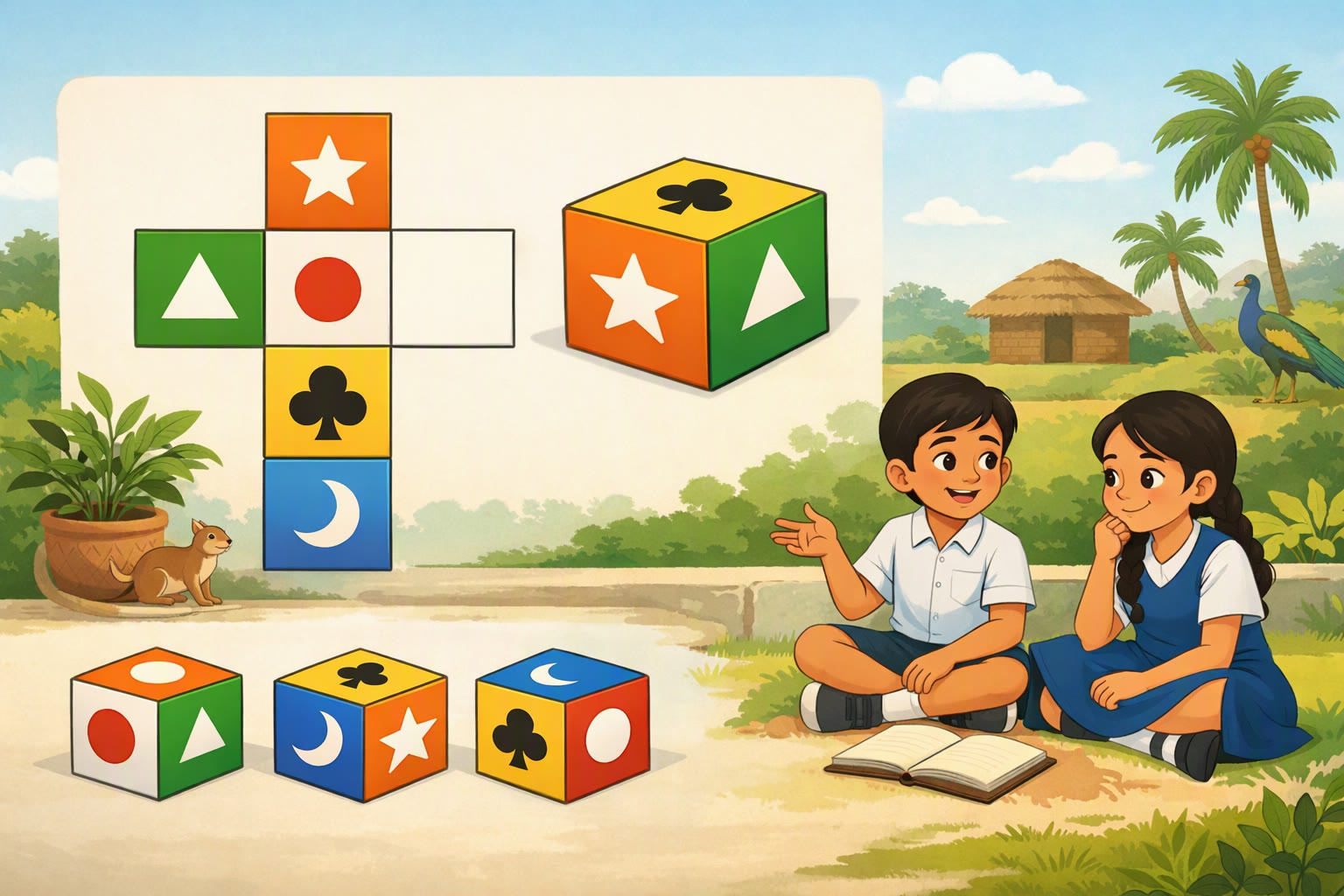
You might be presented with a net and several cube options. You must select the cube that can be formed from the given net. Pay close attention to the orientation and position of any symbols or colors on the faces of the net.
Tips for Solving Cube Problems
- Visualization: Practice visualizing the folding process.
- Elimination: Rule out options that clearly cannot form a cube.
- Patience: Take your time and carefully analyze each option.
Keep learning, free
Create a free Syllabax account to unlock practice questions and games for this topic.
Visual Learning Enhanced! 🚀
To help you master this topic, we use Advanced Syllabax AI to generate detailed diagrams and visual models.
Note on Visuals: The AI sometimes makes spelling errors in image labels. Please refer to the lesson text for the correct terminology.