Learning Journey
Watch this topic in 60 seconds
Free preview · Lesson 1
Understanding Open & closed circuits[PHYSICS]
Understanding Open and Closed Circuits
Welcome, future scientists! Today, we're going to explore the exciting world of electricity by learning about circuits. Think of electricity like water flowing through pipes. A circuit is simply a path that electricity can follow. But for electricity to flow, that path needs to be complete, like a continuous loop.
What is a Circuit?
Imagine you have a toy car and you want it to move. You give it a push, and it rolls forward. In a way, that push is like the energy that makes electricity move. In an electrical circuit, the 'push' comes from a power source, like a battery. This battery has a lot of stored energy that it can give to the tiny electrical charges (called electrons) that make up electricity.
A circuit needs a few key parts to work:
- Power Source: This is where the electricity comes from. Think of it as the pump that pushes the water. Batteries are common power sources for small devices.
- Conductor: This is the path for electricity to travel. In our water analogy, this would be the pipes. In electrical circuits, we usually use wires made of metal, like copper, because metals are excellent at letting electricity flow through them.
- Load: This is what the electricity powers or makes work. It's like the water wheel that spins when water flows past it. For example, a light bulb is a load that lights up when electricity flows through it. A small motor in a toy car is also a load.
The Path Must Be Complete: Open vs. Closed Circuits
Now, let's talk about the two main types of circuits: open and closed. This is where our water analogy becomes really helpful!
Closed Circuits: The Flowing River
A closed circuit is like a river that flows smoothly from its source, through a channel, and eventually back to its starting point, creating a continuous loop. In a closed circuit, there is a complete, unbroken path for the electricity to travel from the power source, through the conductor, to the load, and then back to the power source. When the path is complete, electricity can flow, and our device (the load) works!
Think about a light switch. When you flip the switch ON, you are closing the circuit. You are making sure the path is complete, and the electricity can flow to the light bulb, making it light up. It's like closing a gate in the river to let the water flow through a specific channel.
Key features of a closed circuit:
- There is a complete, unbroken path for electricity.
- Electricity flows from the power source, through the circuit, and back.
- The load (like a light bulb) will work.
Open Circuits: A Broken Bridge
An open circuit is like a river that has a broken bridge or a dam that stops the water flow. In an open circuit, there is a break in the path. This break prevents electricity from flowing from the power source to the load and back. It's like trying to have water flow through a pipe, but there's a gap in the pipe – the water just can't get across!
When you flip a light switch OFF, you are opening the circuit. You are creating a break in the path. This break stops the electricity from flowing, and the light bulb turns off. It's like opening a gate to stop the river's flow.
Another way to think about an open circuit is a road with a large pothole. Cars (electricity) can't get past the pothole to continue their journey.
Key features of an open circuit:
- There is a break or gap in the path.
- Electricity cannot flow.
- The load (like a light bulb) will NOT work.
Visualizing Circuits
Let's look at a simple diagram of a circuit. Imagine a battery, some wires, and a light bulb.
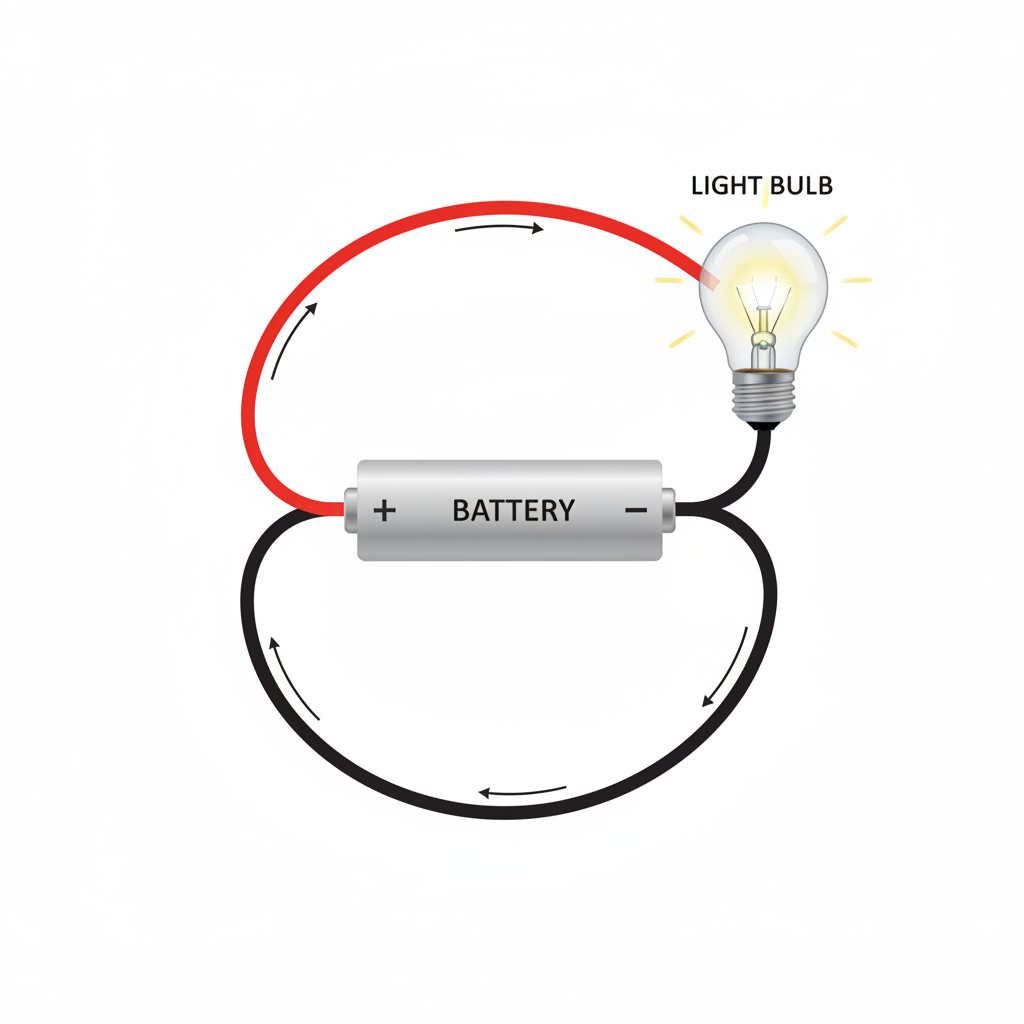
In this diagram, if the wires form a continuous loop from one end of the battery, through the bulb, and back to the other end of the battery, it's a closed circuit. The bulb will light up.
If there's a gap anywhere in that loop – maybe a wire is loose, or a switch is open – it becomes an open circuit, and the bulb won't light.
Real-World Examples
- Flashlight: When the flashlight is ON, the switch closes the circuit, allowing electricity from the batteries to flow to the bulb and make it glow. When you turn it OFF, you open the circuit, stopping the flow.
- Toaster: When you push down the lever on a toaster, you are closing a circuit. Electricity flows to the heating elements, making them red-hot to toast your bread. When the toast pops up, the circuit is opened.
- Remote Control: Pressing a button on a remote control often completes a circuit inside, sending a signal. If the battery is dead or the button is stuck, it might create an open circuit, and nothing happens.
Why is This Important?
Understanding open and closed circuits is fundamental to how almost all electrical devices work. It helps us troubleshoot when something isn't working (Is it plugged in? Is the switch on? Is there a broken wire?) and appreciate the ingenious design behind the technology we use every day.
So, remember: for electricity to do its job, it needs a complete, unbroken path – a closed circuit. Any break, and the flow stops, just like stopping the water in a river!
Keep learning, free
Create a free Syllabax account to unlock practice questions and games for this topic.
Visual Learning Enhanced! 🚀
To help you master this topic, we use Advanced Syllabax AI to generate detailed diagrams and visual models.
Note on Visuals: The AI sometimes makes spelling errors in image labels. Please refer to the lesson text for the correct terminology.