Excretion[BIOLOGY]
Watch this topic in 60 seconds
Free preview · Lesson 1
Understanding Excretion[BIOLOGY]
Understanding Excretion: Your Body's Waste Management System (Grade 10 Biology)
Imagine your house or a bustling city. What would happen if no one ever took out the trash or managed the sewage? Pretty soon, it would become a very unhealthy and unpleasant place to live, right? Your body is very much like that house or city! It's constantly working, producing energy, building new cells, and breaking down old ones. All these amazing activities generate waste products. If these wastes are allowed to build up, they can become toxic and seriously harm your health.
What is Excretion?
Simply put, excretion is the process by which living organisms get rid of waste products of metabolism. These are not just any wastes, but specifically the chemical byproducts generated inside the cells during their normal functions (metabolism). It's different from egestion, which is the removal of undigested food from the digestive tract.
Think of your body as a sophisticated chemical factory. Just like a factory produces its desired products, it also produces byproducts and waste materials that need to be safely disposed of. Excretion is your body's highly efficient waste disposal system, ensuring that your internal environment remains clean and stable – a state called homeostasis.
Why is Excretion So Important?
- Removes Toxic Substances: Many metabolic wastes, like urea, are toxic if allowed to accumulate.
- Maintains Water Balance: Your body needs just the right amount of water. Excretion helps remove excess water or conserve it when needed.
- Regulates Salt Balance: Too much or too little salt can be dangerous. Excretion ensures proper salt levels.
- Maintains pH Balance: The acidity or alkalinity (pH) of your blood must be kept within a very narrow range. Excretory organs help remove excess acids or bases.
Key Waste Products Your Body Needs to Excrete
Your body produces several types of metabolic waste that need to be removed:
- Carbon Dioxide (CO2): This is a gas produced during cellular respiration (when your cells make energy from food). It's like the exhaust fumes from a car engine.
- Urea: When your body breaks down proteins (which are essential for building and repairing tissues), it produces ammonia, a highly toxic substance. Your liver quickly converts this ammonia into a less toxic form called urea. Urea needs to be filtered out of your blood.
- Uric Acid: This is another waste product from the breakdown of nucleic acids (DNA, RNA).
- Excess Water and Salts: While essential, too much water or certain salts can disrupt your body's balance.
- Bile Pigments: These are breakdown products of old red blood cells, processed by the liver and excreted with feces, but some are also filtered by kidneys.
The Main Excretory Organs: Your Body's Cleanup Crew
Different organs specialize in removing different types of waste. Let's meet the main players:
1. The Kidneys (The Master Filters)
Your kidneys are arguably the most important excretory organs. You have two of them, bean-shaped, located on either side of your spine, just below your rib cage. Think of them as incredibly sophisticated water purification plants for your blood.
Every day, your kidneys filter about 180 liters of blood! They remove waste products like urea, uric acid, and excess salts, along with excess water, to form urine. At the same time, they make sure to reabsorb all the useful substances (like glucose, amino acids, and essential water) back into your blood. It's like a recycling center that separates the valuable materials from the trash.
Here's a simplified look at the Urinary System (which the kidneys are a part of):
- Kidneys: Filter blood and produce urine.
- Ureters: Two thin tubes that carry urine from each kidney down to the bladder. Think of them as drainpipes.
- Urinary Bladder: A muscular bag that stores urine until it's ready to be released. It's like a holding tank.
- Urethra: A tube that carries urine from the bladder out of the body. This is the final exit pipe.
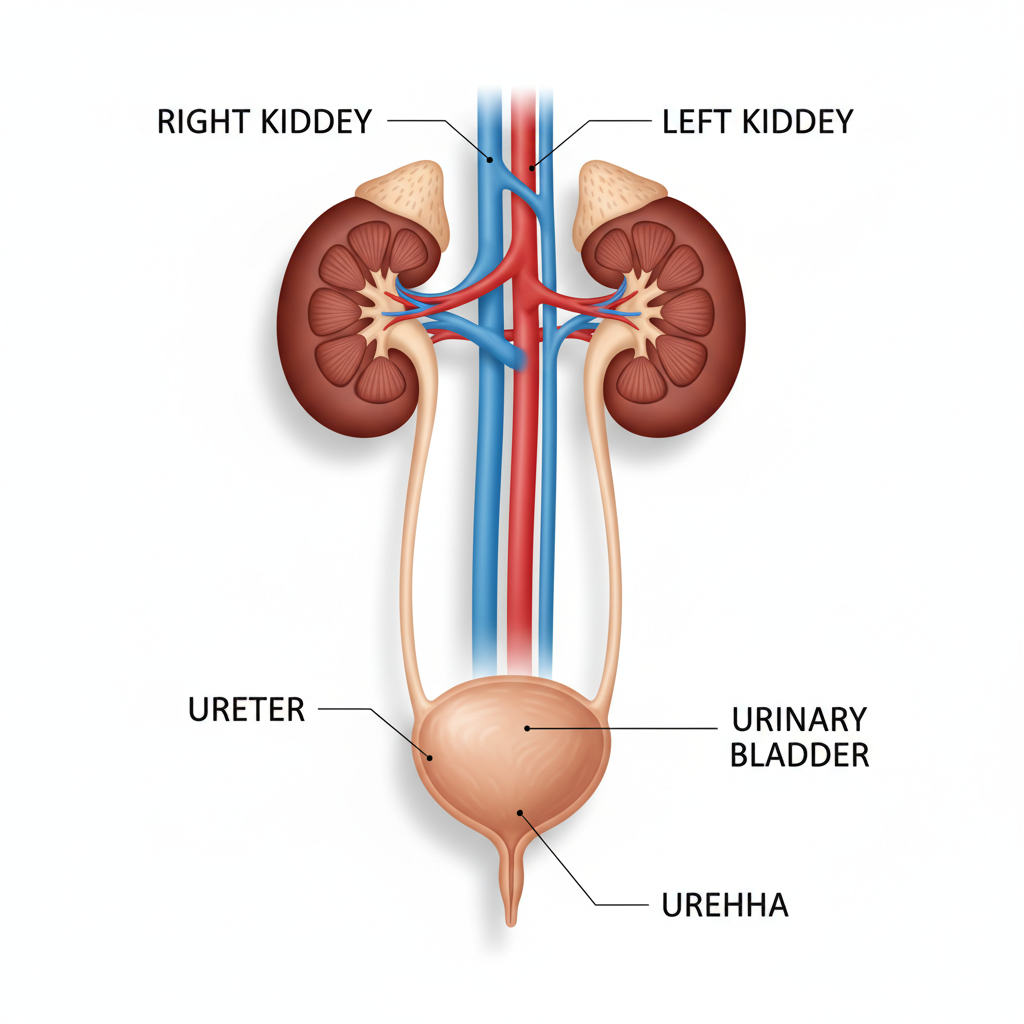 ⚠️ This picture may have spelling mistakes. Trust the words in the lesson.
2. The Lungs (The Gas Exchangers)
Your lungs are primarily known for taking in oxygen and releasing carbon dioxide, but this also makes them vital excretory organs for gaseous wastes. During cellular respiration, your body produces a lot of carbon dioxide. Your blood carries this CO2 to your lungs, where it is exhaled. Along with CO2, a small amount of water vapor is also exhaled with every breath. Think of your lungs as the exhaust pipes of your body's car engine.
3. The Skin (The Sweating System)
Your skin, covered in millions of tiny sweat glands, is another excretory organ. When you sweat, your body releases water, some salts, and a very small amount of urea. While sweating primarily helps to regulate your body temperature (like a radiator for your body), it also serves a minor excretory function. It's like a small overflow valve that helps release some extra liquid and salts.
4. The Liver (The Detoxifier)
While not directly excreting wastes out of the body in the same way as the kidneys or lungs, the liver plays a crucial role in excretion by transforming toxic substances into less harmful ones that can then be excreted by the kidneys. For example, it converts toxic ammonia into urea. It also breaks down old red blood cells and detoxifies drugs and alcohol. So, think of your liver as the body's main processing plant, preparing waste for removal.
Excretion and Homeostasis
The coordinated work of all these excretory organs is essential for maintaining homeostasis – the stable internal environment that allows your cells and organs to function optimally. Without effective waste removal, your body's delicate balance would be disturbed, leading to illness and eventual system failure.
So, the next time you take a deep breath, or use the restroom, remember the incredible and tireless work your excretory system is doing to keep you healthy and clean from the inside out!
Keep learning, free
Create a free Syllabax account to unlock practice questions and games for this topic.
Visual Learning Enhanced! 🚀
To help you master this topic, we use Advanced Syllabax AI to generate detailed diagrams and visual models.
Note on Visuals: The AI sometimes makes spelling errors in image labels. Please refer to the lesson text for the correct terminology.