Types of Data: Numerical
Watch this topic in 60 seconds
Free preview · Lesson 1
Understanding Types of Data: Numerical
Understanding Numerical Data: Counting and Measuring Our World!
Hey Super Statisticians! Get ready to explore a fascinating world where numbers tell us amazing stories. Imagine you're a detective, and numbers are clues. To understand these clues, we first need to know what kind of numbers they are. Today, we're going to dive deep into "Numerical Data" – which simply means data made of numbers!
What is Data, Anyway?
Think of "data" as just information or facts. Every time you count something, measure something, or even just look at numbers, you're gathering data. For example, the number of sunny days in a month is data. The temperature outside is data. Your height is data!
Numerical Data: Numbers That Tell a Story
Numerical data is special because it's all about numbers that represent quantities. That means numbers that show "how much" or "how many." It's not about categories like "red" or "blue" (that's another type of data!). Numerical data is like using a ruler or counting on your fingers.
Analogy Time! Imagine you're at a birthday party. If you count how many balloons there are, that's numerical data. If you measure how tall the birthday cake is, that's also numerical data. It's all about numbers that can be added, subtracted, multiplied, or divided to make sense!
Two Main Kinds of Numerical Data: Discrete and Continuous
Now, here's where it gets really interesting! Numerical data comes in two main flavors, like two different kinds of yummy ice cream. We have Discrete numerical data and Continuous numerical data. They both use numbers, but they use them in slightly different ways.
1. Discrete Numerical Data: The "Counting" Numbers
Think of Discrete data as numbers you get from counting. These are usually whole numbers (like 1, 2, 3, 4, and so on) that can't be broken down into smaller pieces easily. You can't have half a person or 2.7 apples!
Analogy Time! Imagine you're counting your toy cars. You have 1 car, 2 cars, 3 cars... You don't have 2.5 cars! That's discrete data. Another way to think about it is like hopping on stepping stones – you land on one stone, then the next, without stepping in between.
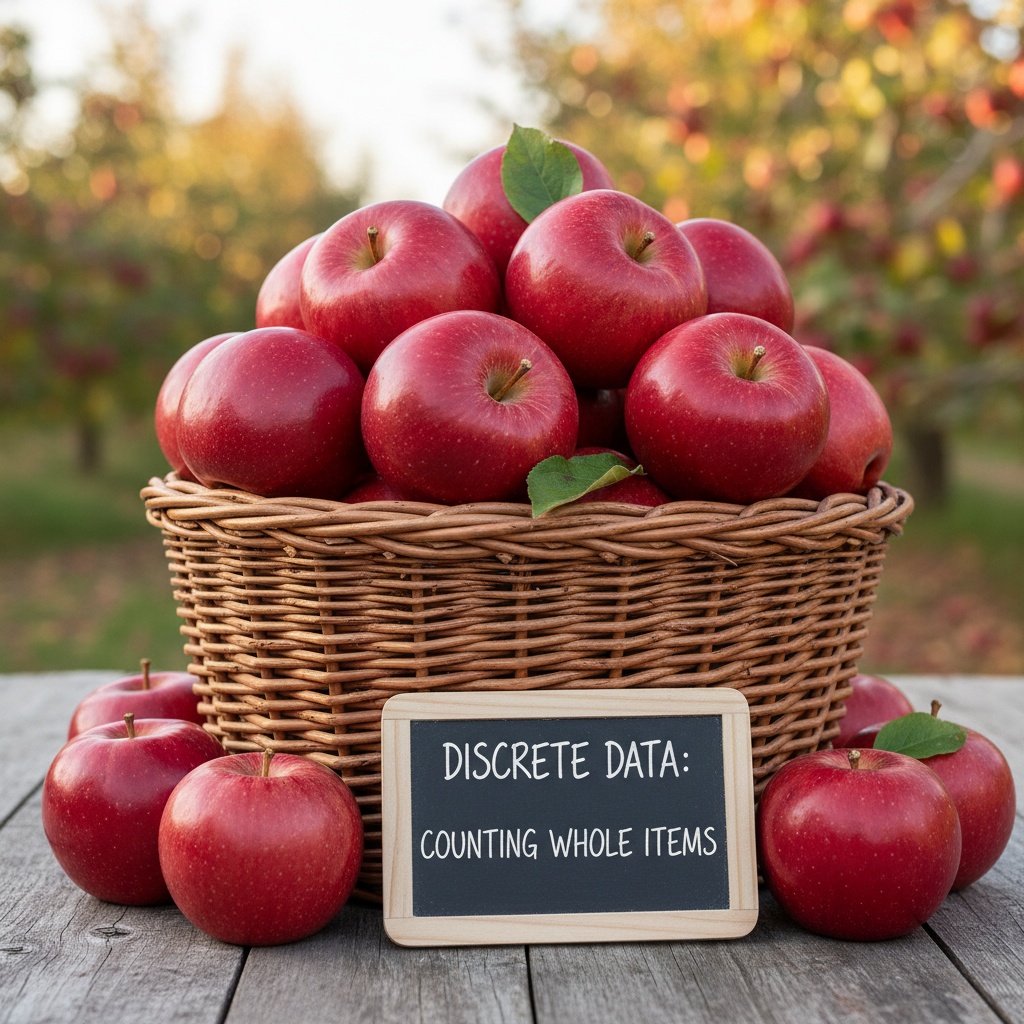
Key Characteristics of Discrete Data:
- You get it by counting things.
- It takes on specific, separate values (usually whole numbers).
- There are often gaps between possible values (e.g., you can have 2 siblings or 3 siblings, but not 2.5 siblings).
Examples of Discrete Data:
- The number of students in your classroom. (You can't have half a student!)
- The number of goals scored in a soccer game.
- The number of pets you have.
- The number of books on a shelf.
2. Continuous Numerical Data: The "Measuring" Numbers
Now let's talk about Continuous data. This is data you get from measuring things. Unlike discrete data, continuous data can take on any value within a certain range. It can have decimals, fractions, and be super precise! Think of measuring with a ruler or a thermometer.
Analogy Time! Imagine you're measuring your height. You might be 4 feet tall, but you could also be 4 feet and 3.5 inches, or 4 feet and 3.57 inches! Your height can be any tiny measurement in between. It's like a ramp where you can stop anywhere, not just on specific steps.
Key Characteristics of Continuous Data:
- You get it by measuring things.
- It can take on any value within a range (including decimals and fractions).
- There are no gaps between possible values; you can always find a value in between two others.
Examples of Continuous Data:
- Your height.
- Your weight.
- The temperature outside.
- The amount of milk in a carton.
- The time it takes to run a race.
How to Tell Them Apart: Count vs. Measure
The easiest way to remember the difference is this:
- If you count it, it's probably Discrete.
- If you measure it, it's probably Continuous.
It's like asking "How many?" versus "How much?" or "How long?"
Why is This Important?
Knowing the difference between discrete and continuous numerical data helps us understand the information better. It helps scientists, mathematicians, and even everyday people make better decisions and understand the world around them. For example, if you're planning a party, knowing the number of guests (discrete) is different from knowing the amount of juice each guest drinks (continuous)!
Let's Review!
Numerical data is all about numbers! It helps us understand "how much" or "how many."
- Discrete Data: You count it. It's usually whole numbers, like the number of books or the number of friends.
- Continuous Data: You measure it. It can be any value, including decimals, like your height or the temperature.
You are now a data expert! Keep an eye out for numbers in your daily life and see if you can figure out if they are discrete or continuous.
Keep learning, free
Create a free Syllabax account to unlock practice questions and games for this topic.
Visual Learning Enhanced! 🚀
To help you master this topic, we use Advanced Syllabax AI to generate detailed diagrams and visual models.
Note on Visuals: The AI sometimes makes spelling errors in image labels. Please refer to the lesson text for the correct terminology.