Reading hour hand (intro) (Time)
Watch this topic in 60 seconds
Free preview · Lesson 1
Understanding Reading hour hand (intro) (Time)
Learning to Tell Time: The Amazing Hour Hand!
Hello, young learners! Today, we're going on an exciting adventure to understand something super important: how to read a clock! Clocks help us know when it's time to play, time to eat, and time to snuggle up for a good night's sleep. Our special helper today is the hour hand. Imagine it's like a tiny, slow-moving superhero on the clock face!
What is the Hour Hand?
A clock usually has two or three hands that move around. One is long and thin, and the other is shorter and fatter. The hour hand is the shorter, fatter one. It's like the slow and steady tortoise in the race, always moving carefully to tell us about the 'big' part of the time – the hour!
Think of the numbers on the clock face, from 1 all the way to 12. These numbers are like little houses for our hour hand. When the hour hand points directly at one of these numbers, it means that hour has arrived!
How the Hour Hand Moves
The hour hand moves very slowly. It takes a whole hour for it to move from one number to the very next number. Imagine you're walking to your friend's house, and it takes you one hour to get there. That's how the hour hand moves! It takes its time.
So, if the hour hand is pointing at the 3, it means it's 3 o'clock. If it moves all the way to the 4, it means it's 4 o'clock. It doesn't jump quickly; it glides smoothly from one number to the next.
Reading the Clock with the Hour Hand
Let's look at a clock. You'll see numbers 1, 2, 3, 4, 5, 6, 7, 8, 9, 10, 11, and 12. These are the hours!
The hour hand is the shorter hand. When you want to know what hour it is, you look at where the hour hand is pointing.
- If the short hand (the hour hand) points right at the 7, it's 7 o'clock.
- If the short hand points right at the 11, it's 11 o'clock.
- If the short hand points right at the 2, it's 2 o'clock.
It's that simple! The hour hand tells us the main part of the time.
In the picture above, see how the short, fat hand is pointing right at the number 3? That means it is 3 o'clock! The long, thin hand (we call that the minute hand, but we'll learn about that another day!) is pointing straight up at the 12. When the minute hand is on the 12, it means it's exactly 'o'clock'. So, this clock shows 3 o'clock.
When the Hour Hand is Between Numbers
Sometimes, the hour hand might be moving between two numbers. Remember how it moves slowly? If the hour hand has passed the 3 but hasn't reached the 4 yet, it means it's still in the 3 o'clock hour. It's like when you're walking home from school. If you've left school but haven't reached your house yet, you are still 'on your way home' from school. You're not home yet, but you're also not at school anymore.
So, if the hour hand is between the 5 and the 6, it means it is still in the 5 o'clock hour. It will become 6 o'clock only when the hour hand reaches the 6.
Let's Practice!
Look at the clock. Find the shorter hand. That's our hour hand!
Where is it pointing?
- If it points at 9, it's 9 o'clock.
- If it points at 1, it's 1 o'clock.
- If it points at 6, it's 6 o'clock.
The hour hand is like the leader of the time parade! It leads the way to tell us which hour we are in. Even though it's slow, it's very important!
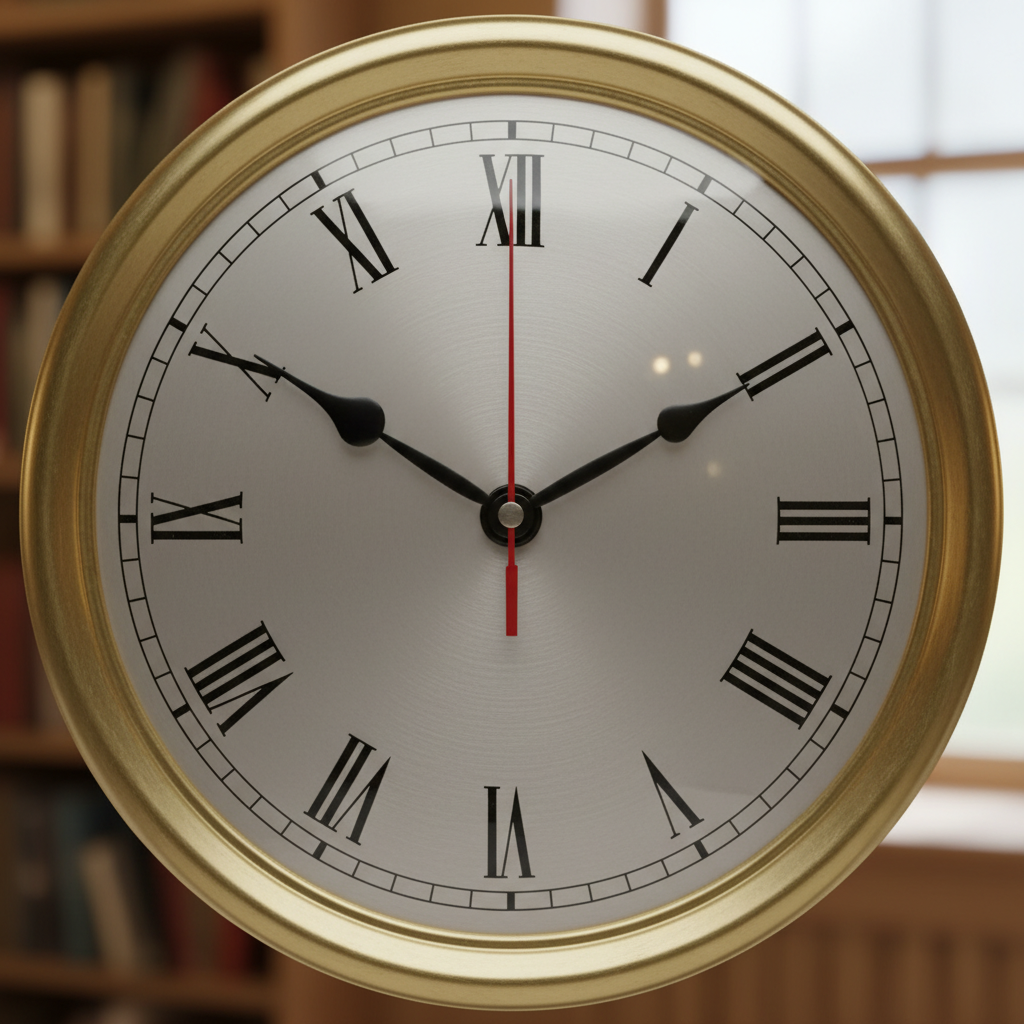 ⚠️ This picture may have spelling mistakes. Trust the words in the lesson.
In this picture, the short hand is pointing right at the number 9. This tells us it is 9 o'clock!
Summary
The hour hand is the shorter, fatter hand on a clock. It moves slowly and points to the numbers 1 through 12 to tell us the hour. When the hour hand points directly at a number, it is that exact hour (like 5 o'clock). When it's between two numbers, it's still in the earlier hour's time.
Keep learning, free
Create a free Syllabax account to unlock practice questions and games for this topic.
Visual Learning Enhanced! 🚀
To help you master this topic, we use Advanced Syllabax AI to generate detailed diagrams and visual models.
Note on Visuals: The AI sometimes makes spelling errors in image labels. Please refer to the lesson text for the correct terminology.