Learning Journey
Free preview · Lesson 1
Understanding Straight & curved lines (Lines & Angles)
Exploring Lines: Straight and Curved! (Grade 3)
Hello, young explorers! Today, we're going on an exciting adventure to discover the amazing world of lines. Lines are everywhere around us, and they come in different shapes and sizes. We'll be focusing on two main types of lines: straight lines and curved lines. Get ready to see them in a whole new way!
What is a Line?
Imagine a tiny ant walking across a piece of paper. If the ant walks in a perfectly straight path without turning, that's like a straight line. If the ant wiggles and turns and goes around in circles, that's like a curved line.
In math, a line is like a path that goes on forever in both directions. But for us, we'll be looking at parts of lines, like line segments. Think of it as the path the ant walked from one spot to another.
Straight Lines: The Super Speedy Slides!
Straight lines are like the fastest way to get from one point to another. They don't bend or wiggle. Think about:
- A ruler: It's perfectly straight, right?
- A stretched rubber band: When you pull it tight, it forms a straight line.
- A fence: The beams of a fence usually go straight up and down or straight across.
- A slide at the playground: When you go down a straight slide, you're following a straight line!
- A noodle: Some noodles, like spaghetti, are straight before you cook them!
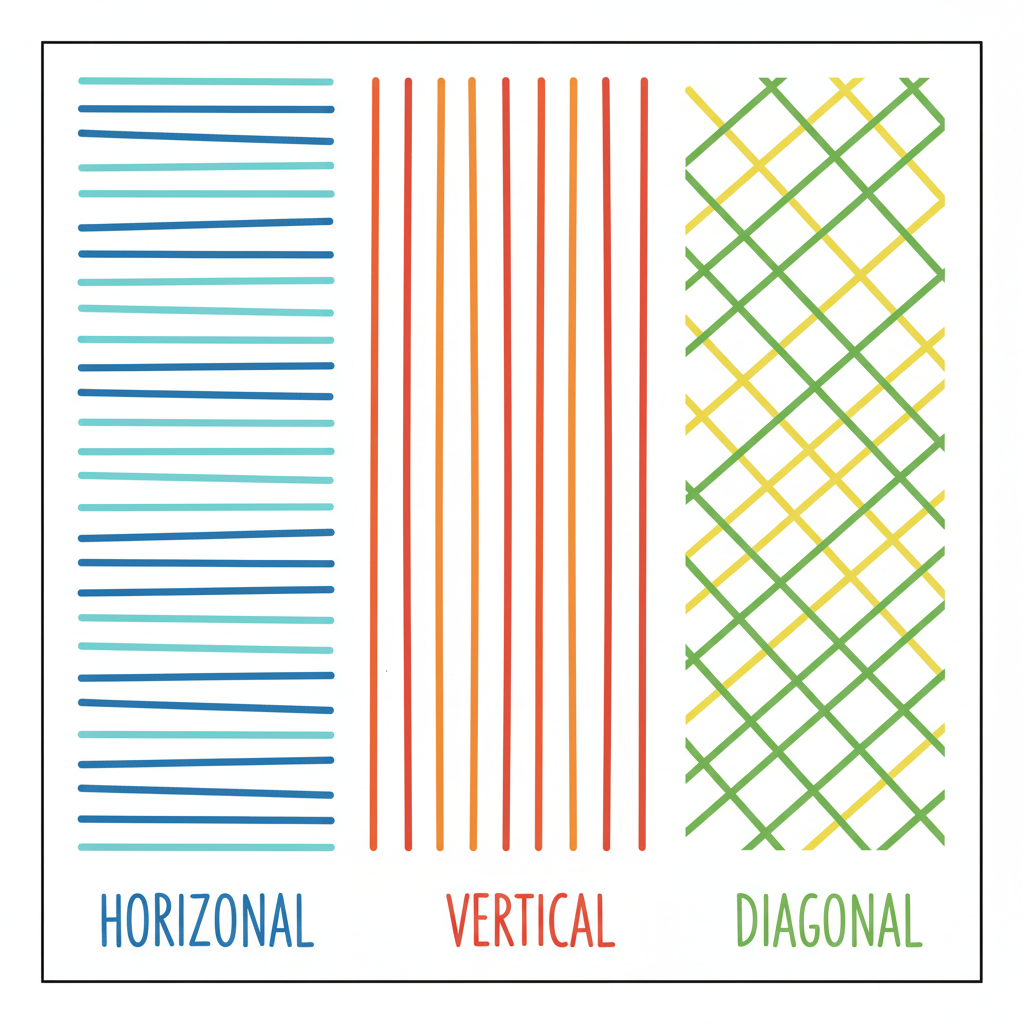
Straight lines can go in different directions:
- Horizontal Lines: These lines go side to side, like the horizon you see when you look out at the ocean. They are also like railroad tracks, running parallel to each other. Think of a sleeping cat – it's lying in a horizontal position.
- Vertical Lines: These lines go up and down, like a tall tree or a flagpole. They stand straight and tall. Think of a superhero standing ready for action – they are standing in a vertical position.
- Diagonal Lines: These lines go slanted, neither straight up-and-down nor straight side-to-side. They are like a ski slope or the ramp to a skateboard park. They connect two points at an angle.
We can draw straight lines using a ruler to make them extra neat, but sometimes we can draw them freehand, like drawing a quick arrow.
Curved Lines: The Wobbly Wonders!
Curved lines are the opposite of straight lines. They bend, loop, and wiggle. They don't take the shortest path. Think about:
- A rainbow: After it rains, you might see a beautiful, curved rainbow in the sky.
- A banana: That yummy fruit has a wonderful curve to it.
- A snake: When a snake slithers, it moves in curvy patterns.
- A Ferris wheel: The path you take on a Ferris wheel is a big curve.
- A river: Rivers often twist and turn as they flow to the sea.
- A smiley face: The smile itself is a curved line!
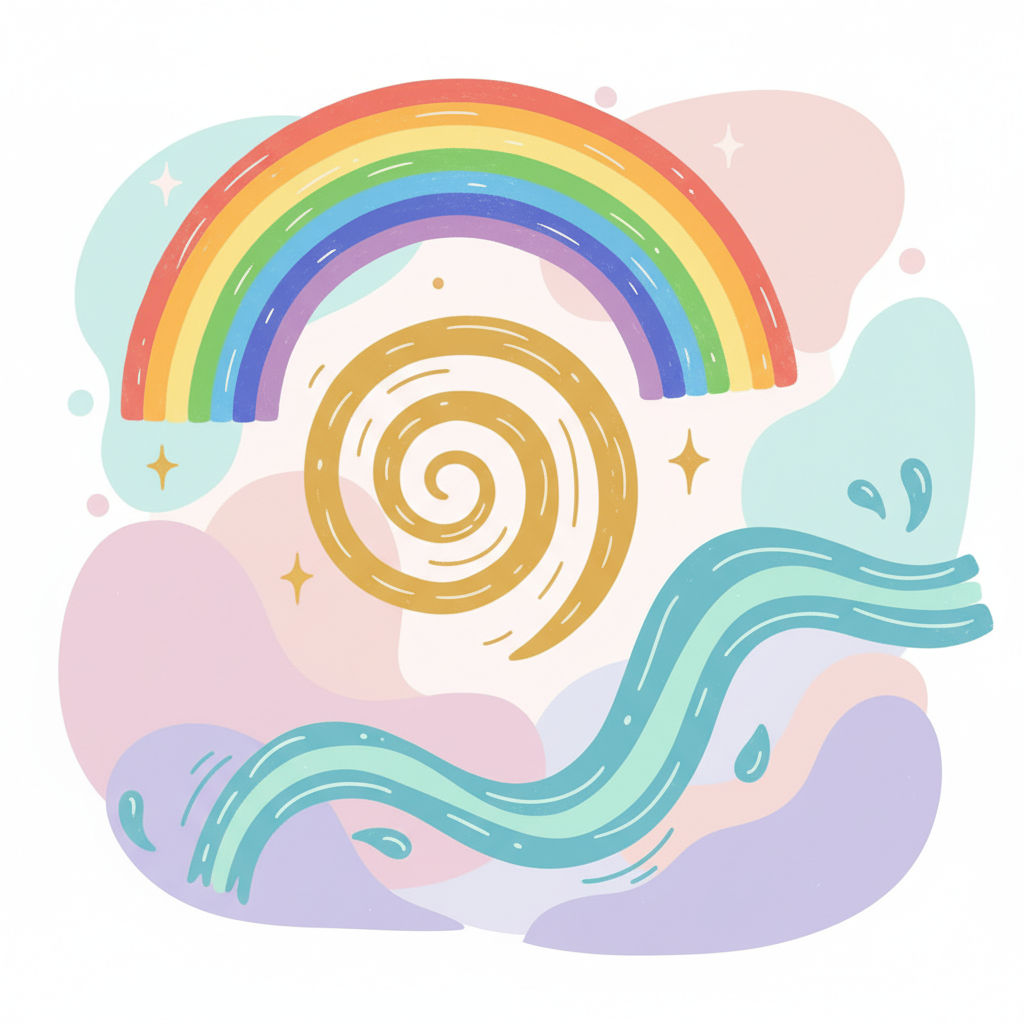
Curved lines can be:
- Simple Curves: These are smooth bends, like the edge of a circle or a gentle hill.
- Wavy Lines: These look like waves in the ocean, going up and down in a repeating pattern.
- Spiral Lines: These lines start from a point and wind outwards or inwards, like the shell of a snail or the uncoiled spring from a pen.
We often see curved lines in nature and in things people make. They can make things look soft and flowing.
 ⚠️ This picture may have spelling mistakes. Trust the words in the lesson.
Straight vs. Curved: What's the Difference?
The biggest difference is how they travel! Straight lines go in one direction without any turns. Curved lines bend and change direction.
Let's think of some more examples:
- Straight: A path in a park that goes directly to a bench.
- Curved: A path in a park that winds around a pond.
- Straight: The edge of a book.
- Curved: The edge of a ball.
Why Learn About Lines?
Understanding straight and curved lines helps us describe the world around us! It helps us draw, build, and even understand maps. When you look at a picture, you can point out all the straight lines and all the curved lines you see. It's like learning a secret code to understand shapes!
So, the next time you see a road, a river, a slide, or even a piece of spaghetti, think about whether the line is straight or curved. You're becoming a line expert!
Keep learning, free
Create a free Syllabax account to unlock practice questions and games for this topic.
Visual Learning Enhanced! 🚀
To help you master this topic, we use Advanced Syllabax AI to generate detailed diagrams and visual models.
Note on Visuals: The AI sometimes makes spelling errors in image labels. Please refer to the lesson text for the correct terminology.