Important salts: washing soda, baking soda, gypsum[CHEMISTRY]
Watch this topic in 60 seconds
Free preview · Lesson 1
Understanding Important salts: washing soda, baking soda, gypsum[CHEMISTRY]
Important Salts: Washing Soda, Baking Soda, and Gypsum (Grade 10 Chemistry)
Welcome, future chemists! Today, we're going to explore some amazing and incredibly useful substances that we often encounter in our daily lives but might not fully understand: important salts. Think of salts not just as the seasoning you put on your food (though that's one type!), but as a large family of chemical compounds formed when an acid reacts with a base. Each member of this family has unique superpowers and applications. We'll be focusing on three super-salts: Washing Soda, Baking Soda, and Gypsum.
What are Salts? (A Quick Refresher)
Imagine you have a team of two different types of chemicals: acids (like lemon juice) and bases (like soap). When these two teams meet and react, they neutralize each other, and one of the main products they create is a 'salt' along with water. So, a salt is essentially an ionic compound made up of a positive ion (cation) from a base and a negative ion (anion) from an acid.
Some salts are found naturally in the Earth, dissolved in oceans, or mined from the ground. Others are made in factories. They all have different properties and different jobs!
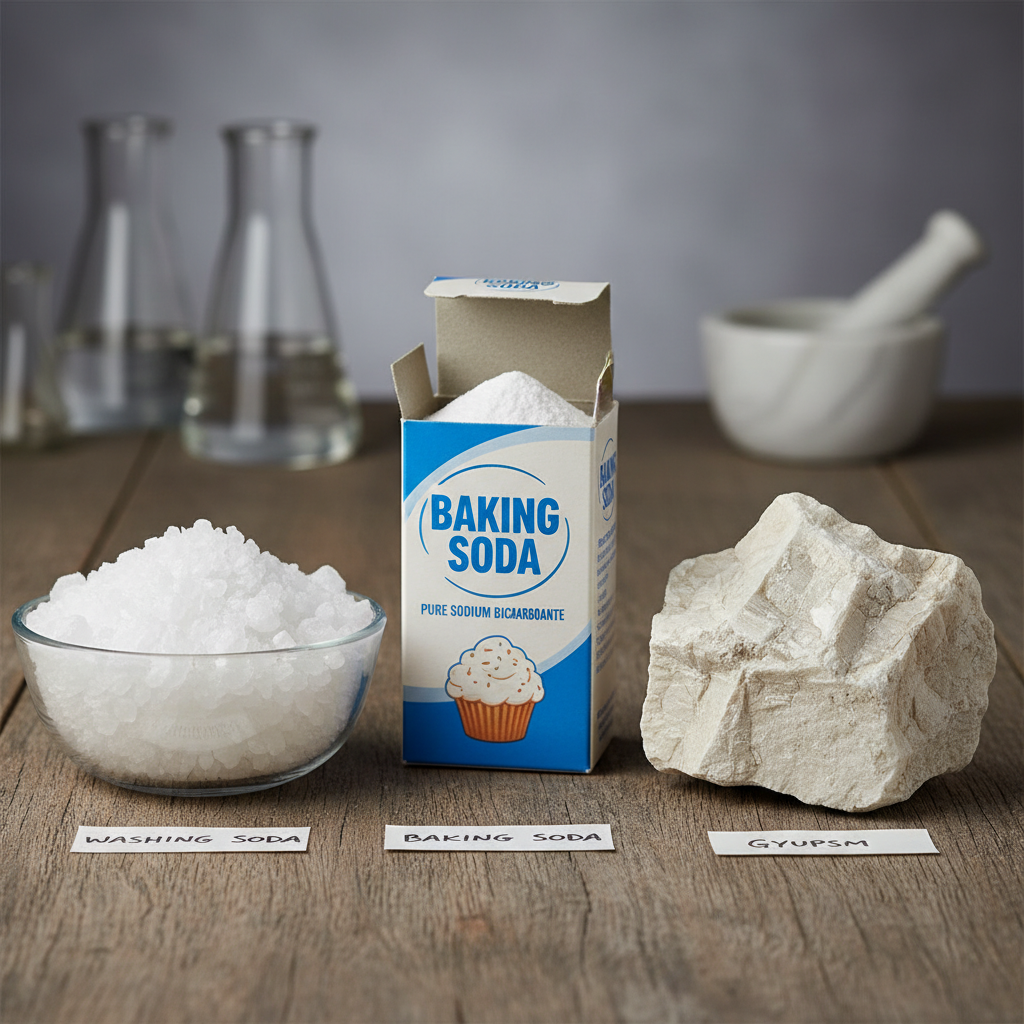 ⚠️ This picture may have spelling mistakes. Trust the words in the lesson.
1. Washing Soda (The Heavy-Duty Cleaner)
What is it?
- Chemical Name: Sodium Carbonate Decahydrate
- Chemical Formula: Na2CO3·10H2O
- Common Name: Washing Soda or Soda Ash (when anhydrous, meaning without water)
Imagine you have a superhero in your cleaning arsenal that's incredibly good at tackling tough dirt, grease, and grime. That's Washing Soda! It's a white, crystalline solid that looks a bit like sugar, but please don't taste it!
How does it work? (Its Superpowers!)
- Powerful Cleaning Agent: When you dissolve washing soda in water, it forms an alkaline (basic) solution. This basic nature helps it break down fats, oils, and grease, making them easier to wash away. Think of it like a special soap designed for really stubborn messes – it can dissolve even the stickiest substances!
- Water Softener: This is one of its most important jobs! Have you ever noticed that soap doesn't lather well in some water? That's 'hard water,' which contains dissolved minerals like calcium and magnesium. These minerals react with soap, forming a scum instead of bubbles. Washing soda comes to the rescue! It reacts with the calcium and magnesium ions in hard water, forming insoluble compounds that sink to the bottom. This effectively 'softens' the water, allowing your soap and detergents to work much better. It's like washing soda 'eats' the hard water minerals so your soap can focus on cleaning!
Where do we use it? (Its Missions)
- Laundry Detergents: A key ingredient in many laundry powders and dishwashing detergents.
- Glass Industry: Used in the manufacture of glass.
- Soap and Paper Manufacturing: An important chemical in producing soap and paper.
- Cleaning Agent: Used for general household cleaning, especially for greasy surfaces.
2. Baking Soda (The Versatile Helper)
What is it?
- Chemical Name: Sodium Bicarbonate
- Chemical Formula: NaHCO3
- Common Name: Baking Soda
Baking Soda is probably the most famous and versatile salt in your kitchen cabinet. It's a fine, white powder that might look unassuming, but it packs a punch with its many uses!
How does it work? (Its Superpowers!)
- Leavening Agent (Making things rise!): This is its star role in baking. When baking soda is mixed with an acid (like buttermilk, yogurt, or vinegar) and/or heated, it produces carbon dioxide (CO2) gas. These tiny gas bubbles get trapped in batter or dough, causing it to expand and become light and fluffy. It's like a tiny, invisible air pump for your cakes and cookies! Without it, your muffins would be flat and dense.
- Antacid: If you've ever had a stomach ache from too much acid, baking soda can help! It's a mild base, so it can neutralize excess stomach acid, providing relief. Think of it as putting out a small fire in your stomach.
- Fire Extinguisher: Remember that carbon dioxide gas? It's heavier than air and doesn't support combustion. When baking soda is sprinkled on small fires (like grease fires), it decomposes and releases CO2, which smothers the flames by cutting off their oxygen supply. It's like blanketing the fire with an invisible gas.
- Deodorizer: Baking soda is excellent at absorbing odors. Its slightly alkaline nature reacts with acidic odor molecules, neutralizing them. That's why you often see an open box in refrigerators!
Where do we use it? (Its Missions)
- Baking: Cakes, cookies, bread, muffins, pancakes – practically anything that needs to rise!
- Medicine: As an antacid for indigestion.
- Cleaning: A gentle abrasive cleaner for various surfaces.
- Odor Control: In refrigerators, shoes, carpets, and as a natural deodorant.
- Fire Safety: For extinguishing small grease or electrical fires.
3. Gypsum (The Shapeshifter Mineral)
What is it?
- Chemical Name: Calcium Sulfate Dihydrate
- Chemical Formula: CaSO4·2H2O
- Common Name: Gypsum
Gypsum is a soft, white mineral that's found naturally in rocks. It's a hydrated salt, meaning it has water molecules chemically bonded within its crystal structure (two water molecules for every calcium sulfate molecule, as shown in its formula).
How does it work? (Its Superpowers!)
- Making Plaster of Paris (POP): This is gypsum's most famous transformation! When gypsum is heated carefully to about 100°C (373 K), it loses about three-quarters of its water molecules. This partially dehydrated form is called Plaster of Paris (POP). Its chemical formula is CaSO4·½H2O. So, gypsum is like a soft, moist clay, and when you heat it, it turns into a magical powder (POP) that's ready for its next trick!
- Rehydration and Hardening: When you mix Plaster of Paris with water, it quickly reabsorbs the lost water molecules and sets into a hard, solid mass. This reaction is exothermic (releases heat). This rapid hardening property is what makes POP so incredibly useful. It's like POP is a quick-setting concrete that you can mold before it hardens!
Where do we use it? (Its Missions)
- Medical Casts: If you've ever broken a bone, you might have worn a cast made of Plaster of Paris. It molds perfectly to the limb and then hardens, keeping the bone in place for healing.
- Statues and Decorative Items: Artists and sculptors use POP to create beautiful statues, intricate molds, and decorative ceiling designs due to its ability to be cast into various shapes.
- Fireproofing Material: POP can act as a fire-resistant material because when heated, it releases its water content as steam, which helps to cool the surface and slow down the spread of fire.
- Building Materials: Gypsum itself is used to make drywall or plasterboards for walls and ceilings in homes and buildings.
- Fertilizer: Gypsum is sometimes added to soil to improve its structure and provide calcium and sulfur, which are important nutrients for plants.
- Cement Manufacturing: A small amount of gypsum is added to cement to slow down its setting time, making it easier to work with.
Conclusion
From cleaning our clothes and cooking our food to healing bones and building houses, these important salts – washing soda, baking soda, and gypsum – play crucial roles in our daily lives and various industries. Understanding their chemical compositions and properties helps us appreciate the science behind their everyday magic!
Keep learning, free
Create a free Syllabax account to unlock practice questions and games for this topic.
Visual Learning Enhanced! 🚀
To help you master this topic, we use Advanced Syllabax AI to generate detailed diagrams and visual models.
Note on Visuals: The AI sometimes makes spelling errors in image labels. Please refer to the lesson text for the correct terminology.