What is Data?
Watch this topic in 60 seconds
Free preview · Lesson 1
Understanding What is Data?
Unlocking the Secrets: What is Data? (Grade 6)
Hey there, future super-thinkers and curious minds! Have you ever wondered how your favorite video game knows your high score, or how your teacher knows how many students prefer pizza for lunch? The answer is simple yet powerful: Data!
Imagine you're a detective, trying to solve a mystery. What's the first thing you do? You look for clues, right? You gather information like footprints, fingerprints, witness statements, or the time the cookies disappeared from the jar. Well, in the world of computers and understanding the world around us, these 'clues' are what we call data.
What Exactly IS Data?
At its core, Data is simply information, facts, or observations that we collect. It can be anything from numbers, words, pictures, sounds, or even how fast a car is moving. Think of it like this:
- The number of students in your class is data.
- The color of your shoes is data.
- The temperature outside right now is data.
- Your favorite animal is data.
Analogy Time! Data as Ingredients
Let's pretend you're going to bake a delicious cake. What do you need? Flour, sugar, eggs, milk, chocolate chips, and a recipe, right? Each of these individual items – the flour, the sugar, the number of eggs – are like data points. By themselves, a spoonful of flour isn't a cake. But when you gather all the ingredients (data) and follow the recipe (process), you get a wonderful cake (useful information or knowledge)! So, data are the raw ingredients of information.
Two Big Kinds of Data
Just like there are different kinds of ingredients (some are liquids, some are dry), there are different kinds of data:
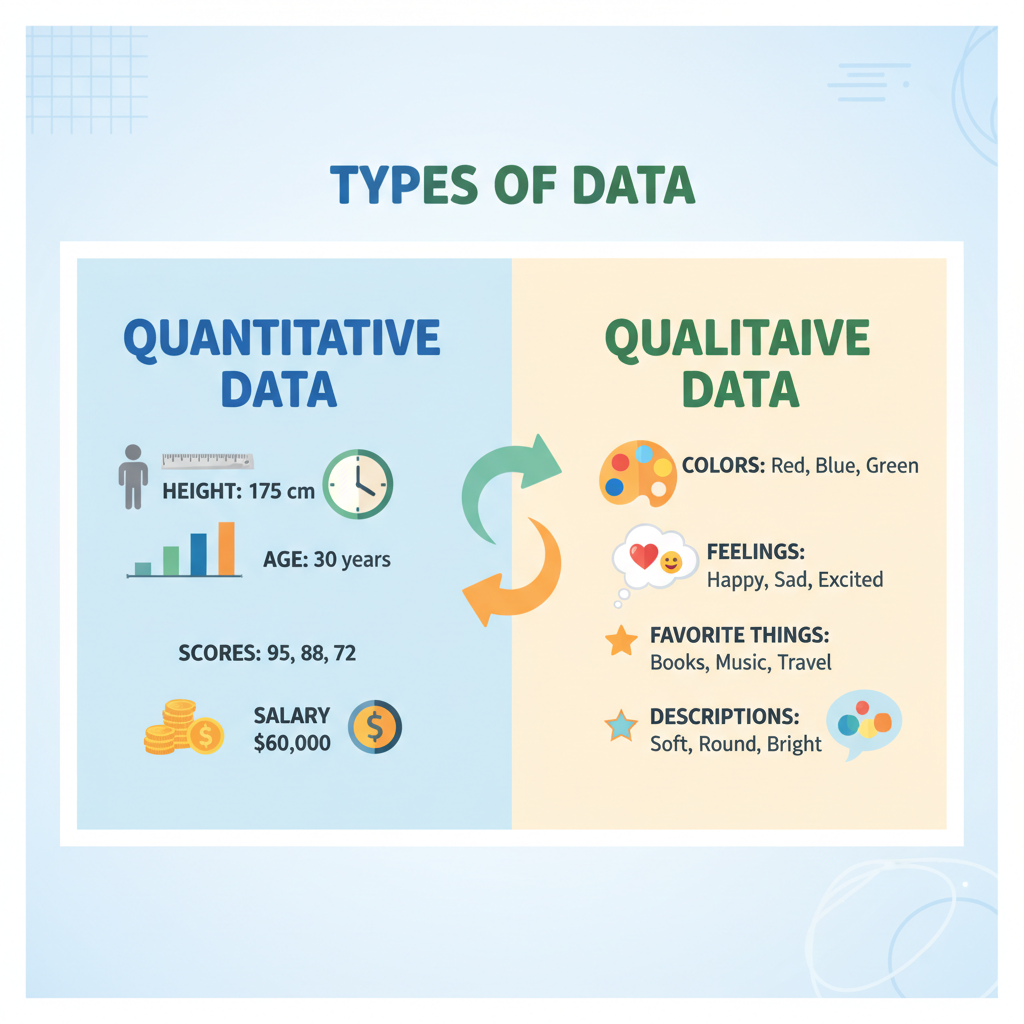
1. Number Data (Quantitative Data)
This is data that you can count or measure. It answers questions like "how many?" or "how much?".
- Examples: Your height (60 inches), your age (11 years old), the number of points your team scored (25 points), the price of a toy ($15.99).
- Analogy: Think of a measuring tape or a ruler. It gives you numbers that tell you size, length, or distance.
2. Description Data (Qualitative Data)
This is data that describes qualities or characteristics. It tells you about things you can observe but can't easily count with a number. It answers questions like "what kind?" or "what color?".
- Examples: The color of your backpack (blue), your favorite subject (science), the feeling of happiness, the taste of a sweet apple.
- Analogy: Imagine describing your best friend to someone who's never met them. You'd talk about their hair color, their friendly smile, their kind personality. These descriptions are all qualitative data.
Here's a visual to help you remember the different types of data:
How Do We Get Data? (Collecting Data)
Data doesn't just appear out of nowhere! We have to collect it. Think of yourself as a super data collector! We collect data in many ways:
- Observing: Watching how many cars pass your house in an hour.
- Measuring: Using a ruler to find the length of your desk.
- Asking Questions: Doing a survey to find out everyone's favorite ice cream flavor.
- Experimenting: Seeing how quickly different plants grow with different amounts of water.
Every time you look at a clock, count your steps, or even notice what kind of shoes your friends are wearing, you're collecting data!
Why is Data So Important?
So, we've collected all these 'clues' and 'ingredients'. What's next? We use data to understand things, make decisions, and solve problems!
- Understanding the World: Data about weather helps scientists predict if it will rain tomorrow.
- Making Decisions: Your school might collect data on what foods students like to decide what to serve for lunch.
- Solving Problems: If a game is crashing a lot, game developers collect data on when and why it crashes to fix the problem.
Analogy: Imagine you're planning a trip to a new city. You wouldn't just pack a random bag, would you? You'd look at data: the weather forecast (temperature, rain), what kinds of activities you'll do (hiking, museum), and how long you'll be there. This data helps you pack the right clothes and plan your trip perfectly!
Putting it all Together
Data is everywhere, and it's super important for helping us learn, explore, and make smart choices. From the number of stars in the sky to the color of your socks, it's all data waiting to be discovered and used!
Keep learning, free
Create a free Syllabax account to unlock practice questions and games for this topic.
Visual Learning Enhanced! 🚀
To help you master this topic, we use Advanced Syllabax AI to generate detailed diagrams and visual models.
Note on Visuals: The AI sometimes makes spelling errors in image labels. Please refer to the lesson text for the correct terminology.