Types of triangles (Triangle Properties)
Watch this topic in 60 seconds
Free preview · Lesson 1
Understanding Types of triangles (Triangle Properties)
Welcome to the World of Triangles!
Hey there, future geometry gurus! Have you ever looked around and noticed shapes everywhere? From the slices of pizza you eat, to the roof of a house, to the yield signs on the road – triangles are everywhere! But did you know that not all triangles are the same? Just like people have different personalities or families have different members, triangles come in all shapes and sizes, each with its own special characteristics. Today, we're going on an adventure to discover the fascinating world of triangles and learn how to tell them apart.
What Exactly IS a Triangle?
Before we dive into their different types, let's make sure we know what a triangle is. Imagine you have three straight sticks. If you connect the ends of these sticks together, you've made a triangle! It's a flat shape (like a drawing on paper) that has:
- Three Sides: These are the 'sticks' you connected.
- Three Vertices: These are the 'corners' where the sticks meet. Think of them as the pointy ends.
- Three Angles: These are the 'openings' or 'bends' at each corner. If you open your fingers a little, that's an angle!
The word "triangle" itself gives us a clue: "tri" means three, and "angle" refers to the corners. So, it's literally a "three-angle" shape!
The Golden Rule of Triangles: The Angle Sum!
No matter what kind of triangle you have, there's a super important secret they all share: If you add up all three angles inside any triangle, they will ALWAYS total exactly 180 degrees!
Think of it like a magic number or a secret code that every triangle knows. If you tear off the corners of any paper triangle and put them together, they'll always form a perfectly straight line, which is 180 degrees. This rule is like the universal law of triangles!
How Do We Classify Triangles? Two Big Ways!
We can sort triangles into different groups based on two main things:
- By the length of their sides (how long each 'stick' is).
- By the size of their angles (how wide or narrow their 'corners' are).
Type 1: Triangles Classified by Their Side Lengths
Imagine you're building with LEGOs. Sometimes you use three identical long bricks, sometimes two long and one short, and sometimes three totally different bricks. Triangles are similar!
1. Equilateral Triangles: The "Perfectly Balanced" Team
- Definition: An equilateral triangle has all three sides equal in length.
- Analogy: Think of an equilateral triangle as a perfectly balanced team where everyone is exactly the same height and strength. No one is taller or shorter; they are all equal!
- Angle Fact: Because all sides are equal, all three angles inside an equilateral triangle are also equal. Since they must add up to 180 degrees, each angle is always 60 degrees (180 / 3 = 60).
- Example: A warning sign for a pedestrian crossing sometimes looks like an equilateral triangle.
2. Isosceles Triangles: The "Twins and a Unique One" Family
- Definition: An isosceles triangle has at least two sides that are equal in length. (Sometimes people say exactly two, but mathematically, equilateral is a special type of isosceles too!). We'll focus on "at least two."
- Analogy: Imagine a family with identical twins and one older sibling who looks a bit different. Two sides are exactly the same, and the third side is usually different.
- Angle Fact: The angles opposite the two equal sides are also equal. These are called the "base angles."
- Example: The roof of a simple house often forms an isosceles triangle.
3. Scalene Triangles: The "Completely Unique" Individuals
- Definition: A scalene triangle has no sides equal in length. All three sides are different lengths.
- Analogy: Think of a group of three best friends where each person is a completely unique individual – different height, different hair color, different favorite food. No two are alike!
- Angle Fact: Because all sides are different, all three angles inside a scalene triangle are also different from each other.
- Example: If you slice a piece of cheese randomly, you might get a scalene triangle.
Type 2: Triangles Classified by Their Angles
Now, let's look at the corners or 'bends' of our triangles. Angles tell us a lot about a triangle's personality!
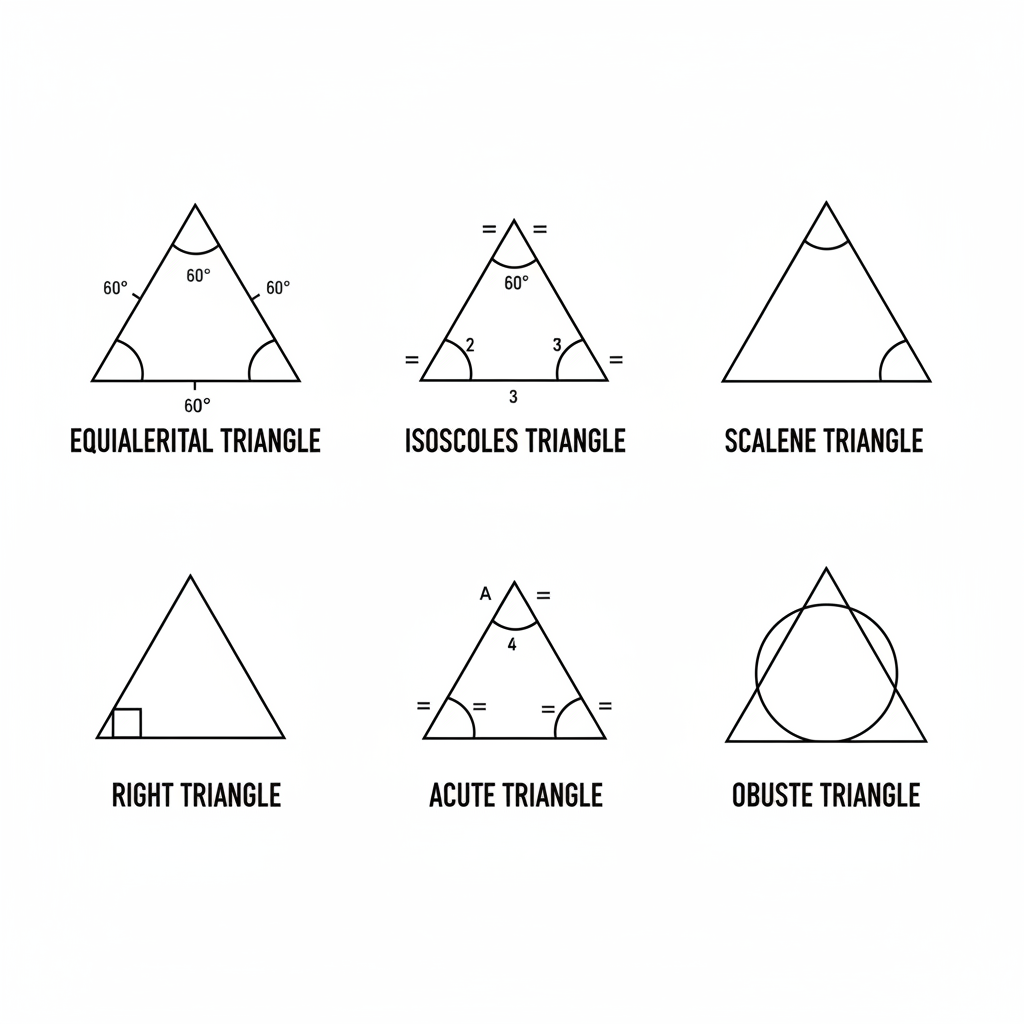 ⚠️ This picture may have spelling mistakes. Trust the words in the lesson.
1. Right-Angled Triangles: The "Perfect Corner" Builder
- Definition: A right-angled triangle (often just called a "right triangle") has one angle that measures exactly 90 degrees.
- Analogy: Imagine the perfect corner of a square room, the corner of a book, or the corner where a wall meets the floor. That's a 90-degree angle, also called a "right angle." It looks like a perfect 'L' shape.
- Special Side Name: The side directly opposite the right angle is called the hypotenuse, and it's always the longest side in a right triangle.
- Example: The ramp leading up to a platform or a piece of cheese cut diagonally often forms a right triangle. Builders use right triangles all the time!
2. Acute-Angled Triangles: The "Sharp but Not Too Sharp" Pointers
- Definition: An acute-angled triangle has all three of its angles measuring less than 90 degrees.
- Analogy: Think of something that's "acute" like a sharp pencil tip. All its corners are pointy and narrow, but none of them are as wide as a square corner. They are all 'sharp' but polite angles.
- Example: An equilateral triangle is always an acute-angled triangle because all its angles are 60 degrees (which is less than 90).
3. Obtuse-Angled Triangles: The "Wide-Open Mouth" Look
- Definition: An obtuse-angled triangle has one angle that measures more than 90 degrees.
- Analogy: Imagine a bird opening its beak really wide, or a door that's swung open past its normal 90-degree corner. That wide, lazy angle is an "obtuse" angle. Only one angle can be obtuse because if you had two, the sum would already be over 180 degrees!
- Example: A slice of pie cut at a very wide angle might form an obtuse triangle.
Putting It All Together: A Triangle Can Be Both!
Remember, a triangle can belong to a category from both lists! For example:
- An equilateral triangle is always an acute-angled triangle. (All angles are 60 degrees, which is less than 90).
- You can have a right isosceles triangle: two sides are equal, and one angle is 90 degrees.
- You can have an obtuse scalene triangle: all sides are different, and one angle is greater than 90 degrees.
It's like saying someone can be both a 'student' (classification by activity) and 'tall' (classification by height)!
Time to Review!
You've done an amazing job exploring the secret lives of triangles! You now know how to identify them by their sides (equilateral, isosceles, scalene) and by their angles (right, acute, obtuse). And you'll never forget that all their angles always add up to 180 degrees. Keep an eye out for these awesome shapes in the world around you!
Keep learning, free
Create a free Syllabax account to unlock practice questions and games for this topic.
Visual Learning Enhanced! 🚀
To help you master this topic, we use Advanced Syllabax AI to generate detailed diagrams and visual models.
Note on Visuals: The AI sometimes makes spelling errors in image labels. Please refer to the lesson text for the correct terminology.