Learning Journey
Watch this topic in 60 seconds
Free preview · Lesson 1
Understanding Substitution & elimination (Pair of Linear Equations in Two Variables)
Mastering Pairs of Linear Equations: The Art of Substitution & Elimination
Welcome, future problem-solvers! Imagine you're on a treasure hunt, and you have two clues. Each clue describes a path you could take. To find the treasure, you need to find the exact spot where both clues lead you. That's essentially what we do when we solve a 'Pair of Linear Equations in Two Variables'!
What are Linear Equations in Two Variables?
Let's break down this mouthful. A 'linear equation' is like a straight path or a straight line on a map. Think of it as a rule that links two different things together. For example, if you're buying apples (let's call the number 'x') and bananas (let's call the number 'y'), and each costs a certain amount, a linear equation could tell you the total cost. 'In two variables' simply means we're dealing with two unknown quantities, usually represented by letters like 'x' and 'y'.
A typical linear equation in two variables looks like this: Ax + By = C, where A, B, and C are just numbers, and x and y are our mysterious variables. For instance, 2x + 3y = 10. This equation has many possible solutions (combinations of x and y that make it true), just like a straight road has many points on it.
What does a 'Pair' Mean?
A 'pair' simply means we have two of these straight paths, two rules, or two clues. We're not just looking at one road; we're looking at two roads simultaneously. Our goal is to find the one special point that lies on *both* roads, or the one combination of 'x' and 'y' that satisfies *both* equations at the same time.
Why Solve Them? The 'Meeting Point' Mystery
Solving a pair of linear equations means finding the unique values for 'x' and 'y' that make both equations true. It's like finding the exact intersection point of two roads on a map. This 'meeting point' is super important in many real-world situations, from figuring out the cost of two different items based on two different purchases, to optimizing resources, or even calculating trajectories in science.
There are a few powerful tools in our mathematical toolkit to find this meeting point. Today, we'll explore two fundamental ones: the Substitution Method and the Elimination Method. Think of them as two different strategies to win a game, both leading to the same victory!
Method 1: The Substitution Method
What is Substitution?
The word 'substitute' means to replace one thing with another, especially one that is equivalent. In sports, a substitute player takes the place of another player. In cooking, you might substitute almond milk for regular milk. In mathematics, we do something similar!
The Substitution Method is like this: If you know one variable is equal to an expression involving the other variable, you can simply swap it out in the second equation. It helps us reduce a problem with two unknowns into a simpler problem with just one unknown.
Step-by-Step Guide to Substitution
- Step 1: Isolate a Variable: Pick one of the two equations and rearrange it so that one variable (either x or y) is by itself on one side of the equals sign. For example, turn
2x + y = 7intoy = 7 - 2x. This is like saying, "I know that 'y' is the same as '7 minus 2x'." - Step 2: Substitute: Now that you have an expression for one variable (like
y = 7 - 2x), take this expression and plug it into the *other* equation wherever you see that variable. If you isolated 'y' in the first equation, substitute its expression into the 'y' of the second equation. This is where the magic happens: your second equation will now only have one type of variable (e.g., only 'x's). - Step 3: Solve for the Remaining Variable: Solve the new single-variable equation. This will give you the numerical value for either 'x' or 'y'.
- Step 4: Back-Substitute: Take the value you just found (e.g., x = 3) and substitute it back into *either* of the original equations (or even the equation from Step 1 where you isolated a variable). This will allow you to find the value of the other variable.
- Step 5: Check Your Solution: Always a good idea! Plug both your 'x' and 'y' values into *both* original equations. If they both hold true, you've found your treasure!
Example 1: Solving with Substitution
Let's solve the system:
Equation 1: x + y = 5
Equation 2: 2x - y = 1
- Step 1 (Isolate): From Equation 1, it's easy to get
yby itself:y = 5 - x. (We could have isolated x too, but y was slightly easier here.) - Step 2 (Substitute): Now, wherever we see 'y' in Equation 2, we'll put '5 - x'.
2x - (5 - x) = 1 - Step 3 (Solve): Simplify and solve for x:
2x - 5 + x = 1
3x - 5 = 1
3x = 6
x = 2 - Step 4 (Back-Substitute): We know
x = 2. Let's usey = 5 - xto find y:
y = 5 - 2
y = 3 - Step 5 (Check):
Equation 1:2 + 3 = 5(True!)
Equation 2:2(2) - 3 = 4 - 3 = 1(True!)
Our solution isx = 2, y = 3or(2, 3).
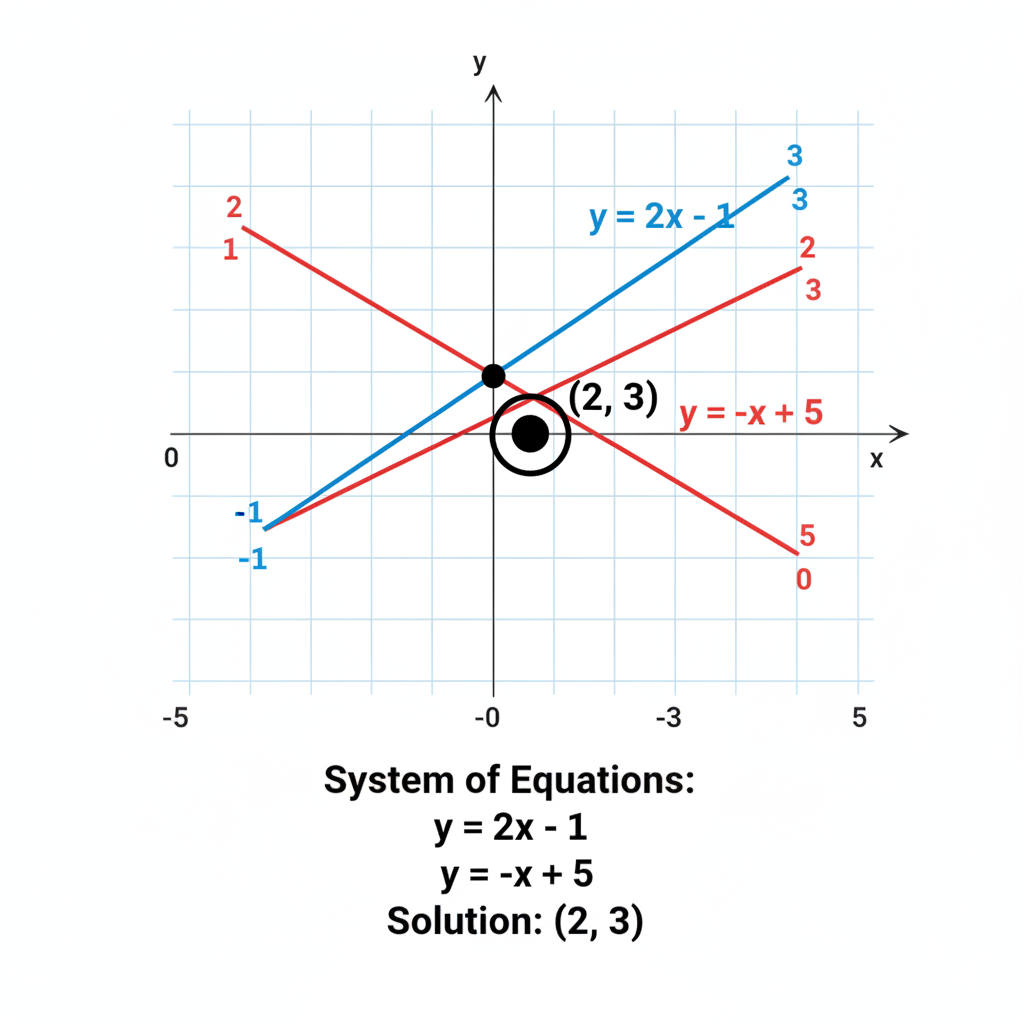 ⚠️ This picture may have spelling mistakes. Trust the words in the lesson.
Method 2: The Elimination Method
What is Elimination?
The word 'eliminate' means to completely remove or get rid of something. Imagine you have two identical items on a balanced scale, one on each side. If you remove both items, the scale remains balanced. In this method, we want to cleverly add or subtract the two equations in such a way that one of the variables completely disappears, or 'gets eliminated'.
This method is particularly useful when the coefficients (the numbers in front of the variables) are opposites (like +3y and -3y) or can be easily made into opposites or the same.
Step-by-Step Guide to Elimination
- Step 1: Align Variables: Make sure both equations are written in the standard form (
Ax + By = C), with x terms aligned, y terms aligned, and constant terms aligned. - Step 2: Choose a Variable to Eliminate: Look at the coefficients of 'x' and 'y' in both equations. Decide which variable would be easier to eliminate. You want their coefficients to be either the same (so you can subtract the equations) or opposite (so you can add them).
- Step 3: Multiply Equations (if needed): If the coefficients aren't already the same or opposite, multiply one or both equations by a number so that the chosen variable's coefficients become the same (or opposites). Remember to multiply *every* term in the equation to keep it balanced!
- Step 4: Add or Subtract the Equations: Once the coefficients of your chosen variable are ready, either add the two equations together (if the coefficients are opposites, like +2y and -2y) or subtract one equation from the other (if the coefficients are the same, like +3x and +3x). One variable should now be gone!
- Step 5: Solve for the Remaining Variable: You'll be left with a single-variable equation. Solve it to find the value of that variable.
- Step 6: Back-Substitute: Plug the value you found back into *either* of the original equations to find the value of the other variable.
- Step 7: Check Your Solution: As with substitution, verify your solution by plugging both 'x' and 'y' values into *both* original equations.
Example 2: Solving with Elimination
Let's solve the system:
Equation 1: 3x + 2y = 10
Equation 2: x - 2y = -2
- Step 1 (Align): The equations are already aligned.
- Step 2 (Choose): Notice the 'y' terms:
+2yand-2y. They are already opposites! This is perfect for elimination. - Step 3 (Multiply): No multiplication needed for this one, as the y-coefficients are already opposites.
- Step 4 (Add/Subtract): Since the 'y' coefficients are opposites, we ADD the two equations:
(3x + 2y) + (x - 2y) = 10 + (-2)
3x + x + 2y - 2y = 8
4x = 8(See how 'y' vanished!) - Step 5 (Solve):
4x = 8
x = 2 - Step 6 (Back-Substitute): We know
x = 2. Let's use Equation 1:
3(2) + 2y = 10
6 + 2y = 10
2y = 4
y = 2 - Step 7 (Check):
Equation 1:3(2) + 2(2) = 6 + 4 = 10(True!)
Equation 2:2 - 2(2) = 2 - 4 = -2(True!)
Our solution isx = 2, y = 2or(2, 2).
Choosing Your Weapon: Substitution vs. Elimination
Both methods are powerful, and for most problems, you can use either! However, some situations make one method a bit easier:
- Use Substitution when:
- One of the variables in an equation already has a coefficient of 1 or -1 (e.g.,
x + 2y = 5or3x - y = 7). It's easy to isolate that variable without dealing with fractions. - One equation is already solved for a variable (e.g.,
y = 3x - 1).
- One of the variables in an equation already has a coefficient of 1 or -1 (e.g.,
- Use Elimination when:
- The coefficients of one variable are already opposites (like
+yand-y). - The coefficients of one variable are the same (like
+2xand+2x). - You can easily multiply one or both equations by whole numbers to make the coefficients of one variable the same or opposite.
- The coefficients of one variable are already opposites (like
With practice, you'll develop an intuition for which method to choose, just like a chef knows whether to chop or slice an ingredient based on the recipe!
Real-World Adventures with Linear Equations
These methods aren't just for math class! They help solve problems like:
- Shopping: You buy 2 shirts and 3 pairs of socks for
- Travel: A boat travels at a certain speed in still water, and the current has its own speed. Going upstream (against the current) affects the total speed differently than going downstream (with the current). Linear equations can help you find the boat's speed and the current's speed.
- Mixing Solutions: A chemist needs to create a specific concentration of a solution by mixing two different solutions. Linear equations help determine how much of each solution is needed.
Recap and Next Steps
You've learned two fundamental techniques for solving pairs of linear equations: Substitution and Elimination. Both aim to find the 'meeting point' (the unique x and y values) of two straight-line equations. Remember to practice these methods with various problems. The more you practice, the more confident and efficient you'll become, turning complex problems into simple steps!
Keep learning, free
Create a free Syllabax account to unlock practice questions and games for this topic.
Visual Learning Enhanced! 🚀
To help you master this topic, we use Advanced Syllabax AI to generate detailed diagrams and visual models.
Note on Visuals: The AI sometimes makes spelling errors in image labels. Please refer to the lesson text for the correct terminology.