Types of Data: Categorical vs. Numerical
Watch this topic in 60 seconds
Free preview · Lesson 1
Understanding Types of Data: Categorical vs. Numerical
Exploring the World of Data: Categorical vs. Numerical
Hey everyone! Have you ever thought about all the different kinds of information, or 'data,' we see and use every single day? From your favorite color to the score of a basketball game, data is all around us! Just like a chef needs to know the difference between flour and sugar to bake a cake, or a librarian needs to know the difference between fiction and non-fiction books to organize shelves, we need to understand different types of data. Why? Because knowing the type of data helps us understand it better, graph it, and even use it to make smart decisions!
What is Data, Anyway?
Think of data as little bits of information or facts. It's like the ingredients in a recipe, the players on a team, or the different types of animals in a zoo. Each bit of information tells us something specific.
But not all data is the same! Imagine you're sorting your toys. You might sort them by their color (red, blue, green) or by how many you have of each type (3 action figures, 5 LEGO bricks, 2 stuffed animals). These are two very different ways of sorting, right? This is exactly how we think about data!
The Two Big Families of Data: Categorical and Numerical
In the world of statistics (which is just a fancy word for studying data!), we generally split data into two main families:
- Categorical Data
- Numerical Data
Let's dive into each one!
1. Categorical Data: Describing Qualities and Groups
Imagine you're describing your favorite things. You might say your favorite color is 'blue,' your favorite animal is a 'dog,' or your favorite subject is 'science.' Notice how all these answers are words or labels? That's what Categorical Data is all about!
Definition: Categorical data (sometimes called Qualitative Data) describes qualities, characteristics, or groups. It tells us 'what kind' or 'which type.' You can't do math operations like adding or subtracting with categorical data.
Analogies for Categorical Data:
- Sorting M&M's: When you sort M&M's by their color (red, green, blue, yellow), you're using categorical data. You can't add 'red' to 'blue' to get a new color, can you? You just count how many of each color there are.
- Types of Fruit: If you have apples, bananas, and oranges, these are categories. You can't say 'apple + banana = new fruit'. They are distinct types.
- Hair Color: Blonde, brown, black, red. These are categories describing a person's hair.
- Favorite Sports: Football, basketball, soccer, tennis. These are different groups of sports.
Key Ideas for Categorical Data:
- It puts things into different groups or labels.
- It's usually words, but sometimes numbers can act like categories (e.g., zip codes – you don't add zip codes together!).
- You can count how many items are in each category, but you can't perform meaningful calculations like averages with the categories themselves.
Examples of Categorical Data:
- Gender (Male, Female, Non-binary)
- Types of cars (Sedan, SUV, Truck)
- Yes/No answers to a survey question
- Favorite ice cream flavors (Vanilla, Chocolate, Strawberry)
- The city you live in (New York, Los Angeles, Chicago)
Here's an image to help visualize different types of data we might encounter:
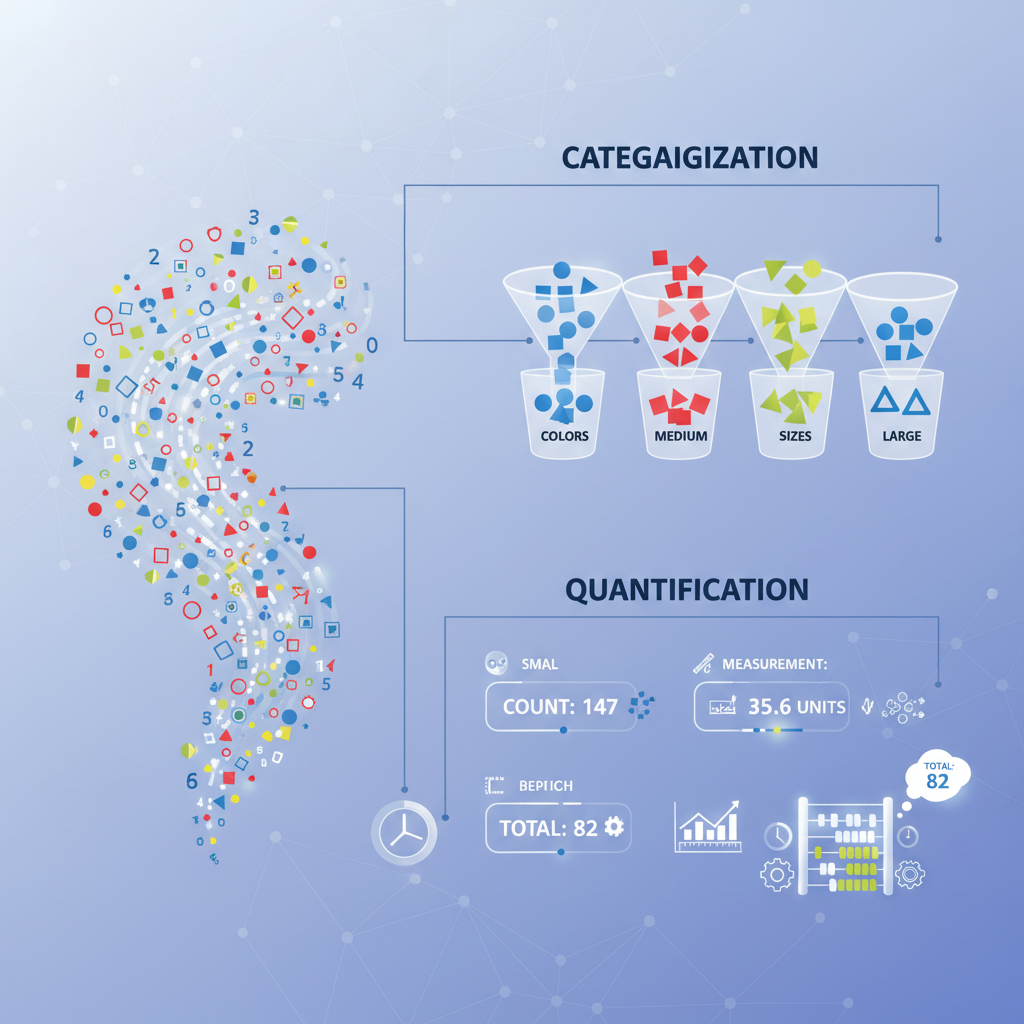 ⚠️ This picture may have spelling mistakes. Trust the words in the lesson.
2. Numerical Data: Counting and Measuring
Now, let's think about numbers. What if you want to know how many points your favorite basketball team scored, or how tall you are, or how many siblings you have? All these answers are numbers that you can actually 'do' math with. This is where Numerical Data comes in!
Definition: Numerical data (sometimes called Quantitative Data) describes quantities or amounts. It tells us 'how many' or 'how much.' You can perform mathematical operations like adding, subtracting, averaging, and more with numerical data.
Analogies for Numerical Data:
-
Counting Your Money: If you have
- Measuring Your Height: When you measure your height, you get a number (e.g., 5 feet 2 inches). Your height can change, and you can compare it with others using numbers.
- Temperature: The temperature outside (e.g., 75 degrees Fahrenheit) is a number. You can compare today's temperature to yesterday's, or calculate the average temperature over a week.
- Number of Pets: If you have 2 dogs and 1 cat, you have a total of 3 pets. These are quantities you can count and add.
Key Ideas for Numerical Data:
- It represents counts or measurements.
- It's always expressed as numbers.
- You can perform mathematical operations (like addition, subtraction, multiplication, division, finding averages) on this type of data.
Examples of Numerical Data:
- Age (e.g., 12 years old)
- Height (e.g., 150 cm)
- Weight (e.g., 45 kg)
- Number of siblings (e.g., 0, 1, 2, 3...)
- Test scores (e.g., 85, 92, 78)
- Temperature (e.g., 25 degrees Celsius)
Why Does It Matter Which Type It Is?
Understanding the difference between categorical and numerical data is super important because it tells us what we can do with the data. You wouldn't try to find the 'average' eye color, would you? (What would 'average brown' even mean?) But you *can* find the average height of students in your class.
Different types of data need different kinds of graphs, too! You might use a bar graph for categorical data (like how many people prefer pizza vs. tacos) and a histogram or line graph for numerical data (like tracking temperature changes over time).
Let's Summarize!
Think of it like this:
- Categorical Data: Describes things using words, labels, or categories. It's about 'what kind' or 'which group.' You count how many are in each group. (e.g., Eye Color, Favorite Sport)
- Numerical Data: Describes things using numbers that can be counted or measured. It's about 'how many' or 'how much.' You can do math with these numbers. (e.g., Height, Number of Siblings)
By learning to tell these two types apart, you've taken a big step in becoming a data detective! Keep practicing, and you'll be able to sort and understand data like a pro in no time.
Keep learning, free
Create a free Syllabax account to unlock practice questions and games for this topic.
Visual Learning Enhanced! 🚀
To help you master this topic, we use Advanced Syllabax AI to generate detailed diagrams and visual models.
Note on Visuals: The AI sometimes makes spelling errors in image labels. Please refer to the lesson text for the correct terminology.