Right angle (recognition) (Lines & Angles)
Watch this topic in 60 seconds
Free preview · Lesson 1
Understanding Right angle (recognition) (Lines & Angles)
Discovering Right Angles: Making Corners in Third Grade!
Hello, young mathematicians! Today, we're going on an exciting adventure to discover a special kind of corner called a right angle. You see right angles all around you, every single day! They are like the secret building blocks of shapes and objects. Let's dive in and learn all about them!
What is an Angle?
Before we talk about right angles, let's quickly remember what an angle is. Imagine two roads that meet at an intersection. The "V" shape or the space between those two roads where they meet is called an angle. It's formed when two lines or rays start at the same point, which we call the vertex.
Think of the hands on a clock. When the hour hand and the minute hand point in different directions, they form an angle at the center of the clock.
What Makes an Angle a "Right" Angle?
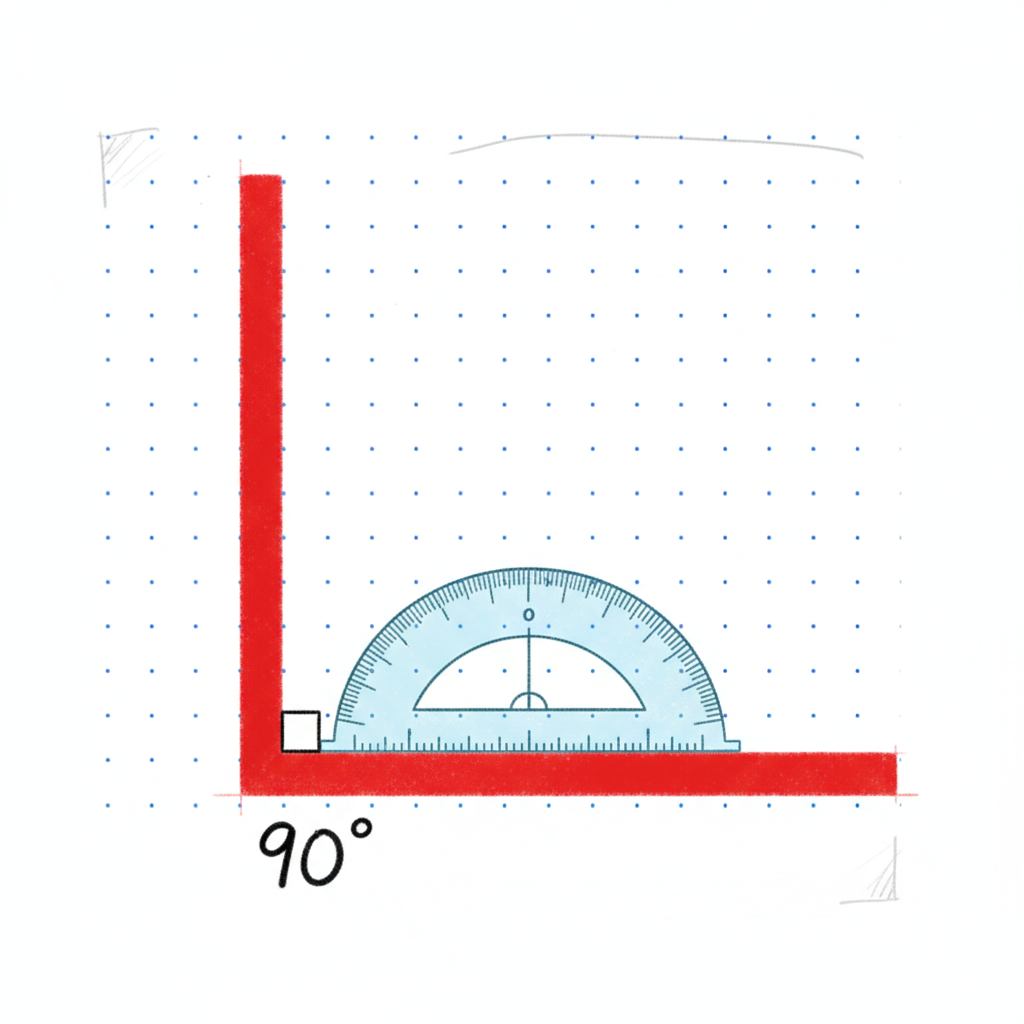
Now, let's focus on our special guest: the right angle! A right angle is a very specific kind of angle. It's perfectly "square" or "straight up and down."
Analogy Time!
- The Corner of a Room: Look at the corner where two walls meet the floor, or where two walls meet each other. That corner is almost always a perfect right angle! It's like a square dancer doing a perfect square turn.
- The Corner of a Book or a Door: Open a book and look at where the pages meet the cover. Or stand in front of a door and look at its corners. They are usually shaped like right angles.
- The Knees of a Stool or Table Leg: If you look at how a table leg joins the tabletop, or how the seat of a stool meets its legs, you'll often find right angles. They make things stand up straight and sturdy!
- A Square Pizza Slice: If you cut a square pizza into four equal square pieces, the corner of each small square piece is a right angle.
A right angle looks like the letter 'L' if you tilt it a bit!
How Can We Recognize a Right Angle?
Recognizing a right angle is like being a detective! You're looking for clues. Here are some ways to spot them:
1. The "L" Shape Clue:
As we mentioned, right angles often look like a perfect 'L'. When you see two lines meeting to form a perfect 'L', you've likely found a right angle.
2. The "Square" Clue:
Right angles make things feel "square." Imagine fitting a perfectly square object into a corner. If it fits snugly without any gaps, the corner is likely a right angle.
3. The "Perpendicular" Clue:
This is a fancy word, but it just means "standing straight up and down" or "meeting at a right angle." When one line or ray is perfectly perpendicular to another, they form a right angle. Think of a flagpole standing straight up on the ground – the flagpole is perpendicular to the ground.
4. The "Right Angle Measurer" (or Protractor Lite!):
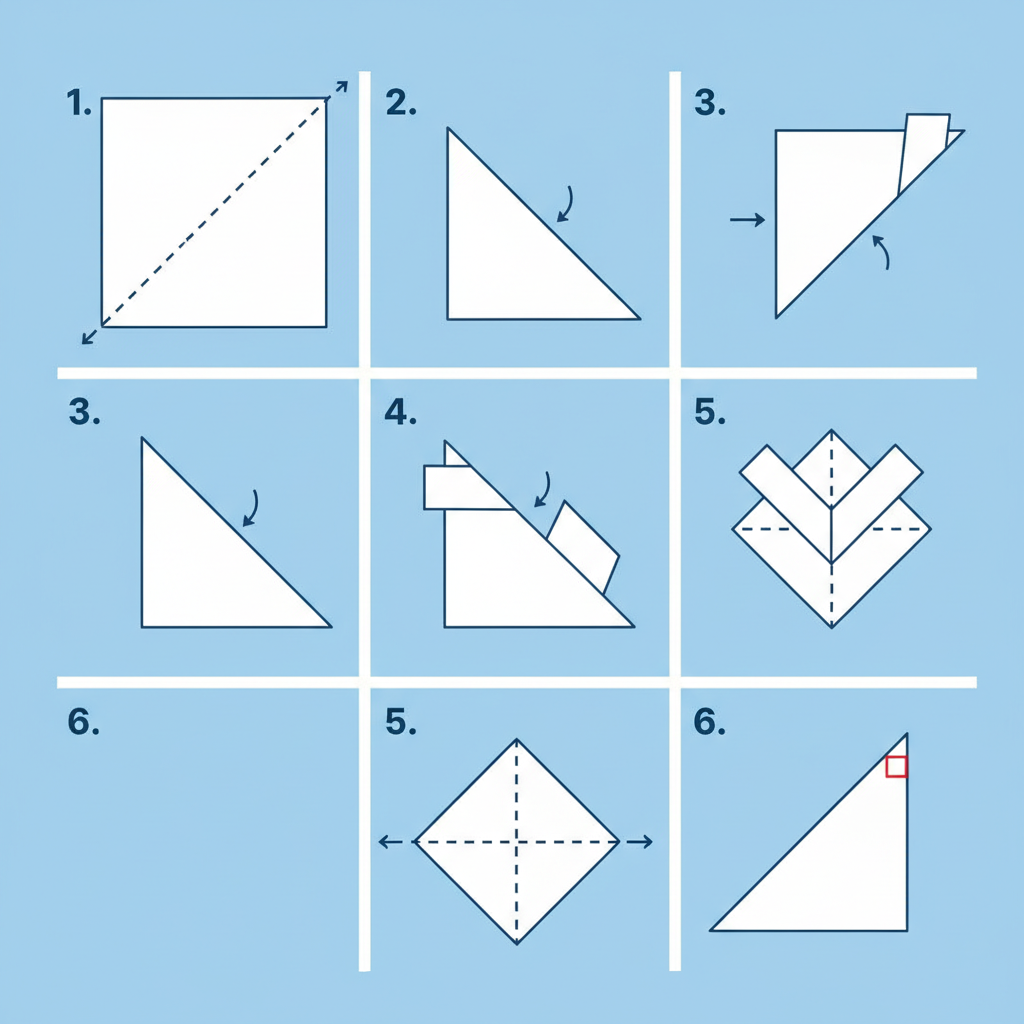
In math class, you might use a special tool called a protractor to measure angles. But for now, we can use a simple trick. Take a piece of paper. Fold it in half, and then fold it in half again to make a small, neat square corner. That folded corner is a perfect right angle! You can use this folded corner like a stencil to check if other corners are right angles. If the corner fits perfectly, it's a right angle!
 ⚠️ This picture may have spelling mistakes. Trust the words in the lesson.
5. The "Square Corner" Symbol:
Sometimes, in drawings of shapes, you'll see a tiny square drawn right in the corner where the angle is. This little square is a special symbol that means, "Hey! This is a right angle!" It's a math shortcut!
Where Do We Find Right Angles?
Right angles are everywhere! Let's list some more places:
- The sides of a window pane.
- The screen of a TV or tablet.
- The pages of a notebook.
- The shape of a stop sign (actually, stop signs are octagons, but their corners might have right angles in their construction!). Let's think of a road sign that IS a rectangle, like a speed limit sign.
- The blades of scissors (where they cross).
- The keys on a piano.
- Chessboards and checkerboards.
- The tiles on a floor.
- The edges of a brick.
- The hands on a clock when it's exactly 3:00 or 9:00!
Why Are Right Angles Important?
Right angles are super important because they help things be:
- Stable: Buildings, tables, and chairs need right angles to be strong and not wobble.
- Neat: They help make things look organized and tidy, like the pages in a book or the tiles on a floor.
- Easy to Measure: They give us a standard way to measure and build things accurately.
Let's Compare: Right Angles vs. Other Angles
It's helpful to see what a right angle IS by also knowing what it ISN'T.
- Acute Angle: This is an angle that is smaller than a right angle. It's "sharp" and "pointy," like the angle you make when you pinch your fingers together. Think of the angle on a slice of pizza that's less than a quarter of the whole pizza.
- Obtuse Angle: This is an angle that is larger than a right angle. It's "wide" or "gaping," like the angle your legs make when you sit on the floor with your legs spread wide apart. Think of the angle on a slice of pizza that's more than a quarter of the whole pizza but less than half.
A right angle is like the Goldilocks angle – not too sharp, not too wide, but just right!
Summary: Be a Right Angle Finder!
Your mission now is to become a "Right Angle Finder"! Look around your classroom, your home, and even when you're outside. Can you spot all the right angles? Remember their "L" shape, their "squareness," and the little square symbol that mathematicians use. Happy angle hunting!
Keep learning, free
Create a free Syllabax account to unlock practice questions and games for this topic.
Visual Learning Enhanced! 🚀
To help you master this topic, we use Advanced Syllabax AI to generate detailed diagrams and visual models.
Note on Visuals: The AI sometimes makes spelling errors in image labels. Please refer to the lesson text for the correct terminology.