Sources of sound (Sound )
Watch this topic in 60 seconds
Free preview · Lesson 1
Understanding Sources of sound (Sound )
Exploring the World of Sound: Where Does Sound Come From?
Hello, young explorers! Today, we're going on an exciting adventure to discover the secrets of sound. Have you ever wondered how we hear music, people talking, or even a dog barking? It all comes from something super cool called vibrations!
What is Sound?
Imagine you're listening to your favorite song. The music is filling the air and reaching your ears. That's sound! Sound is energy that travels to our ears and lets us know what's happening around us. It helps us communicate, enjoy music, and even stay safe by hearing warnings like a car horn.
The Big Secret: Vibrations!
The most important thing to remember about sound is this: all sound is made by something vibrating. What does 'vibrating' mean? It means moving back and forth, very, very quickly. Like a tiny wiggle!
Analogy Time!
- The Guitar String: Imagine a guitar. When you pluck a string, what happens? It wiggles back and forth super fast! You can often even see it blur. That fast wiggle, or vibration, is what creates the sound you hear. If the string stopped wiggling, the sound would stop.
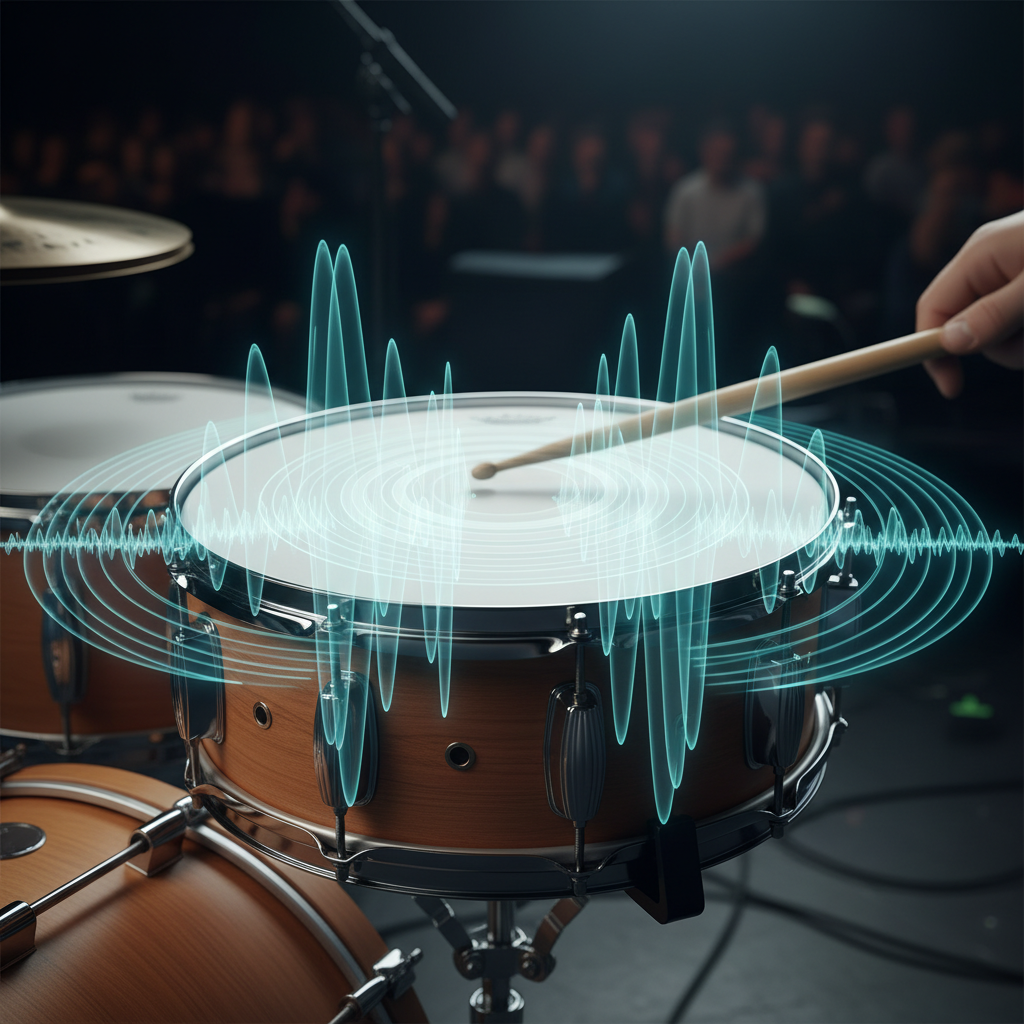
- The Drum: Think about hitting a drum. The top part, called the drumhead, shakes and wiggles up and down. You might not see it clearly because it's so fast, but you can feel it if you gently touch the drumhead right after someone hits it. This vibration makes the loud boom!
- Your Voice: Yes, even your own voice comes from vibrations! If you gently put your fingers on your throat while you hum or speak, you can feel a little buzzing. Those are tiny parts inside your throat called vocal cords vibrating to make the sounds you speak and sing.
So, every time you hear a sound, somewhere, something is wiggling or shaking very fast!
How Do Vibrations Make Sound Travel?
When an object vibrates, it pushes the air particles around it. Imagine those air particles like tiny, invisible balls. When the vibrating object pushes one ball, that ball pushes the next, and so on, creating a chain reaction. This pushing and pulling creates waves that travel through the air, just like ripples spreading out in a pond when you drop a stone.
More Analogies!
- The Rippling Pond: If you drop a small stone into a calm pond, you see ripples spread out from where the stone hit. Sound waves are a bit like those water ripples, but they travel through the air to your ears instead of across water.
- The Domino Effect: Line up a bunch of dominoes. When you push the first one, it falls and pushes the next, and so on. Sound waves travel in a similar way, where one air particle 'pushes' the next one, carrying the sound energy forward.
When these sound waves reach your ears, a special part inside your ear vibrates, and your brain tells you what sound you're hearing!
Different Sources of Sound
Now that we know sound comes from vibrations, let's look at some amazing things that are sources of sound all around us!
1. People and Animals
- Talking and Singing: Our vocal cords vibrate to make our voices.
- Clapping Hands: Your hands vibrate when they hit each other.
- Animal Sounds: A dog's bark, a cat's meow, a bird's chirp – all come from vibrating parts inside their bodies!
2. Musical Instruments
- String Instruments (Guitar, Violin, Piano): The strings vibrate.
- Wind Instruments (Flute, Trumpet): Air inside the instrument vibrates.
- Percussion Instruments (Drum, Cymbals): The surface of the instrument vibrates when hit.
3. Nature
- Thunder: The sudden heating and expanding of air during a lightning strike cause powerful vibrations.
- Wind: Wind blowing through trees or past objects can make them vibrate, creating sounds like rustling leaves or whistling.
- Running Water: Water hitting surfaces or tumbling over rocks creates vibrations.
4. Machines and Objects
- Car Engines: Many parts inside a car engine vibrate to make it run and create engine noises.
- Bells: When a bell is rung, its metal sides vibrate.
- Alarms and Sirens: These devices are designed to vibrate very loudly to get our attention.
- Dropping an Object: When a book falls and hits the floor, both the book and the floor vibrate for a moment, making a sound.
Everywhere you look and listen, you'll find something vibrating to make a sound! It's like the whole world is full of tiny, hidden shakers.
 ⚠️ This picture may have spelling mistakes. Trust the words in the lesson.
Remembering the Main Idea
So, the next time you hear any sound, whether it's soft music or a loud clap of thunder, you'll know the secret: it all starts with something moving back and forth, back and forth, super fast! That's a vibration, and vibrations are the magical way sound is made.
Keep learning, free
Create a free Syllabax account to unlock practice questions and games for this topic.
Visual Learning Enhanced! 🚀
To help you master this topic, we use Advanced Syllabax AI to generate detailed diagrams and visual models.
Note on Visuals: The AI sometimes makes spelling errors in image labels. Please refer to the lesson text for the correct terminology.