Sector & segment areas (Areas Related to Circles)
Watch this topic in 60 seconds
Free preview · Lesson 1
Understanding Sector & segment areas (Areas Related to Circles)
Unlocking Circle Secrets: Sectors & Segments (Grade 10 - Foundational)
Welcome, young mathematicians! Have you ever wondered how much pizza is in one slice? Or how much area a windshield wiper cleans? Believe it or not, these everyday questions involve special parts of a circle called sectors and segments. In this lesson, we'll explore these fascinating shapes, understand their core definitions, and learn how to calculate their areas using simple terms and lots of helpful analogies.
Refresher: The Basics of a Circle
Before we dive into sectors and segments, let's quickly review the fundamental parts of a circle:
- Center (O): The point equidistant from all points on the circle.
- Radius (r): A line segment from the center to any point on the circle. Think of it as the arm extending from your shoulder (center) to the edge of a spinning wheel.
- Diameter (d): A line segment passing through the center and connecting two points on the circle. It's simply two radii put together (d = 2r).
- Circumference: The distance around the circle, like the crust of a whole pizza. Formula: C = 2πr.
- Area: The amount of space inside the circle. Formula: A = πr².
These basics are our building blocks for understanding more complex parts of a circle!
What is a Sector? Think 'Pizza Slice'!
Imagine you have a delicious, perfectly round pizza. When you cut a slice, what do you get? That's right – a sector!
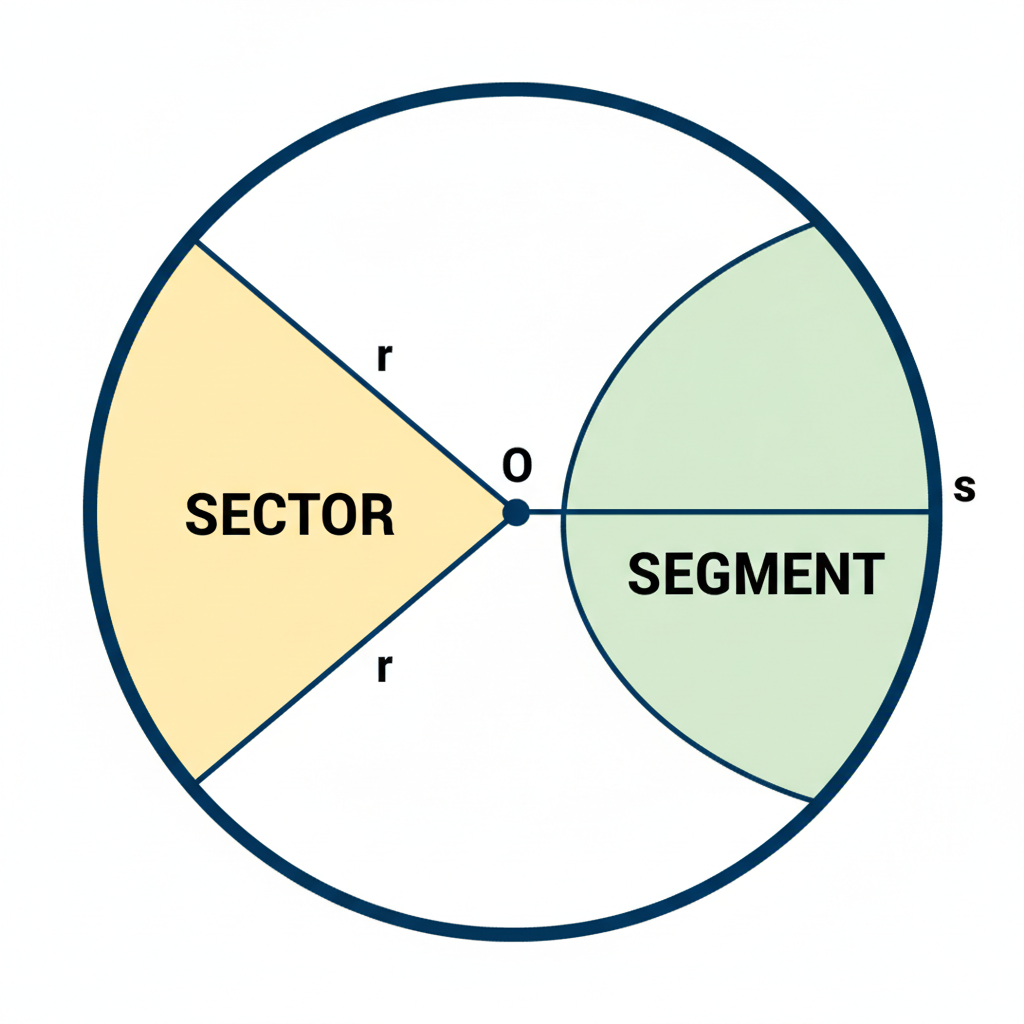
Definition: A sector of a circle is the region enclosed by two radii and the arc (a curved part of the circle's circumference) connecting their endpoints. It's essentially a 'slice' of the whole circle.
Key Components:
- Two Radii: These are the straight edges of your pizza slice, extending from the center.
- An Arc: This is the curved crust part of your pizza slice.
- Central Angle (θ): The angle formed by the two radii at the center of the circle. This angle tells us how big or small your slice is. Think of it as how wide you open your scissors to cut the pizza.
Analogy: Beyond a pizza slice, a sector can be compared to:
- A slice of pie or cake.
- The area covered by a sprinkler head rotating a certain angle.
- The sweep of a car's windshield wiper.
Calculating the Area of a Sector
How do we find the area of just one slice of pizza? It's a fraction of the entire pizza's area! The fraction depends on how big the central angle (θ) is compared to the total angle in a full circle (360°).
The Idea: If the central angle is 90°, that's 90/360 = 1/4 of the circle. So, the area of that sector would be 1/4 of the total circle's area.
Formula for Area of a Sector:Area of Sector = (θ / 360°) × πr²
θ(theta) is the central angle in degrees.π(pi) is approximately 3.14159.ris the radius of the circle.
Let's say you have a circle with a radius of 10 cm, and you want to find the area of a sector with a central angle of 60°. You would calculate: (60/360) * π * (10²) = (1/6) * 100π = 50π/3 cm².
What is a Segment? Think 'Watermelon Rind'!
Now, let's think about a watermelon. If you cut a straight line across a slice of watermelon, the part of the watermelon that's just the red fleshy bit with the rind (but no pointy center) – that's a segment!
Definition: A segment of a circle is the region enclosed by a chord and its corresponding arc. It's the area left over when you cut off a 'slice' (sector) and then draw a straight line (chord) between the two ends of the crust.
Key Components:
- A Chord: A straight line segment connecting two points on the circle. This is like the straight cut across the watermelon.
- An Arc: The curved part of the circle's circumference between the two endpoints of the chord.
Analogy: A segment can be seen as:
- The 'crusty' part of a pie slice after you've taken the main triangle.
- The area of a partially filled circular pool.
- The shape of a crescent moon (though a true crescent is usually not a circular segment).
Calculating the Area of a Segment
Calculating the area of a segment is a bit trickier because it's not a direct fraction of the circle. Instead, we use what we already know about sectors and triangles.
The Idea: Imagine your pizza slice (sector). If you cut a straight line across the pointy end of the slice, you're essentially removing a triangular piece from the sector. The part that's left over is the segment.
Formula for Area of a Segment:Area of Segment = Area of Sector - Area of Triangle
The triangle in question is formed by the two radii and the chord that defines the segment. This triangle has the two radii as two of its sides, and the chord as the third side. The angle between the two radii is the central angle (θ) of the sector.
How to find the Area of the Triangle:
- For any triangle with two sides 'a' and 'b' and the angle 'C' between them:
Area = (1/2) * a * b * sin(C). - In our case, the two sides are both radii (r), and the angle between them is the central angle (θ).
- So,
Area of Triangle = (1/2) * r * r * sin(θ) = (1/2) * r² * sin(θ).
Putting it all together:Area of Segment = [(θ / 360°) × πr²] - [(1/2) × r² × sin(θ)]
Remember, `sin(θ)` requires your calculator to be in degree mode for angle θ in degrees. For simple cases like θ = 90°, sin(90°) = 1, making the triangle area (1/2)r². For θ = 60°, sin(60°) = √3/2, making the triangle area (1/2)r²(√3/2) = (√3/4)r².
Sector vs. Segment: A Quick Distinction
- Sector: Looks like a slice of pizza. Includes the center of the circle. Bounded by two radii and an arc.
- Segment: Looks like a rounded-off sliver. Does NOT include the center of the circle. Bounded by a chord and an arc.
Why Does This Matter? Real-World Applications!
Understanding sectors and segments isn't just for textbooks; it's everywhere!
- Engineering: Designing curved parts, gears, or components of machinery.
- Architecture: Creating arched windows, domed roofs, or circular layouts.
- Gaming/Animation: Calculating collision areas or visibility fields.
- Agriculture: Planning irrigation systems with rotating sprinklers.
- Art and Design: Creating patterns in stained glass, pottery, or graphic design.
By understanding these basic concepts, you've unlocked a whole new way to see and analyze the circular shapes around you. Keep practicing, and you'll master these 'slices' and 'segments' of geometry in no time!
Keep learning, free
Create a free Syllabax account to unlock practice questions and games for this topic.
Visual Learning Enhanced! 🚀
To help you master this topic, we use Advanced Syllabax AI to generate detailed diagrams and visual models.
Note on Visuals: The AI sometimes makes spelling errors in image labels. Please refer to the lesson text for the correct terminology.