Heating effects of current[PHYSICS]
Watch this topic in 60 seconds
Free preview · Lesson 1
Understanding Heating effects of current[PHYSICS]
The Heating Effects of Electric Current: Grade 10 Physics (Foundational)
Have you ever noticed how your phone gets warm when you charge it, or how an electric heater starts glowing red after being switched on? These are all everyday examples of something amazing happening with electricity: the Heating Effect of Electric Current. In simple terms, this means that whenever electric current flows through a wire or any conductor, it generates heat. Let's dive into why this happens and how it impacts our lives!
1. The Basics: What is Electric Current?
Before we talk about heating, let's quickly remember what electric current is. Imagine electricity as tiny, invisible runners called electrons moving through a pathway, which we call a conductor (like a copper wire). When these electrons move in an organized way from one point to another, we call it electric current. The more electrons moving per second, the greater the current.
2. Introducing Resistance: The Obstacle Course for Electrons
Now, imagine our electron runners are trying to sprint through a crowded hallway. The hallway isn't perfectly clear; it has other people, furniture, and maybe even a few tight corners. These obstacles make it harder for the runners to move smoothly. In the world of electricity, these 'obstacles' are called resistance.
Resistance is the opposition a material offers to the flow of electric current. Every material has some resistance, though some have very little (like copper wires – good conductors) and some have a lot (like rubber – insulators). When electrons try to move through a material with resistance, they don't have a perfectly smooth path. They keep bumping into the atoms and other electrons within the material.
3. How Bumps Lead to Heat: The Friction Analogy
Think about rubbing your hands together very fast. What happens? They get warm, right? That's because of friction – the resistance to motion between two surfaces. When you rub your hands, the kinetic energy (energy of motion) is converted into heat energy.
The same idea applies to electrons! As electrons zoom through a wire, they constantly collide with the atoms and other particles in the conductor. These collisions are like tiny bumps and rubs. Each time an electron bumps into an atom, it transfers some of its kinetic energy to that atom. This makes the atoms vibrate more vigorously. When atoms in a material vibrate faster, what happens? The material gets hotter!
So, the heat generated is essentially the electrical energy being converted into thermal energy (heat energy) due to the 'friction' (resistance) encountered by the flowing electrons.
4. The Science Behind It: Joule's Law of Heating
The relationship between current, resistance, and the heat produced was first described by a scientist named James Prescott Joule. His discovery is known as Joule's Law of Heating. It gives us a way to calculate exactly how much heat is produced.
Joule's Law states that the heat (H) produced in a conductor is directly proportional to:
- The square of the current (I²) flowing through it.
- The resistance (R) of the conductor.
- The time (t) for which the current flows.
In simple mathematical terms, Joule's Law is expressed as:
H = I²Rt
Let's break down what this formula means with more analogies:
-
I² (Current Squared): Imagine our electron runners again. If a few runners are jogging (low current), they cause some bumps. But if ten times as many runners are sprinting (high current), the chaos and bumps increase dramatically, not just by ten times, but even more! This is why current is 'squared' in the formula. A small increase in current can lead to a much larger increase in heat. Think of it like a crowded dance floor: a few dancers might cause some minor jostling, but a lot of dancers moving quickly causes a huge amount of energetic collisions and heat!
-
R (Resistance): This is the 'bumpiness' or 'crowdedness' of our hallway. If the hallway has more obstacles (higher resistance), the electrons will collide more often, generating more heat for the same amount of current. Imagine two paths: one smooth and clear, the other full of rocks and potholes. Running the same distance on the rocky path would make you much more tired and warmer due to the effort and friction.
-
t (Time): This one is straightforward. The longer the current flows, the longer the electrons are bumping and colliding, and therefore, the more heat is generated. Running for 10 minutes will make you warmer than running for 1 minute.
5. Visualizing the Heating Effect
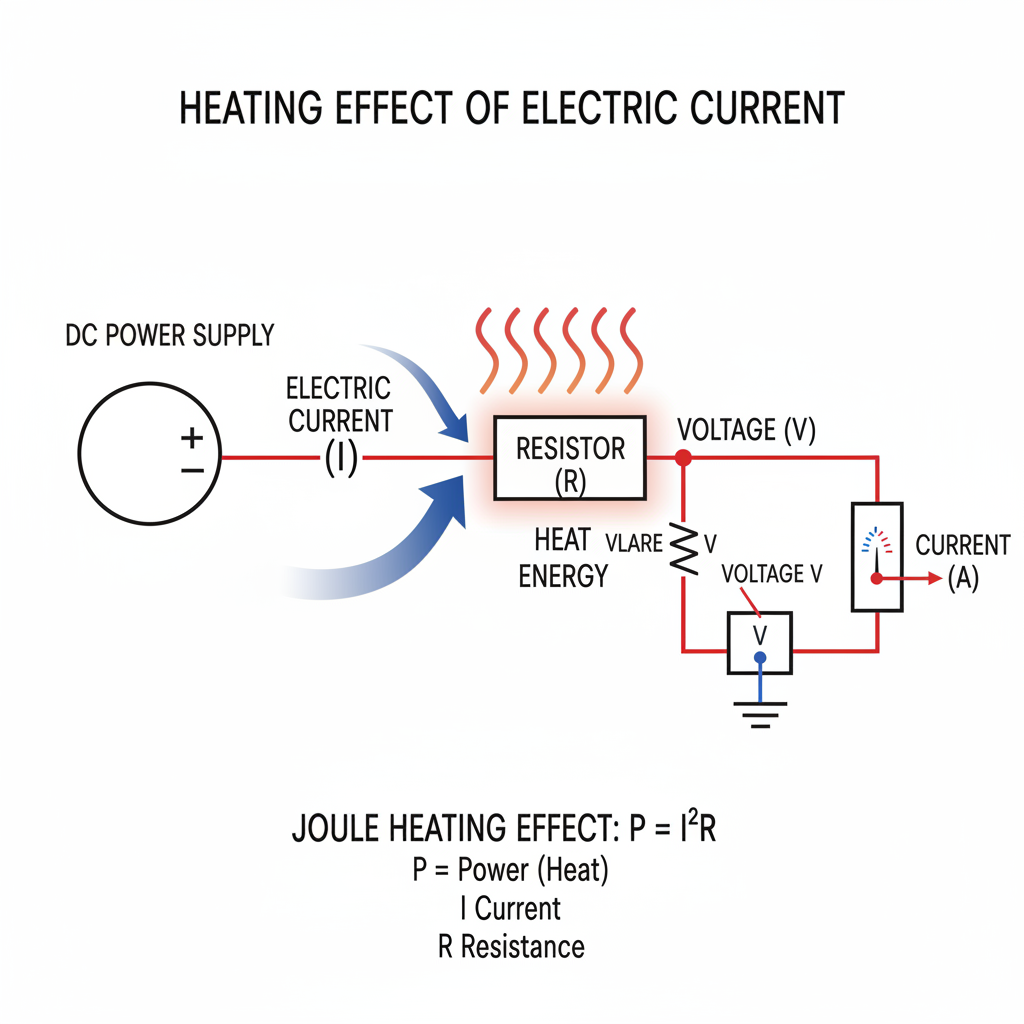
Here's a simple diagram to help you visualize what's happening in a circuit when heat is generated:
 ⚠️ This picture may have spelling mistakes. Trust the words in the lesson.
In the diagram, you can see a power source (battery) providing the push for electrons. The electrons flow through a wire, but when they encounter a component with significant resistance (like the resistor shown), they start bumping and colliding, converting electrical energy into heat energy, which is represented by the heat waves rising from the resistor.
6. Where Do We See the Heating Effect? (Applications and Consequences)
The heating effect of current isn't just a physics concept; it's everywhere! We use it for many things, but it can also cause problems.
Useful Applications: Heating on Purpose!
-
Electric Heaters and Toasters: These devices use special wires (often made of Nichrome, an alloy of nickel and chromium) that have very high resistance. When current passes through them, they get extremely hot, sometimes even glowing red, providing warmth or toasting bread.
-
Electric Kettles and Water Heaters: Similar to heaters, they have high-resistance heating elements immersed in water. The heat generated warms up the water.
-
Incandescent Light Bulbs: Older light bulbs (the ones that get very hot) work on this principle. A very thin filament (often tungsten) has extremely high resistance. When current passes through it, it gets so hot (over 2000°C!) that it glows brightly, producing light. Unfortunately, most of the energy is converted to heat, making them inefficient.
-
Electric Iron: The soleplate of an iron contains a heating element with high resistance, which gets hot and helps smooth out clothes.
-
Electric Fuses: These are safety devices! A fuse contains a thin wire made of a material with a low melting point and moderate resistance. If too much current flows through a circuit (perhaps due to a short circuit or overload), the fuse wire heats up rapidly according to H=I²Rt, melts, and breaks the circuit. This prevents damage to expensive appliances and potential fires. It's like a circuit's sacrificial lamb, protecting the rest of the flock.
Undesirable Effects: Heating We Don't Want
-
Energy Loss in Transmission Wires: When electricity travels long distances through power lines, the wires themselves have some resistance. Even though it's usually low, current flowing through them continuously generates heat (H=I²Rt), leading to a waste of electrical energy as heat lost to the surroundings. This is why power stations transmit electricity at very high voltages and low currents to minimize these losses (because heat loss depends on I²).
-
Overheating of Appliances: If an appliance is poorly designed, old, or overloaded, its internal wires or components can heat up excessively. This can damage the appliance, reduce its lifespan, or even cause a fire. Remember your warm phone? Sometimes it's normal, but too hot could be a sign of an issue.
7. Safety First: Preventing Overheating
Because unwanted heating can be dangerous, several safety measures are put in place:
-
Fuses: As mentioned, fuses are crucial. They protect circuits by melting and breaking the connection if the current becomes dangerously high.
-
Circuit Breakers: These are modern alternatives to fuses. Instead of melting, they automatically trip (switch off) when excessive current flows, and can be reset once the fault is cleared. They are like a reusable safety guard.
-
Proper Wiring and Insulation: Using wires of the correct thickness for the expected current and ensuring they are well-insulated prevents short circuits and reduces the risk of overheating.
Conclusion: The Power of Resistance
The heating effect of electric current is a fundamental concept in physics. It all boils down to the tiny, energetic collisions between flowing electrons and the atoms of the conductor. This 'friction' converts electrical energy into heat. Understanding this effect helps us design useful heating appliances and also implement safety measures to prevent hazards. From keeping us warm to lighting our homes and protecting our circuits, the heating effect of current is a powerful and essential part of our electrified world!
Keep learning, free
Create a free Syllabax account to unlock practice questions and games for this topic.
Visual Learning Enhanced! 🚀
To help you master this topic, we use Advanced Syllabax AI to generate detailed diagrams and visual models.
Note on Visuals: The AI sometimes makes spelling errors in image labels. Please refer to the lesson text for the correct terminology.