Types of triangles [Triangles & Quadrilaterals]
Watch this topic in 60 seconds
Free preview · Lesson 1
Understanding Types of triangles [Triangles & Quadrilaterals]
All About Triangles!
Welcome, super geometry explorers! Today, we're diving into the wonderful world of triangles. Triangles are everywhere, from the slice of pizza you love to the roofs of houses. They are basic building blocks in math and art, and understanding them is super important.
What is a Triangle?
Imagine you have three sticks. If you connect the ends of these sticks together, what shape do you get? That's right, a triangle! A triangle is a shape with three straight sides and three corners (we call these corners vertices). It's like a tiny shape with three huggable sides!
Parts of a Triangle
- Sides: These are the three straight lines that form the triangle.
- Vertices: These are the pointy corners where the sides meet.
- Angles: At each vertex, there's an angle. An angle is like a "turn" you make. The three angles inside any triangle always add up to 180 degrees. Think of it as a total "turn" budget for the triangle!
Why Do Triangles Matter?
Triangles are super strong shapes! Think about bridges or the frames of buildings. Triangles help make them sturdy. They are also used in patterns, art, and even in computer graphics to create amazing 3D worlds. They are like the LEGO bricks of the shape world – you can build so many cool things with them!
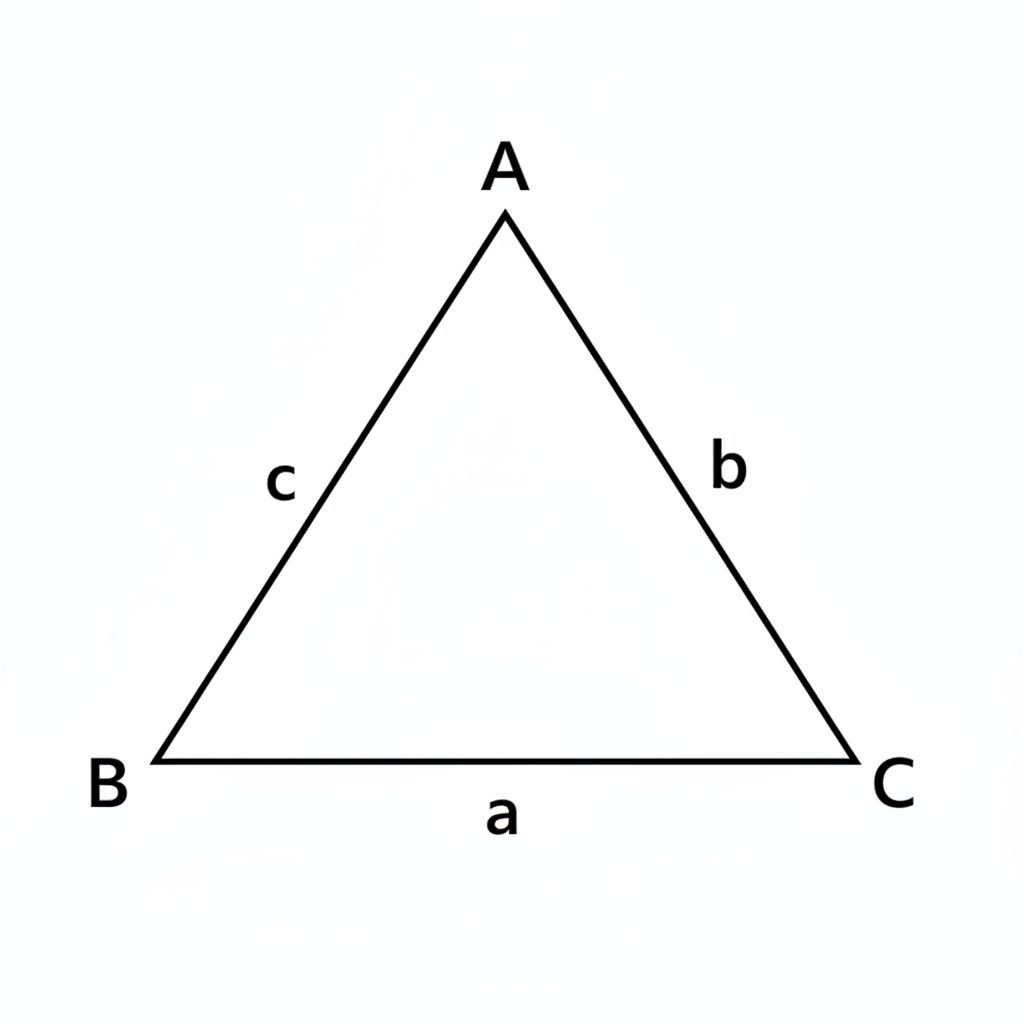 ⚠️ This picture may have spelling mistakes. Trust the words in the lesson.
Let's Meet the Triangle Family!
Just like you have different family members (parents, siblings, cousins), triangles also have different types. We can sort them into two main groups based on their sides and their angles. Let's explore!
Triangles Based on Their Sides
How long are the sides of a triangle? Are they all the same, or are some different? We have three types of triangles based on their sides:
-
Equilateral Triangle: The "All Equal" Friend
Imagine a triangle where all three sides are exactly the same length. This is an equilateral triangle. It's like having three best friends who are all exactly the same height! Because all the sides are equal, all the angles inside are also equal (each one is 60 degrees, which is a perfect third of the total 180 degrees).
Analogy: Think of a perfectly balanced traffic light. All three lights are the same size, just like the sides of an equilateral triangle.
-
Isosceles Triangle: The "Two Alike" Pal
Now, imagine a triangle where two sides are the same length, but the third side is different. This is an isosceles triangle. It's like having two twins and one other sibling – two are the same, one is different! In an isosceles triangle, the two angles opposite the equal sides are also equal.
Analogy: Think of a house with a symmetrical roof. The two sloping sides of the roof are usually the same length, but the base of the triangle (the bottom edge of the roof) might be different.
-
Scalene Triangle: The "All Different" Explorer
Finally, imagine a triangle where all three sides are different lengths. This is a scalene triangle. It's like a group of friends who are all different heights! Because all the sides are different, all the angles inside are also different.
Analogy: Think of a mountain range. The different mountains have different heights and different slopes, just like the sides and angles of a scalene triangle.
Triangles Based on Their Angles
How big are the angles inside a triangle? Are they all small, or is there a big one? We have three types of triangles based on their angles:
-
Acute Triangle: The "Tiny Angles" Club
An acute triangle is a triangle where all three angles are acute angles. An acute angle is an angle that is less than 90 degrees (like a sharp corner). So, in an acute triangle, all the "turns" are small and sharp. Think of a tiny slice of pizza – the crust corners are quite sharp.
Analogy: Imagine a tiny sliver of cake. All the corners are pointy and small.
-
Right Triangle: The "Perfect Corner" Star
A right triangle has one angle that is exactly 90 degrees. This is called a right angle, and it looks like the corner of a square or a book. It's the perfect "L" shape. The other two angles in a right triangle must be acute (less than 90 degrees).
Analogy: Think of the corner of a piece of paper or the corner where a wall meets the floor. That's a perfect right angle!
-
Obtuse Triangle: The "Big Angle" Champ
An obtuse triangle has one angle that is greater than 90 degrees but less than 180 degrees. This is called an obtuse angle, and it's a wide, "lazy" angle. Think of opening a book almost all the way, but not quite flat. The other two angles in an obtuse triangle must be acute.
Analogy: Imagine a reclining chair. The angle where the back meets the seat is wide and open, like an obtuse angle.
Putting It All Together!
Sometimes, a triangle can belong to more than one group! For example, an isosceles triangle could also be an acute triangle, a right triangle, or an obtuse triangle. The only triangle that can't be isosceles or scalene is an equilateral triangle, because all its sides (and angles) are the same!
Quick Summary Table
Let's recap the main types:
| Type (Sides) | Description | Type (Angles) | Description |
|---|---|---|---|
| Equilateral | All 3 sides equal | Acute | All 3 angles < 90° |
| Isosceles | 2 sides equal | Right | 1 angle = 90° |
| Scalene | All 3 sides different | Obtuse | 1 angle > 90° |
Keep an eye out for triangles in your everyday life! You'll be surprised how often you see them. Happy exploring!
Keep learning, free
Create a free Syllabax account to unlock practice questions and games for this topic.
Visual Learning Enhanced! 🚀
To help you master this topic, we use Advanced Syllabax AI to generate detailed diagrams and visual models.
Note on Visuals: The AI sometimes makes spelling errors in image labels. Please refer to the lesson text for the correct terminology.