Magnetic field basics[PHYSICS]
Watch this topic in 60 seconds
Free preview · Lesson 1
Understanding Magnetic field basics[PHYSICS]
Understanding Magnetic Fields: A First Look
Have you ever played with magnets? Maybe you've seen them stick to your refrigerator, or perhaps you've used them to make toys move. Magnets are fascinating objects that have a special invisible force around them called a magnetic field. Think of it like a secret superpower that magnets have!
What is a Magnetic Field?
A magnetic field is an area around a magnet where its magnetic influence can be felt. It's invisible, like the wind you can't see but can feel blowing. This field is what allows magnets to attract or repel (push away) other magnetic materials or even other magnets.
Imagine a magnet as a tiny, invisible superhero. The magnetic field is its superpower zone. Anything that enters this zone can be affected by the magnet's power.
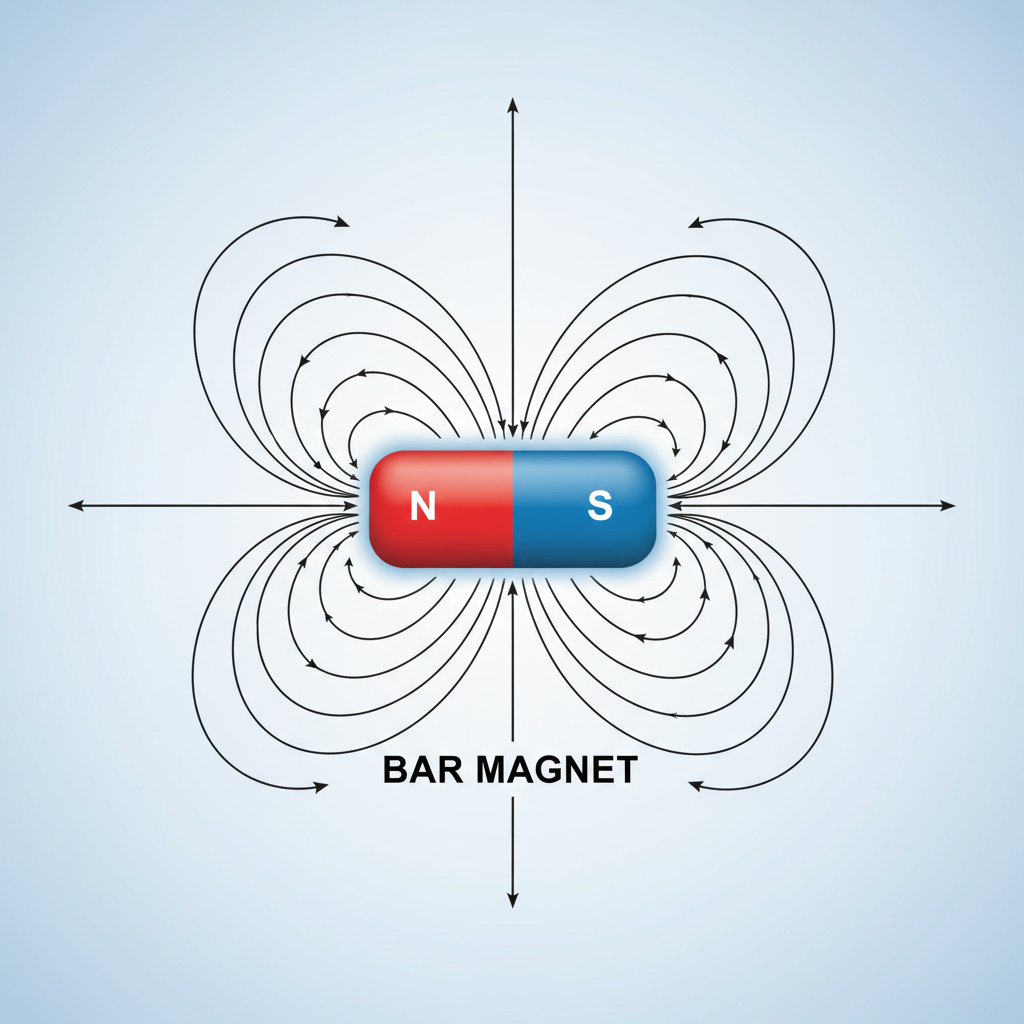
Poles of a Magnet
Every magnet has two ends, or poles. These are usually called the North Pole (N) and the South Pole (S). You can think of these poles like the 'head' and 'tail' of a magnet.
What's special about these poles? They behave in predictable ways:
- Opposite poles attract: If you bring the North Pole of one magnet close to the South Pole of another, they will pull towards each other, like two friends hugging.
- Like poles repel: If you bring two North Poles together, or two South Poles together, they will push away from each other, like two people who don't want to get too close.
Imagine you have two friends, Alice and Bob. Alice is always friendly with Bob (North attracts South). But if Alice meets another Alice (North meets North), they might feel a bit awkward and want to keep their distance (repel). The same happens if Bob meets another Bob.
Magnetic Field Lines
Scientists use invisible lines to show where the magnetic field is and in which direction it's pointing. These are called magnetic field lines.
Think of these lines like invisible roads that the magnetic force travels on. They always start at the North Pole of a magnet and end at the South Pole. They loop around and go back from the South Pole to the North Pole outside the magnet, forming complete circles.
Here are some key things about these lines:
- Direction: The lines show the direction of the magnetic force. If you were to place a tiny compass needle in a magnetic field, it would point in the direction of the magnetic field line at that spot. It's like the lines are telling the compass which way to go.
- Density: Where the lines are closer together, the magnetic field is stronger. This usually happens near the poles of the magnet. Think of it like a busy highway versus a quiet country road – more cars (force) on the busy highway.
- No Crossing: Magnetic field lines never cross each other. They are like separate lanes on a highway, each going its own way without merging.
Imagine you have a bunch of tiny arrows. If you place them around a magnet, they would all point away from the North Pole and towards the South Pole. That's what magnetic field lines represent!
What Can Be Magnetic?
Not everything can be attracted or repelled by magnets. Only certain materials are affected. The most common ones are:
- Iron: Think of nails, paperclips, and the metal in your fridge.
- Nickel
- Cobalt
These materials are called ferromagnetic materials. Other things, like wood, plastic, or aluminum, are not magnetic and won't be attracted to a magnet. A magnet trying to attract a piece of wood is like trying to get a shy cat to play with you – it just won't happen!
How Magnets Create Fields
Magnets create magnetic fields because of the tiny particles inside them called electrons. Electrons are like tiny spinning tops. When lots of these tiny tops spin in the same direction within a material, it can become a magnet and create a magnetic field.
In most materials, these tiny tops spin in random directions, canceling each other out. But in magnetic materials, they line up, and their combined effect creates the invisible force we call a magnetic field.
Real-World Examples
Magnetic fields are all around us and are super important!
- Refrigerator Magnets: They stick to your fridge because the fridge door is made of steel (which contains iron) and is magnetic.
- Compasses: The needle in a compass is a small magnet that aligns itself with the Earth's natural magnetic field, helping us find directions.
- Electric Motors: These use magnets to create movement in things like fans and blenders.
- Speakers: The sound you hear from speakers is produced by magnets interacting with electricity.
So, next time you play with a magnet, remember that it's not just a toy; it's a demonstration of an invisible force field that plays a big role in our world!
Keep learning, free
Create a free Syllabax account to unlock practice questions and games for this topic.
Visual Learning Enhanced! 🚀
To help you master this topic, we use Advanced Syllabax AI to generate detailed diagrams and visual models.
Note on Visuals: The AI sometimes makes spelling errors in image labels. Please refer to the lesson text for the correct terminology.