Number Series – Analytical Reasoning
Watch this topic in 60 seconds
Free preview · Lesson 1
Number Series – Analytical Reasoning (Foundational)
Number Series – Analytical Reasoning (Foundational)
Hey there, future problem-solvers! Ever noticed how numbers can follow a pattern? That's what we're diving into today with Number Series!
What is a Number Series?
A number series is simply a list of numbers that follow a specific rule or pattern. Our job is to figure out what that rule is and use it to find missing numbers or the next number in the series. It's like being a detective, but with numbers!
Key Definitions:
- Series: A sequence or list of numbers.
- Pattern: The rule or relationship between the numbers in the series.
Basic Number Series Patterns
Let's look at some common patterns:
- Adding/Subtracting the Same Number:
- Example: 2, 4, 6, 8, ___. (We're adding 2 each time!)
- Multiplying/Dividing by the Same Number:
- Example: 3, 9, 27, 81, ___. (We're multiplying by 3 each time!)
- Increasing or Decreasing by a Pattern:
- Example: 1, 3, 6, 10, ___. (We're adding 2, then 3, then 4...)

How to Solve Number Series Problems
Here's a simple step-by-step guide:
- Look for a Pattern: Is it adding, subtracting, multiplying, or dividing?
- Figure Out the Rule: What exactly is being added, subtracted, multiplied, or divided?
- Apply the Rule: Use the rule to find the missing number or the next number in the series.
- Check Your Answer: Does your answer fit the pattern?
Example Problem
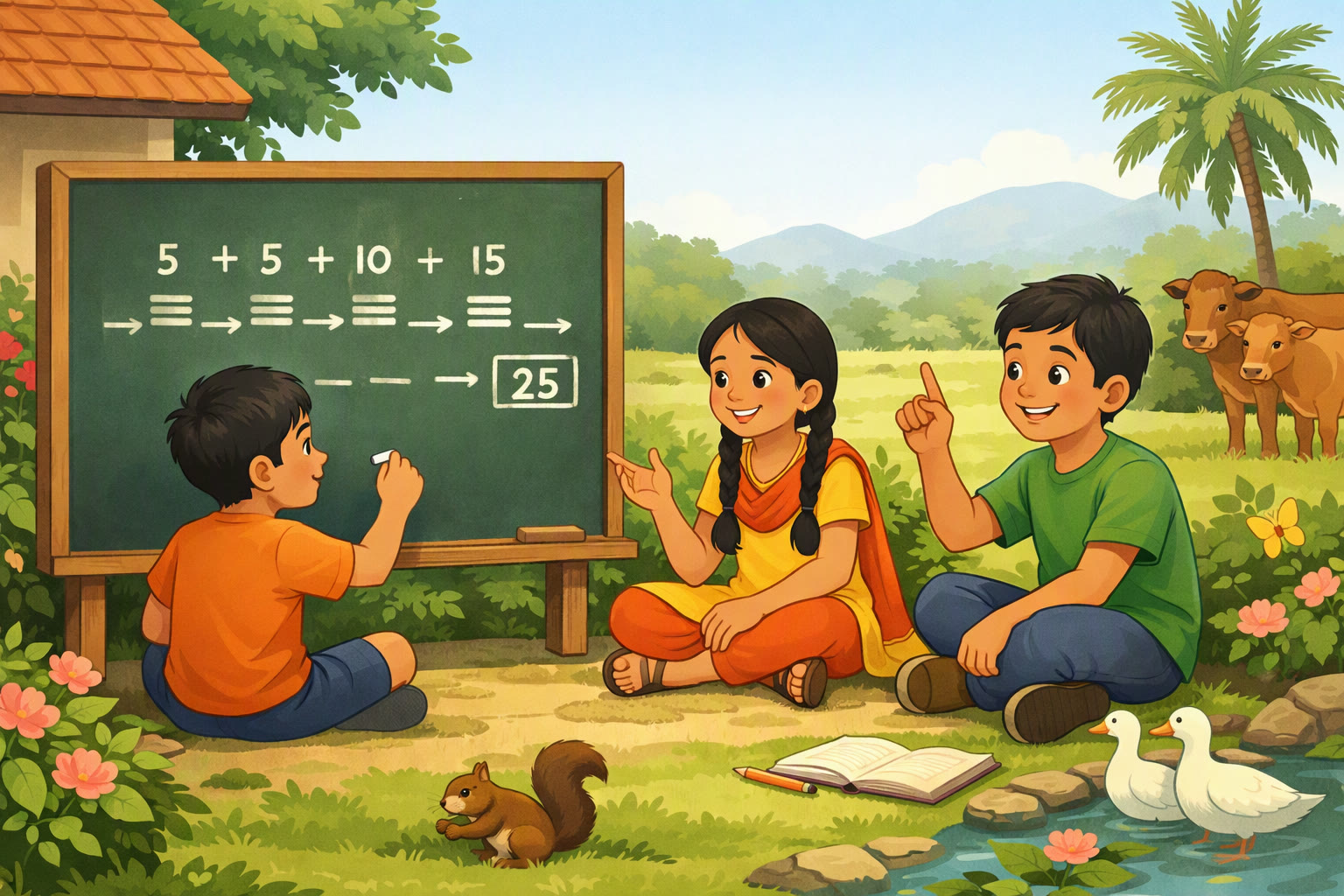
Let's try one together: 5, 10, 15, 20, ___
- Pattern: It looks like we're adding something.
- Rule: We're adding 5 each time (5 + 5 = 10, 10 + 5 = 15, 15 + 5 = 20).
- Apply the Rule: 20 + 5 = 25
- Check: 5, 10, 15, 20, 25... The pattern holds!
So, the missing number is 25!
With a little practice, you'll become a number series master!
Keep learning, free
Create a free Syllabax account to unlock practice questions and games for this topic.
Visual Learning Enhanced! 🚀
To help you master this topic, we use Advanced Syllabax AI to generate detailed diagrams and visual models.
Note on Visuals: The AI sometimes makes spelling errors in image labels. Please refer to the lesson text for the correct terminology.