Learning Journey
Free preview · Lesson 1
Understanding Symmetry in objects (Symmetry)
Discovering Symmetry: A Mirror Image Adventure!
Hello, young explorers! Today, we're going on a super fun adventure to discover something magical called **symmetry**. Have you ever looked in a mirror and seen yourself? It's like looking at a perfect twin, right? Symmetry is a lot like that! It's when one side of an object looks exactly like the other side, just like a mirror image. Let's dive in and find out more!
What is Symmetry?
Imagine you have a beautiful butterfly. If you could fold that butterfly perfectly in half, so that both wings touch each other exactly, then that butterfly has symmetry! This imaginary folding line is called the **line of symmetry**. It's like a secret line that divides an object into two identical halves.
Think of a perfectly round pizza. If you cut it right down the middle, you get two equal pieces, right? That cut is the line of symmetry! Many things in nature and the things we build have this amazing quality.
Looking for the Line of Symmetry
The line of symmetry is like a magic wand that cuts something in half, and when you fold it along that line, everything matches up perfectly. It can be a straight line or a curved line, depending on the shape!
Objects with One Line of Symmetry
Some objects have just one special line where you can fold them to make two equal halves. Let's think of some examples:
- A heart shape: If you draw a line straight down the middle of a heart, the left side looks exactly like the right side.
- A leaf: Many leaves have a stem and then veins that spread out. If you imagine a line going from the tip of the leaf down through the stem, it often divides the leaf into two similar halves.
- A capital letter 'A': This letter looks the same on both sides if you draw a line right down its middle.
Objects with More Than One Line of Symmetry
Some objects are so special that they have more than one line of symmetry! They can be folded in different ways to create matching halves.
- A square: A square is amazing! You can fold it in half across the middle, from top to bottom, or side to side. You can even fold it diagonally from corner to corner! That means a square has four lines of symmetry. It's like a super-symmetric shape!
- A circle: A circle is like a symmetry superstar! You can draw a line of symmetry through its center in any direction, and it will always divide the circle into two equal halves. It has an infinite number of lines of symmetry!
- A starfish: A starfish usually has five arms. If you can draw lines from the center of the starfish to the tip of each arm, you'll have five lines of symmetry.
Symmetry in Nature
Nature is full of symmetry! It's like nature's way of making things beautiful and balanced.
- Butterflies: We talked about butterflies earlier. Their wings are almost always symmetrical.
- Flowers: Many flowers have petals arranged in a symmetrical way. Think of a daisy with its petals spread out evenly.
- Snowflakes: Every snowflake is unique, but they all have a beautiful, delicate symmetry, usually with six arms.
Symmetry in Everyday Objects
Symmetry isn't just in nature; we see it all around us in the things we use and see every day!
- A table: A rectangular table can have two lines of symmetry.
- A clock: A round clock face has a line of symmetry going straight down the middle through the 12 and the 6.
- A balanced scale: This is a perfect example of symmetry – when both sides are equal.
Why is Symmetry Important?
Symmetry makes things look pleasing to our eyes. It helps create balance and order. Think about how a perfectly balanced drawing or a symmetrical toy looks more complete and beautiful.
Let's Practice!
Now that we've learned about symmetry, let's test our knowledge. Remember, symmetry means having two halves that are exactly the same when you fold an object along its line of symmetry.
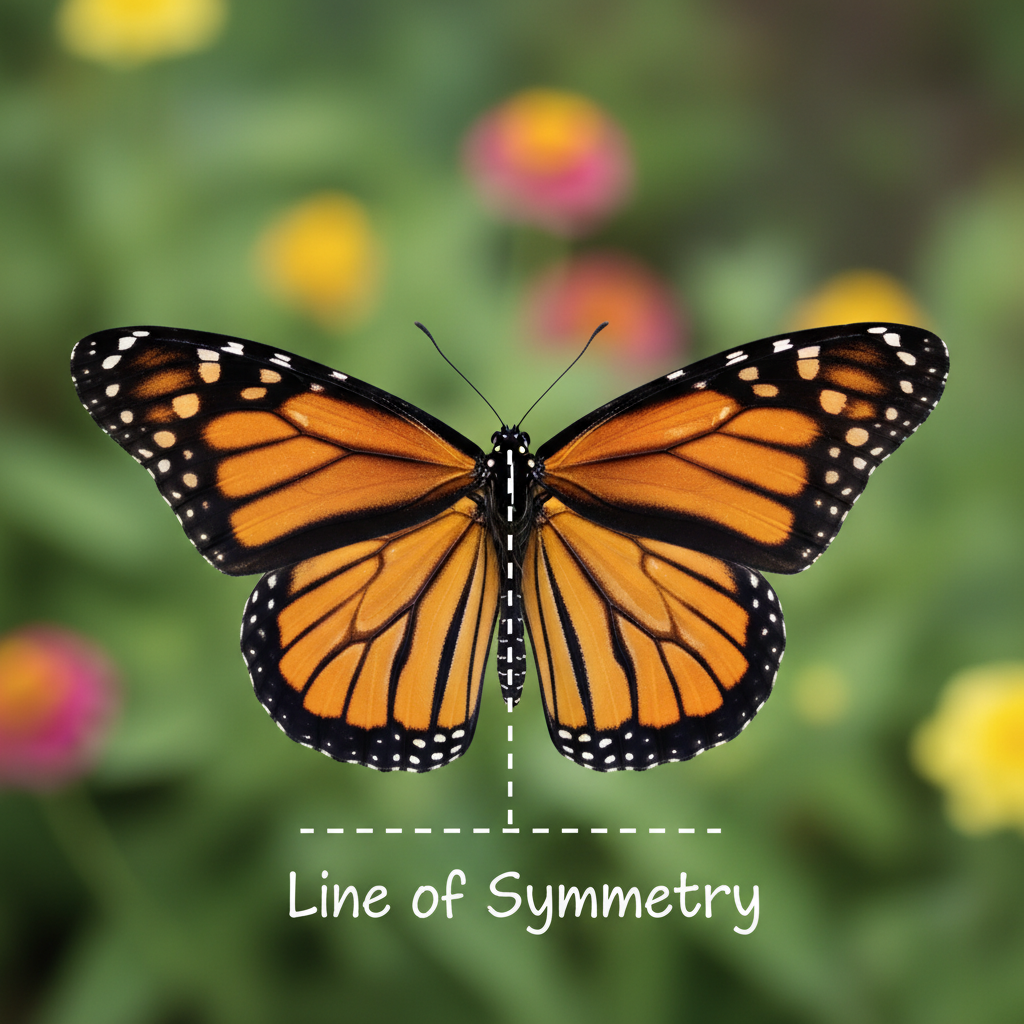
In the picture above, the butterfly has a dotted line. Can you imagine folding the butterfly along that dotted line? Both sides would match perfectly! This dotted line is the line of symmetry for the butterfly.
Look at the chair in the picture. The vertical dotted line shows one way to fold it to get two equal sides. Does the horizontal dotted line also show a way to fold it to get two equal sides? Think carefully!
What is a Line of Symmetry?
A line of symmetry is like a special folding line. When you fold an object exactly on this line, both halves match up perfectly. It's like looking in a mirror!
Objects That Are Symmetrical
An object is symmetrical if it has a line of symmetry. This means you can divide it into two identical halves.
Let's look at some shapes:
- A square: Symmetrical! It has 4 lines of symmetry.
- A rectangle: Symmetrical! It has 2 lines of symmetry.
- A circle: Symmetrical! It has many lines of symmetry.
- A triangle (equilateral): Symmetrical! It has 3 lines of symmetry.
- A heart: Symmetrical! It has 1 line of symmetry.
- A star (regular 5-pointed): Symmetrical! It has 5 lines of symmetry.
Objects That Are Not Symmetrical (Asymmetrical)
Some objects don't have a line of symmetry. No matter how you try to fold them, the halves won't match perfectly. These are called asymmetrical objects.
- A hand shape: If you try to fold a hand perfectly in half, the fingers won't match up.
- A random blob: Most irregular shapes are asymmetrical.
Keep your eyes open for symmetry all around you! It's a wonderful way to see the beauty and order in the world!
Keep learning, free
Create a free Syllabax account to unlock practice questions and games for this topic.
Visual Learning Enhanced! 🚀
To help you master this topic, we use Advanced Syllabax AI to generate detailed diagrams and visual models.
Note on Visuals: The AI sometimes makes spelling errors in image labels. Please refer to the lesson text for the correct terminology.