Addition word problems (simple) (Addition)
Watch this topic in 60 seconds
Free preview · Lesson 1
Understanding Addition word problems (simple) (Addition)
Addition Word Problems: Let's Count Together!
Welcome, young mathematicians! Today, we're going on an adventure with numbers. We're going to learn how to solve word problems using addition. Don't worry, it's like solving a little mystery where the answer is how many things we have in total!
What is a Word Problem?
Imagine you're at the park. You see a dog with 2 red balls. Then, another dog comes over with 3 blue balls. A word problem is like a story that asks you to figure something out using numbers. In this case, the mystery is: How many balls are there in total?
What is Addition?
Addition is like putting things together. When we add, we take two or more groups of things and combine them to find out how many we have altogether. Think about it like this:
- If you have 1 cookie and your friend gives you 1 more cookie, you put them together, and now you have 2 cookies! That's addition.
- If you have 3 crayons in your box and you add 2 more crayons, you're putting them all together. Now you have 5 crayons!
The symbol we use for addition is a plus sign: +. When you see a plus sign, it means we need to add, or put together.
Solving Addition Word Problems: Our Detective Toolkit!
To be great word problem detectives, we need a special toolkit. Here's what we'll use:
- Read the Story Carefully: We need to understand what the story is telling us. What are the numbers? What are we trying to find out?
- Tip: Look for words like "altogether," "total," "how many in all," "and," "plus," or "more." These words often tell you to add!
- Find the Numbers: What numbers are in the story? In our dog park example, the numbers are 2 (red balls) and 3 (blue balls).
- Analogy: Think of these numbers as clues! We need to collect all the clues to solve the mystery.
- Choose the Right Operation (Addition!): The story tells us to find the total number of balls. This means we need to put the groups together. So, we will use addition (+).
- Analogy: This is like deciding which tool to use in our detective kit. If we need to count everything together, we grab the 'addition tool'!
- Write the Number Sentence: We write down the numbers and the plus sign to show what we are doing. For the dog balls, it would be: 2 + 3.
- Analogy: This is like writing down our plan before we start the mission!
- Find the Answer: Now we solve our number sentence. We can count on our fingers, draw pictures, or use objects.
- For 2 + 3: Start with 2. Then, count 3 more. 3, 4, 5. So, 2 + 3 = 5.
- Analogy: This is the final reveal of the mystery! We found the total number of balls!
- Write the Answer in a Sentence: It's important to answer the question asked in the story. The question was "How many balls are there in total?" Our answer is 5. So, we write: "There are 5 balls in total."
Let's Try Another One!
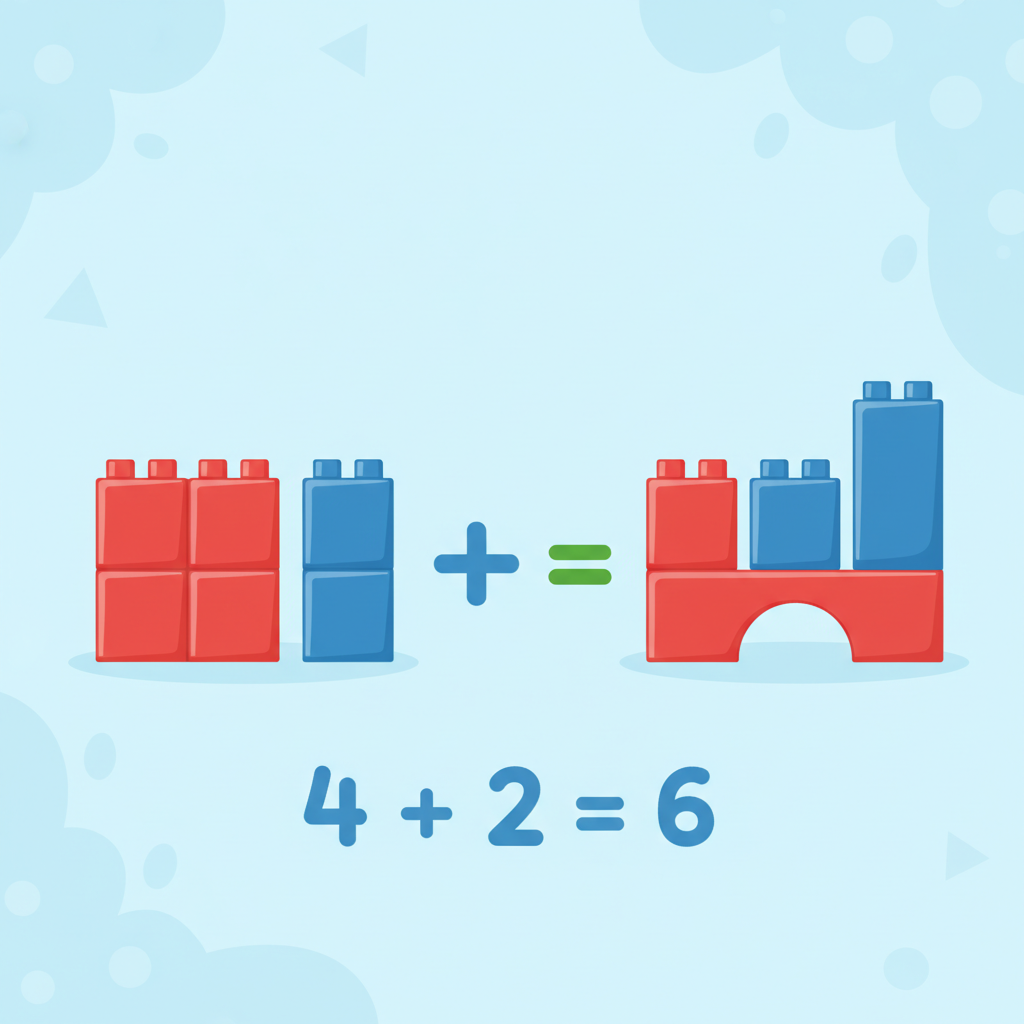
Sarah has 4 shiny stickers. Her mom gives her 2 more stickers for her birthday. How many stickers does Sarah have now?
Let's use our detective toolkit:
- Read: The story is about Sarah's stickers. We need to find out how many stickers she has now.
- Find the Numbers: Sarah has 4 stickers, and she gets 2 more. The numbers are 4 and 2.
- Choose Operation: The words "more" and "how many now" tell us to put them together. We use addition (+).
- Write Number Sentence: 4 + 2
- Find Answer: 4 + 2 = 6. (You can count: start at 4, then count 5, 6).
 ⚠️ This picture may have spelling mistakes. Trust the words in the lesson.
- Write Answer Sentence: Sarah has 6 stickers now.
More Fun Examples!
Example 1: Apples in a Basket
In a basket, there are 5 red apples and 3 green apples. How many apples are there in the basket altogether?
- Numbers: 5 and 3
- Operation: Addition (+)
- Number Sentence: 5 + 3
- Answer: 8
- Answer Sentence: There are 8 apples in the basket altogether.
Example 2: Birds on a Branch
A little bird sees 6 yummy worms on the ground. Then, it sees 1 more worm. How many worms did the bird see in total?
- Numbers: 6 and 1
- Operation: Addition (+)
- Number Sentence: 6 + 1
- Answer: 7
- Answer Sentence: The bird saw 7 worms in total.
Example 3: Toys on the Floor
Tom has 3 toy cars. His sister gives him 4 toy trucks. How many toys do they have together?
- Numbers: 3 and 4
- Operation: Addition (+)
- Number Sentence: 3 + 4
- Answer: 7
- Answer Sentence: They have 7 toys together.
Why is Addition Important?
Addition helps us every single day! When you count how many friends are at your party, how many candies you have, or how many steps you take, you are using addition (even if you don't write it down!). Being good at addition helps us understand the world around us better and solve everyday problems.
Keep practicing, and you'll become a word problem superstar!
 ⚠️ This picture may have spelling mistakes. Trust the words in the lesson.
Keep learning, free
Create a free Syllabax account to unlock practice questions and games for this topic.
Visual Learning Enhanced! 🚀
To help you master this topic, we use Advanced Syllabax AI to generate detailed diagrams and visual models.
Note on Visuals: The AI sometimes makes spelling errors in image labels. Please refer to the lesson text for the correct terminology.