Learning Journey
Watch this topic in 60 seconds
Free preview · Lesson 1
Understanding Direction sense (Logical Reasoning)
Mastering Direction Sense: Your Inner Compass (Grade 10, Foundational)
Hey there, future problem-solvers! Have you ever wondered how birds find their way home, or how sailors navigate vast oceans without GPS? While they use complex methods, the core idea is understanding direction. In logical reasoning, 'Direction Sense' is your superpower to figure out paths, positions, and movements, all without getting lost!
What is Direction Sense?
Imagine you're standing in a big, open field. Where's the school? Where's your friend's house? To answer these, you need a sense of direction. Direction sense in logical reasoning is all about understanding the relationship between different points or objects based on their positions relative to each other, and how movements change these positions.
Think of it like being a detective. You get clues like, 'He walked 5 steps North, then turned West.' Your job is to put these clues together and figure out where 'he' ended up. Sounds fun, right?
The Four Main Pillars: Cardinal Directions
Our world is generally mapped using four primary or 'cardinal' directions. These are your fundamental guides:
- North (N): Imagine standing where the sun rises. North is generally to your left. Or, think of the top of most maps.
- South (S): This is directly opposite North. If North is up, South is down.
- East (E): Where the sun rises! If you face North, East is to your right.
- West (W): Where the sun sets! This is directly opposite East. If you face North, West is to your left.
Analogy: Think of a simple cross (+) sign. The top arm points North, the bottom arm points South, the right arm points East, and the left arm points West. This simple visual is your first mental map!
Adding More Detail: Intermediate Directions
What if something isn't exactly North or East, but somewhere in between? That's where our intermediate directions come in. They combine the cardinal directions:
- Northeast (NE): Exactly between North and East.
- Southeast (SE): Exactly between South and East.
- Southwest (SW): Exactly between South and West.
- Northwest (NW): Exactly between North and West.
Analogy: Think of a clock face. If 12 is North, 3 is East, 6 is South, and 9 is West. Then 1:30 would be Northeast, 4:30 would be Southeast, and so on. These intermediate directions help us be more precise.
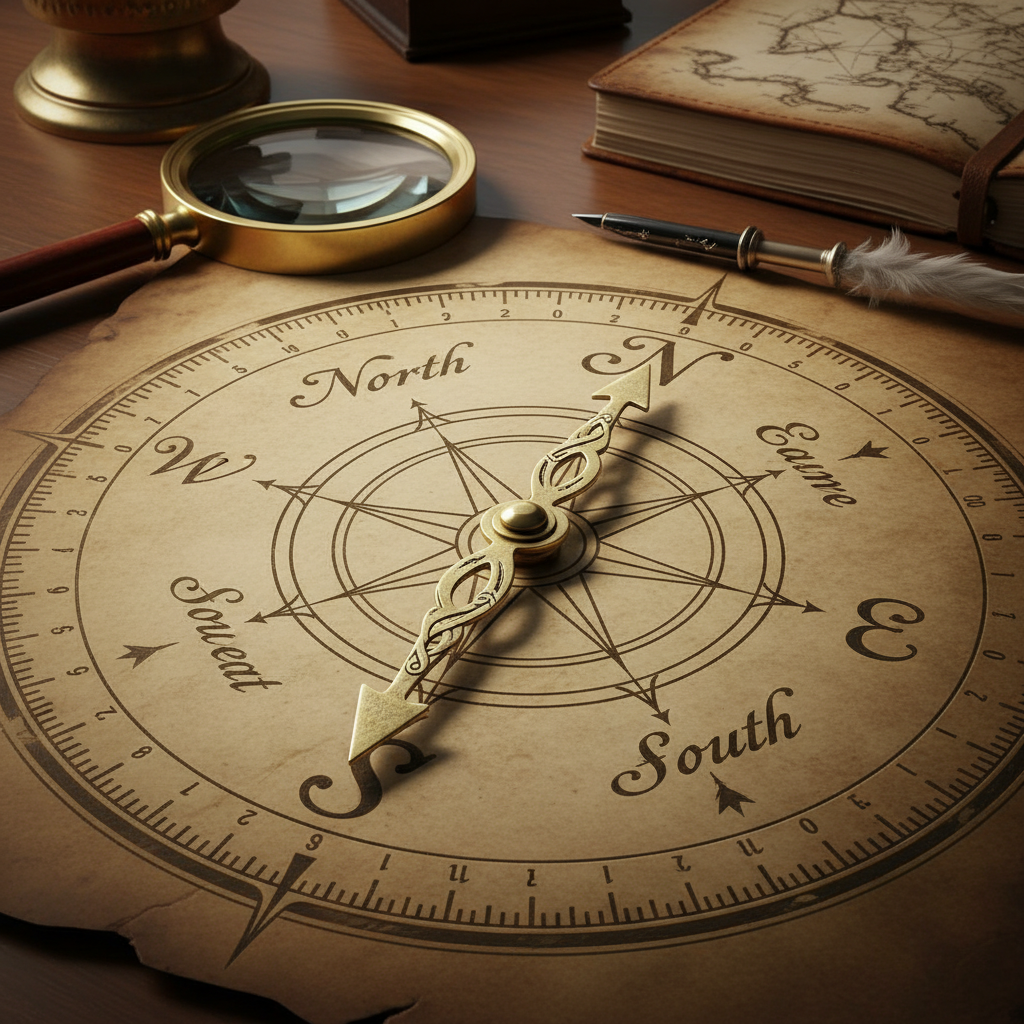 ⚠️ This picture may have spelling mistakes. Trust the words in the lesson.
The Art of Turning: Left and Right
Movements often involve turns. Understanding left and right turns is super important.
- Right Turn: When you turn to your right side. If you're walking North, a right turn means you'll now be walking East.
- Left Turn: When you turn to your left side. If you're walking North, a left turn means you'll now be walking West.
Analogy: Imagine you're driving a car. When you turn the steering wheel to the right, the car goes right. When you turn it left, the car goes left. The key is to always imagine yourself facing the direction you are currently moving in *before* making the turn.
Important Tip: If you're ever confused about left or right, simply stretch out your arms. Your left hand is usually the one you write with (if you're right-handed), or the one closer to your heart. Or, make an 'L' shape with your left thumb and forefinger – if it looks like a proper 'L', that's your left!
What About Degrees? Rotations!
Sometimes, turns are described in 'degrees'. Think of a full circle as 360 degrees. Each cardinal direction is 90 degrees away from its neighbor.
- Clockwise: Turning in the same direction as the hands of a clock (right turn).
- Anti-clockwise (or Counter-clockwise): Turning in the opposite direction of the hands of a clock (left turn).
Here’s how degrees relate to turns:
- 90-degree turn: This is a standard 'single' right or left turn, moving you from a cardinal direction to the next (e.g., North to East, or North to West).
- 180-degree turn: This is a 'U-turn' or turning completely around. If you were facing North, a 180-degree turn means you're now facing South.
- 270-degree turn: This is equivalent to three 90-degree turns in the same direction, or one 90-degree turn in the opposite direction. For example, a 270-degree clockwise turn from North would make you face West.
Analogy: Imagine standing on the center of a clock face. If you face 12 (North), turning to 3 (East) is a 90-degree clockwise turn. Turning to 9 (West) is a 90-degree anti-clockwise turn. Turning to 6 (South) is a 180-degree turn.
Putting It All Together: Simple Problem-Solving Strategy
- Start with a Point: Always assume a starting point, usually the center of your page.
- Draw as You Go: Use lines and arrows to represent movements. If someone walks North, draw a line upwards.
- Mark Turns Clearly: When a turn happens, change the direction of your next line. Remember to always orient yourself to the *current* direction of travel before making a turn.
- Visualize: Try to see the path in your mind's eye.
- Don't Overthink Distance (for direction problems): For foundational direction problems, the exact length of the line isn't always critical, but the direction is. However, if distance is asked, draw lengths proportionally.
Example Walkthrough:
Rahul walks 5 meters North. Then he turns right and walks 3 meters. Then he turns left and walks 2 meters. In which direction is he now from his starting point?
- Start: Mark a dot.
- North: Draw a line up from the dot.
- Turns Right: From the end of the North line, draw a line to the right (East).
- Turns Left: From the end of the East line, draw a line upwards (North).
If you look at your final position relative to the starting dot, you'll see he's generally 'up' and 'right' from the start. So, he is in the Northeast direction from his starting point.
Why is This Important?
Beyond competitive exams, direction sense helps you:
- Navigate new places.
- Understand maps better.
- Give clear directions to others.
- Improve your spatial reasoning skills (how well you understand objects in space).
So, practice makes perfect! The more you visualize these movements, the better your internal compass will become. You've got this!
Keep learning, free
Create a free Syllabax account to unlock practice questions and games for this topic.
Visual Learning Enhanced! 🚀
To help you master this topic, we use Advanced Syllabax AI to generate detailed diagrams and visual models.
Note on Visuals: The AI sometimes makes spelling errors in image labels. Please refer to the lesson text for the correct terminology.