Cylinder (basic introduction) (Volume & Surface Area)
Watch this topic in 60 seconds
Free preview · Lesson 1
Understanding Cylinder (basic introduction) (Volume & Surface Area)
Understanding Cylinders: The Basics of Volume and Surface Area
Imagine a soda can, a battery, or even a toilet paper roll. What do these everyday objects have in common? They're all examples of a fascinating 3D shape called a cylinder! In this lesson, we're going to dive into what makes a cylinder special and how to measure two important things about it: its volume (how much it can hold) and its surface area (how much material it takes to make it).
What is a Cylinder, Anyway?
Think of a cylinder as a "tube" or a "can" shape. More formally, a cylinder is a three-dimensional shape that has two identical, flat, circular ends (called bases) and one curved side that connects them. The bases are always parallel to each other. If you stack a bunch of identical coins perfectly on top of each other, you'd be building a cylinder!
Key Parts of a Cylinder:
- Bases: The two flat, circular ends. Think of the top and bottom of a soup can. These are congruent (exactly the same size and shape).
- Height (h): The distance between the two circular bases. If you stand a can upright, its height is how tall it is.
- Radius (r): The distance from the center of one of the circular bases to its edge. It's half of the diameter of the circle. This is super important because it determines how wide or narrow your cylinder is.
- Curved Surface: This is the side that wraps around the two circular bases. Imagine the label on a can of peas – that's the curved surface!
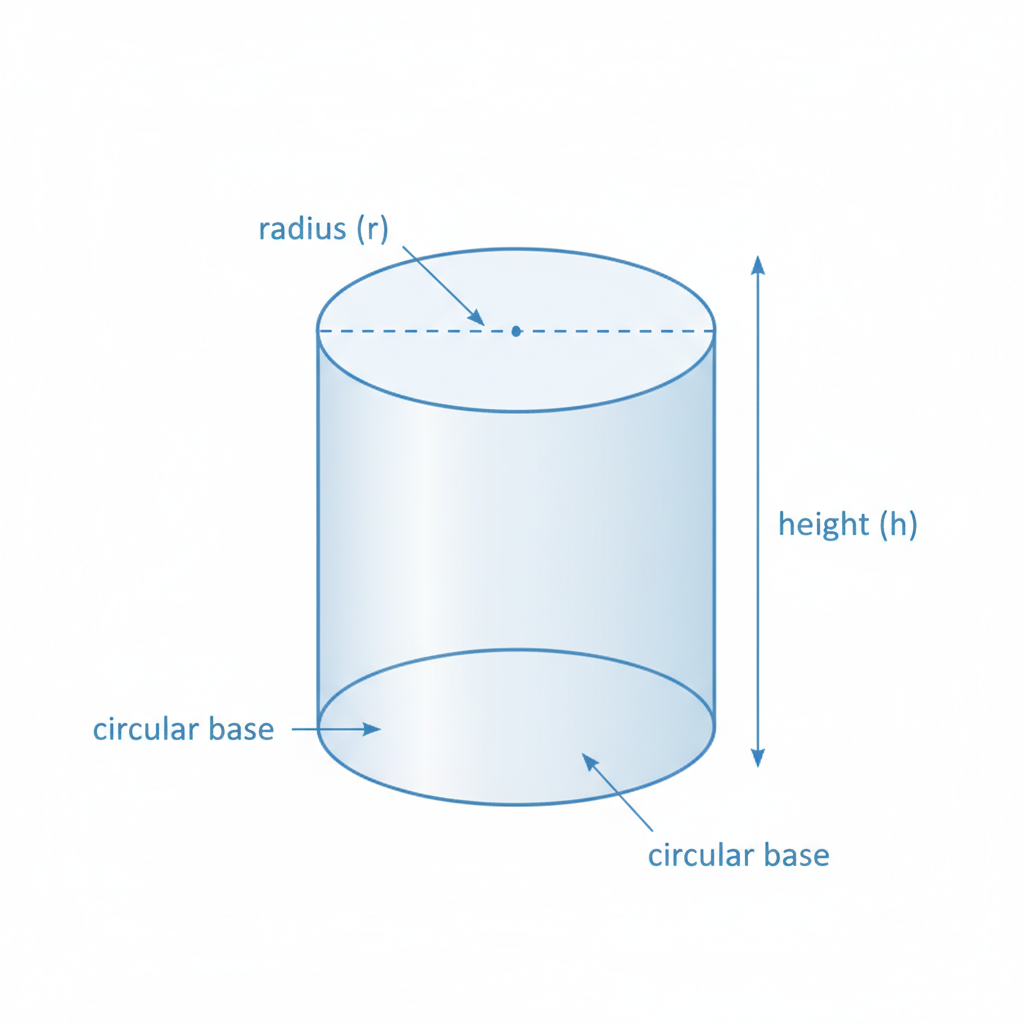 ⚠️ This picture may have spelling mistakes. Trust the words in the lesson.
Volume of a Cylinder: How Much Can It Hold?
When we talk about the volume of a cylinder, we're asking: "How much space does this cylinder take up?" or "How much can I fit inside it?" Think about filling a glass with water, a silo with grain, or a swimming pool with water. You're measuring its volume!
An Easy Way to Think About Volume:
Imagine you have a stack of pancakes. Each pancake is a circle. If you know the area of one pancake (its circular base) and you know how many pancakes are in the stack (its height), you can find the total "volume" of your pancake stack! It's the same idea with a cylinder.
The volume of any prism-like shape (and a cylinder is kind of like a circular prism!) is found by a simple idea:
Volume = (Area of the Base) × (Height)
Let's break down the Cylinder Volume Formula:
- Area of the Base: Since the base of a cylinder is a circle, its area is calculated using the formula for the area of a circle: Area = πr². Remember, π (pi) is a special number, approximately 3.14. 'r' is the radius of the circular base.
- Height (h): This is simply the distance between the two bases.
So, putting it all together, the formula for the Volume of a Cylinder is:
Volume (V) = πr²h
The units for volume are always "cubic" units, like cubic centimeters (cm³) or cubic inches (in³), because you're multiplying three dimensions together (radius squared is like length × length, then × height).
Example Time! Calculating Volume:
Let's say you have a cylindrical can with a radius of 3 cm and a height of 10 cm. How much water can it hold?
- Radius (r) = 3 cm
- Height (h) = 10 cm
- π ≈ 3.14
Volume (V) = πr²h
V = 3.14 × (3 cm)² × 10 cm
V = 3.14 × 9 cm² × 10 cm
V = 3.14 × 90 cm³
V ≈ 282.6 cm³
So, the can can hold approximately 282.6 cubic centimeters of water!
Surface Area of a Cylinder: How Much Material to Cover It?
The surface area of a cylinder is the total area of all the surfaces that make up the cylinder. Imagine you want to paint the entire outside of a cylindrical water tank, or wrap a gift in a cylindrical box. The amount of paint or wrapping paper you'd need tells you its surface area.
Unwrapping a Cylinder: A Helpful Analogy
To understand surface area, let's "unwrap" a cylinder. If you carefully cut open a soup can (remove the top and bottom lids, then cut the curved label straight down and unroll it), what shapes would you get?
- Two circles (the top and bottom lids).
- One rectangle (the unrolled label).
The total surface area is simply the sum of the areas of these three pieces!
Breaking Down the Surface Area Formula:
- Area of the Two Circular Bases: Each base is a circle, so its area is πr². Since there are two identical bases (top and bottom), their combined area is 2 × πr².
- Area of the Curved Surface (the Rectangle):
- When you unroll the curved surface, it becomes a rectangle.
- One side of this rectangle is the height (h) of the cylinder.
- The other side of this rectangle is the distance around the circular base. What's the distance around a circle? It's its circumference! The formula for circumference is 2πr.
- So, the area of the curved rectangle is: (Circumference) × (Height) = 2πrh.
Now, let's add them all up to get the total Surface Area of a Cylinder:
Surface Area (SA) = 2πr² + 2πrh
The units for surface area are always "square" units, like square centimeters (cm²) or square inches (in²), because you're measuring a flat area.
Example Time! Calculating Surface Area:
Let's use the same can: radius of 3 cm and height of 10 cm. What is its total surface area?
- Radius (r) = 3 cm
- Height (h) = 10 cm
- π ≈ 3.14
First, find the area of the two bases:
Area of two bases = 2 × πr²
= 2 × 3.14 × (3 cm)²
= 2 × 3.14 × 9 cm²
= 56.52 cm²
Next, find the area of the curved surface:
Area of curved surface = 2πrh
= 2 × 3.14 × 3 cm × 10 cm
= 6.28 × 30 cm²
= 188.4 cm²
Now, add them together for the total surface area:
Surface Area (SA) = Area of two bases + Area of curved surface
SA = 56.52 cm² + 188.4 cm²
SA ≈ 244.92 cm²
So, the total surface area of the can is approximately 244.92 square centimeters.
Putting It All Together
Cylinders are everywhere, and understanding their volume and surface area helps us in many ways, from packaging design to engineering. Remember these core ideas:
- Volume is about how much "stuff" fits inside.
- Surface Area is about how much "skin" or material covers the outside.
- The radius and height are your best friends when working with cylinders!
Keep practicing, and you'll be a cylinder expert in no time!
Keep learning, free
Create a free Syllabax account to unlock practice questions and games for this topic.
Visual Learning Enhanced! 🚀
To help you master this topic, we use Advanced Syllabax AI to generate detailed diagrams and visual models.
Note on Visuals: The AI sometimes makes spelling errors in image labels. Please refer to the lesson text for the correct terminology.