Types of mixtures[CHEMISTRY]
Watch this topic in 60 seconds
Free preview · Lesson 1
Understanding Types of mixtures[CHEMISTRY]
Understanding Mixtures: A Blend of Substances!
Welcome, budding scientists, to the fascinating world of chemistry! Today, we're going to explore something you encounter every single day, even if you don't realize it: mixtures. Think of chemistry as a giant toolbox, and elements and compounds are like individual tools. Mixtures are what happen when you decide to put a few of those tools together, but they don't permanently change each other. They just hang out together!
What is a Mixture?
Imagine you're making a delicious fruit salad. You chop up strawberries, blueberries, grapes, and maybe some melon. You toss them all into a bowl. Do the strawberries magically turn into blueberries? No! They still keep their own flavors, colors, and shapes. That's exactly what a mixture is: two or more substances that are physically combined, but not chemically bonded. This means each substance in the mixture keeps its own properties.
Think about it like this:
- A team of superheroes: Each superhero has their own unique powers (like Superman's flight or Batman's detective skills), but they work together as a team. They don't merge into one super-being.
- A box of crayons: You have red, blue, green, and yellow crayons all in the same box. They are mixed together, but each crayon is still its distinct color.
- A classroom: You have students with different personalities, interests, and hair colors all learning together. They are a group, but each student remains an individual.
In a mixture, the different substances can be easily separated by physical means. For example, if you have a mixture of sand and salt, you can use water to dissolve the salt, and then filter out the sand. The salt can be recovered by evaporating the water. It's like taking your fruit salad apart – you can pick out the grapes from the strawberries if you wanted to!
Types of Mixtures
Now, not all mixtures are created equal. Some are really uniform, like a perfectly blended smoothie, while others are chunky, like a trail mix. We classify mixtures into two main types:
1. Homogeneous Mixtures (Solutions)
The word 'homo' means 'same'. In a homogeneous mixture, the substances are evenly distributed throughout. This means that no matter where you take a sample from the mixture, it will have the same composition. These are often called solutions.
Think about these examples:
- Saltwater: When you dissolve salt in water, the salt particles spread out so evenly that you can't see them anymore. The water tastes salty all the way through.
- Sugar in tea: Stirring sugar into your tea until it dissolves creates a homogeneous mixture. The sweetness is spread throughout the entire cup.
- Air: The air we breathe is a mixture of gases like nitrogen, oxygen, and a little bit of carbon dioxide. These gases are mixed so perfectly that we can't see or separate them easily.
- Vinegar: It's a solution of acetic acid in water.
The key here is uniformity. It looks like just one substance, even though there are multiple components. It's like a perfectly blended milkshake – you can't pick out the ice cream from the milk anymore.
Components of a Solution:
Solutions have two parts:
- Solute: The substance that gets dissolved. In saltwater, the salt is the solute.
- Solvent: The substance that does the dissolving. In saltwater, the water is the solvent.
The solute dissolves *in* the solvent. Think of the solvent as the 'bigger' or more abundant part that makes space for the solute.
2. Heterogeneous Mixtures
The word 'hetero' means 'different'. In a heterogeneous mixture, the substances are *not* evenly distributed. You can usually see the different parts of the mixture, and they don't blend together uniformly.
Imagine these:
- Trail mix: You can easily see the peanuts, raisins, and chocolate chips all mixed together. They are not evenly spread; you might get a handful with mostly peanuts and another with mostly raisins.
- Salad: A tossed salad has lettuce, tomatoes, cucumbers, and dressing. You can see and pick out each individual ingredient.
- Sand and water: If you mix sand into water, the sand particles will sink to the bottom, or you'll see clumps of sand suspended in the water. It's clearly not uniform.
- Cereal with milk: The cereal pieces and the milk are mixed, but they remain distinct.
Heterogeneous mixtures can be further divided, but for foundational understanding, remember that you can usually see the separate components. It's like a bag of marbles of different colors – you can pick out the blue ones from the red ones easily.
Here's a helpful visual!
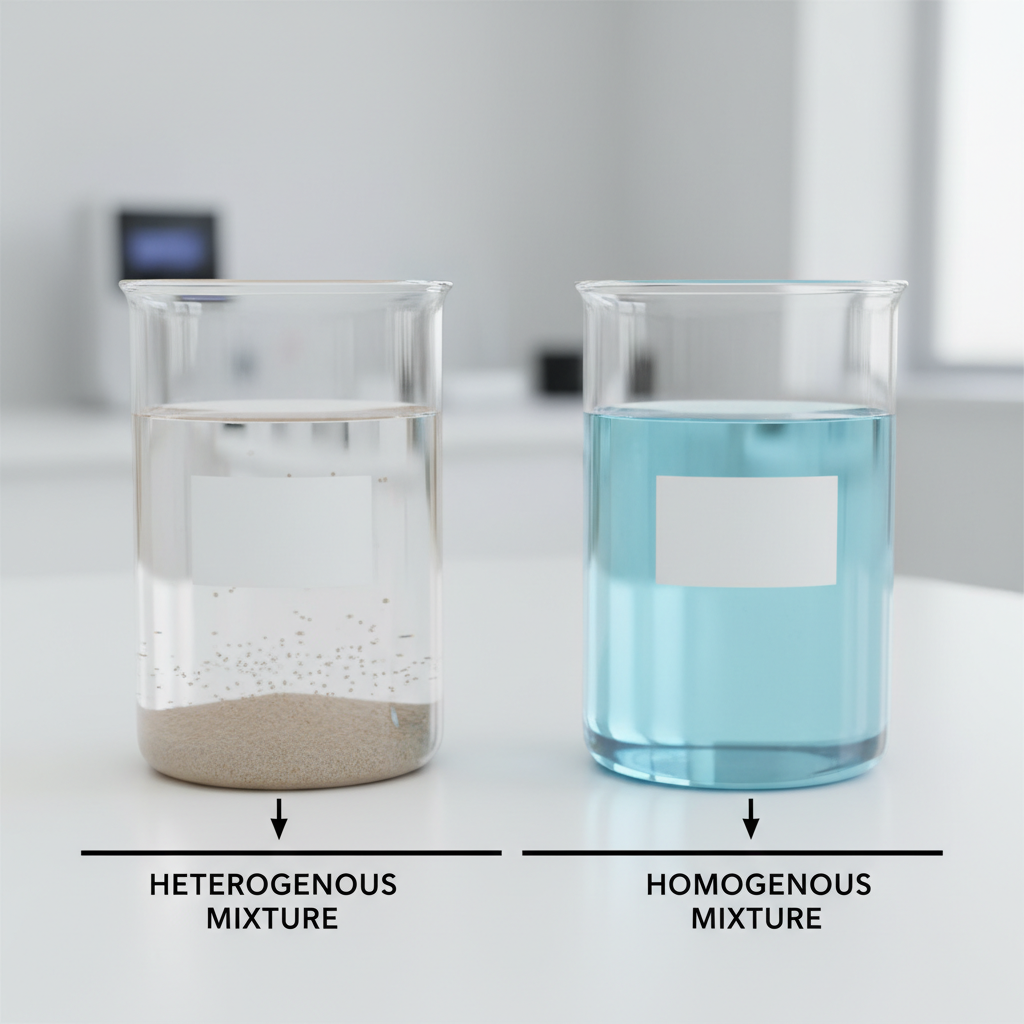 ⚠️ This picture may have spelling mistakes. Trust the words in the lesson.
Why Does This Matter?
Understanding mixtures helps us in so many ways. When scientists make medicines, they need to ensure everything is mixed just right (homogeneous solutions). When we cook, we create mixtures – sometimes homogeneous (like a smooth sauce) and sometimes heterogeneous (like a chunky stew). Knowing the difference helps us control how our food turns out and how our substances behave.
So, the next time you have a glass of juice, a bowl of cereal, or even just breathe the air, think about the mixtures you're interacting with! Are they all blended perfectly, or can you see the different parts? You're now one step closer to becoming a chemistry whiz!
Keep learning, free
Create a free Syllabax account to unlock practice questions and games for this topic.
Visual Learning Enhanced! 🚀
To help you master this topic, we use Advanced Syllabax AI to generate detailed diagrams and visual models.
Note on Visuals: The AI sometimes makes spelling errors in image labels. Please refer to the lesson text for the correct terminology.