Fundamental Counting Principle
Watch this topic in 60 seconds
Free preview · Lesson 1
Understanding Fundamental Counting Principle
Unlocking the World of Choices: The Fundamental Counting Principle
Have you ever stood in front of your closet, overwhelmed by all the possible outfits you could create? Or maybe you've tried to guess a friend's phone passcode? Life is full of choices, and often, we want to know just how many different ways something can happen. That's where the Fundamental Counting Principle comes in! It's a simple, yet powerful, tool that helps us count possibilities without having to list every single one.
The Big Question: How Many Ways?
Imagine you're at an ice cream parlor. They have 3 different cone types (waffle, sugar, plain) and 4 different ice cream flavors (chocolate, vanilla, strawberry, mint). If you can only pick one cone and one flavor, how many different combinations can you create?
You could start listing them:
- Waffle + Chocolate
- Waffle + Vanilla
- Waffle + Strawberry
- Waffle + Mint
- Sugar + Chocolate
- Sugar + Vanilla
- Sugar + Strawberry
- Sugar + Mint
- Plain + Chocolate
- Plain + Vanilla
- Plain + Strawberry
- Plain + Mint
That's 12 combinations! But what if the numbers were much bigger? What if there were 10 cone types and 20 flavors? Listing them all would be a nightmare!
The Secret Sauce: The Fundamental Counting Principle Explained
The Fundamental Counting Principle (FCP) gives us a much easier way to find the total number of outcomes. It states that if there are 'm' ways to do one thing, and 'n' ways to do another thing, then there are m × n total ways to do both things.
Think of it like building blocks. If you have different choices for the first block, and different choices for the second block, you just multiply the number of choices for each step to get the total number of ways to build the full structure.
Analogy Time! Let's Connect the Dots:
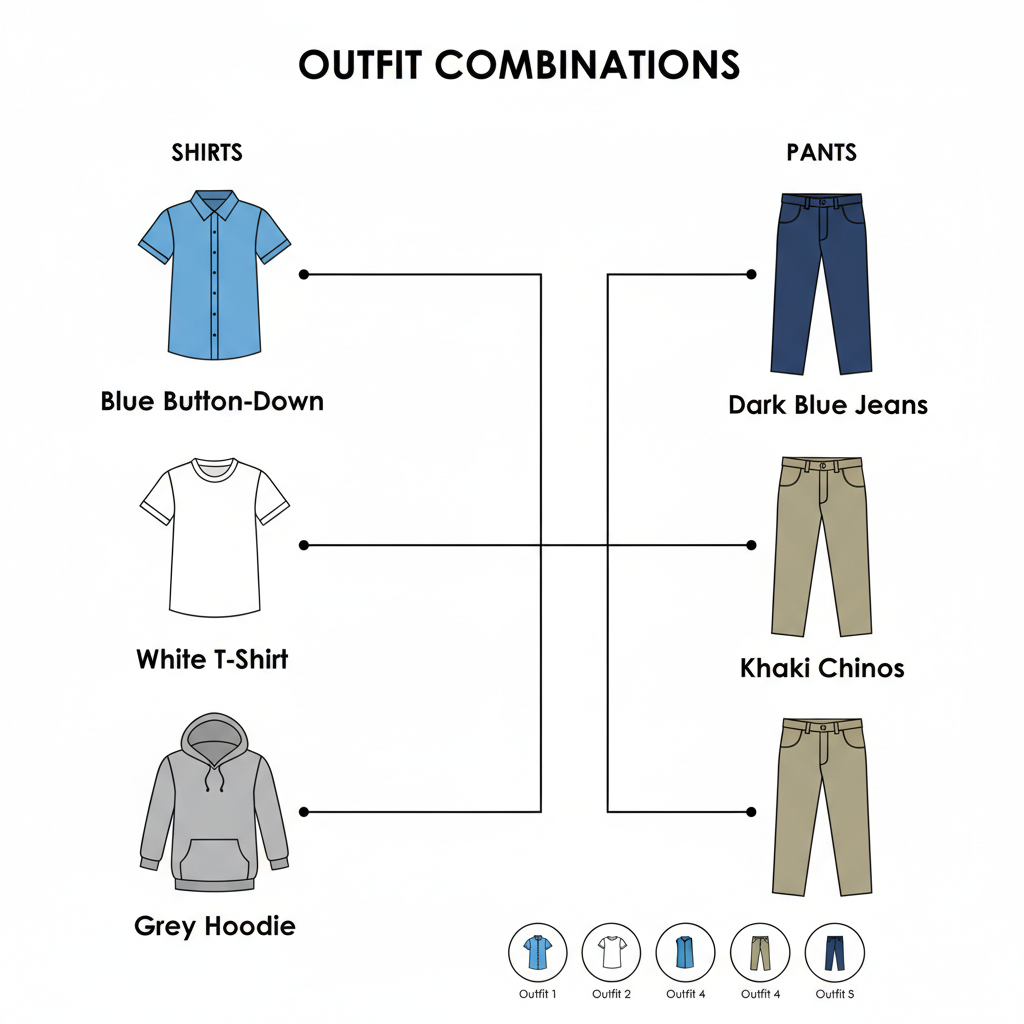
Analogy 1: The Outfit Creator
Imagine you have 3 different shirts (Red, Blue, Green) and 2 different pairs of pants (Jeans, Khakis). How many different outfits can you make?
- Step 1 (Choosing a shirt): You have 3 options.
- Step 2 (Choosing pants): You have 2 options.
Using the FCP: Total outfits = 3 (shirts) × 2 (pants) = 6 outfits. Let's list them to be sure:
- Red Shirt + Jeans
- Red Shirt + Khakis
- Blue Shirt + Jeans
- Blue Shirt + Khakis
- Green Shirt + Jeans
- Green Shirt + Khakis
It works!
 ⚠️ This picture may have spelling mistakes. Trust the words in the lesson.Analogy 2: The Ice Cream Parlor (Revisited)
Back to our ice cream. We had 3 cone types and 4 flavors.
- Step 1 (Choosing a cone): 3 options.
- Step 2 (Choosing a flavor): 4 options.
Total combinations = 3 (cones) × 4 (flavors) = 12 combinations. Exactly what we found by listing them!
Applying the Principle to More Steps
The beauty of the FCP is that it works for more than just two choices. If there are 'm' ways for the first event, 'n' ways for the second, 'p' ways for the third, and so on, then the total number of ways all the events can occur is m × n × p × ...
Example 1: Creating a PIN Code
You need to create a 4-digit PIN for your bank card. Each digit can be any number from 0 to 9.
- Step 1 (First digit): 10 choices (0, 1, 2, 3, 4, 5, 6, 7, 8, 9)
- Step 2 (Second digit): 10 choices (0-9)
- Step 3 (Third digit): 10 choices (0-9)
- Step 4 (Fourth digit): 10 choices (0-9)
Total possible PINs = 10 × 10 × 10 × 10 = 10,000 different PINs. That's a lot!
Example 2: License Plates
Imagine a license plate format where the first two characters are letters (A-Z) and the next three characters are numbers (0-9).
- Step 1 (First character - Letter): 26 choices (A-Z)
- Step 2 (Second character - Letter): 26 choices (A-Z)
- Step 3 (Third character - Number): 10 choices (0-9)
- Step 4 (Fourth character - Number): 10 choices (0-9)
- Step 5 (Fifth character - Number): 10 choices (0-9)
Total possible license plates = 26 × 26 × 10 × 10 × 10 = 676,000 different license plates.
What if there are restrictions?
Sometimes, choices aren't unlimited. For example, what if you couldn't repeat digits in your 4-digit PIN?
- Step 1 (First digit): 10 choices (0-9)
- Step 2 (Second digit): Now one digit is used, so only 9 choices left.
- Step 3 (Third digit): Two digits are used, so only 8 choices left.
- Step 4 (Fourth digit): Three digits are used, so only 7 choices left.
Total possible PINs (no repeats) = 10 × 9 × 8 × 7 = 5,040. Notice how the number of choices changes for each step when there's a restriction like 'no repeats'.
Why is this important?
The Fundamental Counting Principle isn't just for math class. It helps:
- Computer Scientists: Understand how many passwords or encryption keys are possible.
- Statisticians: Calculate probabilities of certain events occurring.
- Businesses: Figure out how many different product variations they can offer (like car models with different features).
- Everyday Life: From planning a trip with different routes and activities to choosing lottery numbers!
Wrapping It Up
The Fundamental Counting Principle is your key to efficiently counting possibilities. Instead of listing every single option, you just need to identify the number of choices at each independent step and multiply them together. It simplifies complex counting problems into straightforward multiplication. Keep practicing, and you'll soon be a master of choices!
Keep learning, free
Create a free Syllabax account to unlock practice questions and games for this topic.
Visual Learning Enhanced! 🚀
To help you master this topic, we use Advanced Syllabax AI to generate detailed diagrams and visual models.
Note on Visuals: The AI sometimes makes spelling errors in image labels. Please refer to the lesson text for the correct terminology.