Formula applications (Direct & Inverse Proportion)
Watch this topic in 60 seconds
Free preview · Lesson 1
Understanding Formula applications (Direct & Inverse Proportion)
Unlocking Formulas: Direct and Inverse Proportion (Grade 8)
Welcome, future math whizzes! Today, we're going on an exciting journey to understand how things in the world are connected through two very important relationships: Direct Proportion and Inverse Proportion. Don't worry, we'll break it down with simple words and lots of real-life examples!
What's a 'Proportion' Anyway?
Think about everyday situations. If you buy more ice cream cones, you usually pay more money, right? If more friends share a pizza, each friend gets a smaller slice. These are examples of things changing together in a predictable way. That 'predictable way' is what we call a proportion.
1. Direct Proportion: The 'Go-Together' Relationship
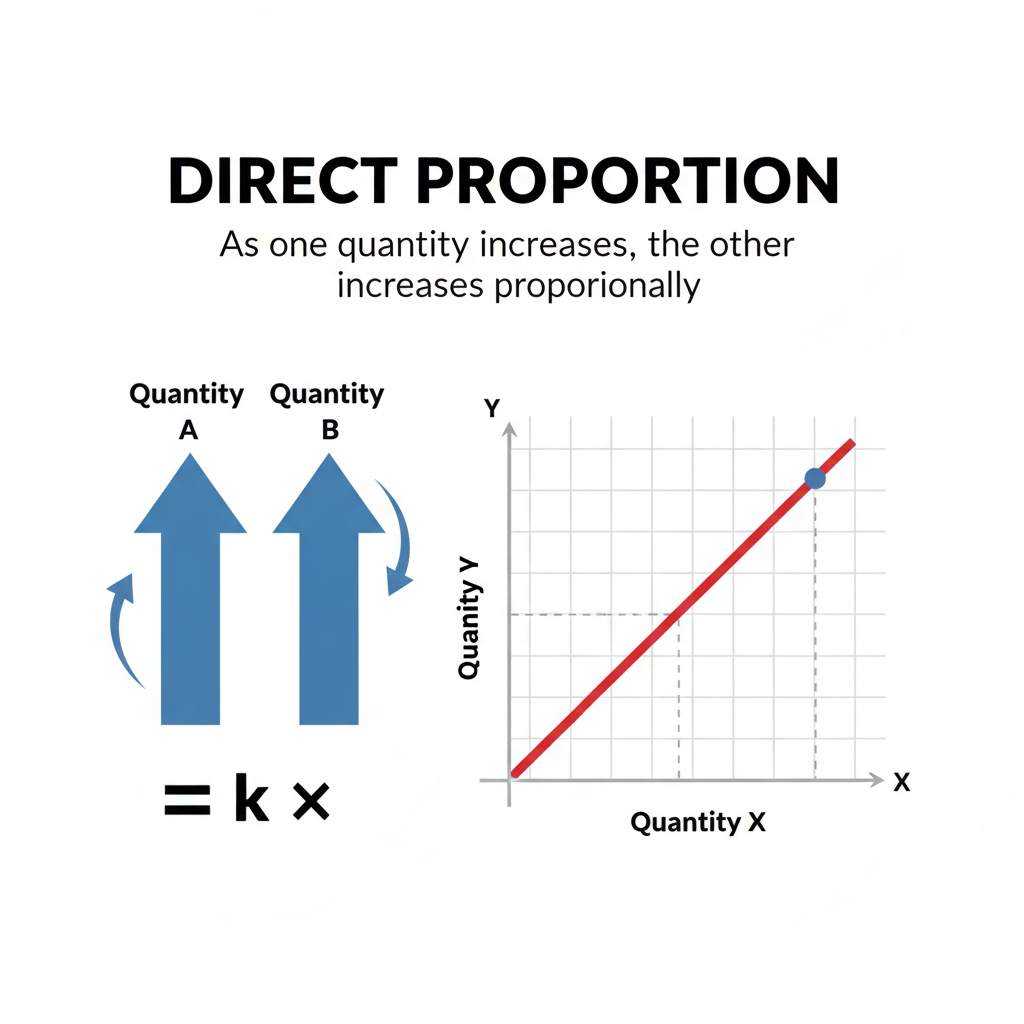
Imagine two friends, Alex and Ben. When Alex smiles, Ben smiles too. When Alex laughs, Ben laughs harder! This is like direct proportion – when one thing increases, the other thing also increases. And when one thing decreases, the other thing also decreases. They move in the same direction.
Key Idea:
- If two quantities are in direct proportion, their ratio stays the same.
- This means if
Ais directly proportional toB, thenA / B = k(wherekis a constant number). - We can also write this as
A = k * B. The 'k' is called the constant of proportionality. It's like the special rule or rate that connects the two things.
Analogy Time! Buying Apples 🍎
Let's say 1 apple costs $0.50. This is our constant rule, our 'k'.
- If you buy 2 apples, you pay $1.00 (
2 * $0.50). - If you buy 10 apples, you pay $5.00 (
10 * $0.50).
Notice how as the number of apples goes UP, the total cost also goes UP. And if you buy fewer apples, the cost goes DOWN. The ratio of (Cost / Number of Apples) is always $0.50. That's our 'k'!
Formula for Direct Proportion: If y is directly proportional to x, then y = kx.
Another Example: Distance and Time 🏃♂️
If you walk at a steady speed of 5 kilometers per hour, how far do you walk?
- In 1 hour, you walk 5 km.
- In 2 hours, you walk 10 km.
- In 3 hours, you walk 15 km.
Here, 'Distance' is directly proportional to 'Time'. The 'k' is your speed (5 km/h). As time increases, the distance increases.
2. Inverse Proportion: The 'Opposite Reaction' Relationship
Now, let's think about a seesaw. When one side goes UP, the other side goes DOWN. That's exactly how inverse proportion works! When one thing increases, the other thing decreases, and vice versa. They move in opposite directions.
Key Idea:
- If two quantities are in inverse proportion, their product stays the same.
- This means if
Ais inversely proportional toB, thenA * B = k(wherekis again a constant number). - We can also write this as
A = k / B.
Analogy Time! Sharing a Pizza 🍕
Imagine you have a single pizza (this is our constant, 'k'). How much pizza does each person get?
- If there's 1 person, they get the whole pizza.
- If there are 2 people, each gets 1/2 of the pizza.
- If there are 4 people, each gets 1/4 of the pizza.
Notice how as the number of people (one quantity) goes UP, the amount of pizza each person gets (the other quantity) goes DOWN. The total amount of pizza (1 whole pizza) is our 'k'. The product of (Number of People * Pizza per Person) is always 1 (or the total number of slices if we count slices).
Formula for Inverse Proportion: If y is inversely proportional to x, then y = k/x or xy = k.
Another Example: Speed and Travel Time 🚗
You need to drive a fixed distance, say 100 km (this is our 'k'). How long will it take?
- If you drive at 100 km/h, it takes 1 hour (
100 km / 100 km/h). - If you drive at 50 km/h, it takes 2 hours (
100 km / 50 km/h). - If you drive at 25 km/h, it takes 4 hours (
100 km / 25 km/h).
Here, 'Speed' is inversely proportional to 'Time'. As your speed increases, the time it takes to travel the same distance decreases.
How to Solve Problems with Proportion
Most proportion problems follow a few simple steps:
- Identify the relationship: Is it direct or inverse proportion? Read the problem carefully. Does one thing increasing make the other thing increase (direct) or decrease (inverse)?
- Write the formula: Use
y = kxfor direct ory = k/xfor inverse. - Find 'k': Use the information given in the problem to find the value of the constant of proportionality, 'k'. This usually involves plugging in a known pair of values for x and y.
- Use 'k' to find the unknown: Once you have 'k', use it with the new information to find the missing value.
Example: Solving a Direct Proportion Problem
Problem: The cost of fencing is directly proportional to its length. If 10 meters of fence cost $200, how much will 25 meters of fence cost?
- Identify: Cost increases with length, so it's direct proportion.
- Formula:
Cost = k * Length(Let Cost = C, Length = L, soC = kL) - Find 'k': We know
C = 200whenL = 10.200 = k * 10
k = 200 / 10
k = 20(This means each meter costs $20) - Use 'k' to find unknown: Now we want to find
CwhenL = 25.C = 20 * 25
C = 500
So, 25 meters of fence will cost $500.
Example: Solving an Inverse Proportion Problem
Problem: The time it takes to build a wall is inversely proportional to the number of workers. If 4 workers can build a wall in 6 days, how long will it take 8 workers?
- Identify: More workers mean less time, so it's inverse proportion.
- Formula:
Time = k / Workers(Let Time = T, Workers = W, soT = k/WorTW = k) - Find 'k': We know
T = 6whenW = 4.6 = k / 4
k = 6 * 4
k = 24(This 'k' represents the total 'worker-days' needed for the job) - Use 'k' to find unknown: Now we want to find
TwhenW = 8.T = 24 / 8
T = 3
So, 8 workers will take 3 days to build the wall.
Wrapping Up
Direct and inverse proportion are fundamental tools for understanding how quantities relate to each other in the real world. From calculating grocery bills to planning construction projects, these concepts are everywhere! Keep practicing, and you'll soon be a master of proportions!
Keep learning, free
Create a free Syllabax account to unlock practice questions and games for this topic.
Visual Learning Enhanced! 🚀
To help you master this topic, we use Advanced Syllabax AI to generate detailed diagrams and visual models.
Note on Visuals: The AI sometimes makes spelling errors in image labels. Please refer to the lesson text for the correct terminology.