Nets of cube (visual identification) (Spatial Reasoning)
Watch this topic in 60 seconds
Free preview · Lesson 1
Understanding Nets of cube (visual identification) (Spatial Reasoning)
Nets of a Cube: Unfolding the Mystery!
Imagine you have a magic box. This box is special because it's a perfect cube, with six square sides all the same size. We call these sides 'faces'. Now, what if we could magically unfold this box so it lays flat, like a cardboard box you might get in the mail? The flat pattern we get when we unfold a 3D shape is called a net. Today, we're going to become master detectives and learn how to identify the nets of a cube!
What is a Cube?
A cube is a familiar shape. Think of a dice you use for board games, or a sugar cube. It has:
- 6 Faces: Each face is a perfect square.
- 12 Edges: These are the lines where two faces meet.
- 8 Vertices: These are the pointy corners where three edges meet.
All the faces of a cube are identical squares. This is super important when we talk about nets!
What is a Net?
Think of a present wrapped in paper. Before it was a present, the wrapping paper was flat, right? A net is like that flat wrapping paper for a 3D shape. When you cut along some of the edges of a 3D shape and lay it flat, you get its net. For a cube, the net will always be made up of six squares connected in a way that they can be folded back up into a cube.
Imagine you're a tailor cutting out the pieces to make a fabric box. You'd lay out all the pieces flat first, wouldn't you? A net is exactly that: all the flat pieces of a 3D shape laid out together.
Visualizing Nets of a Cube
The trickiest part is figuring out which flat patterns can actually fold up to make a cube. Not every arrangement of six squares will work! Let's look at some common patterns:
The "T" Shape Net
One of the most common nets looks a bit like the letter 'T'. It has a row of four squares in a line, and then one square attached above the second square and one square attached below the second square.
Imagine you have a roll of tape, and you stick four squares in a row. Then, you take another square and tape it to the top of the second square, and another square and tape it to the bottom of the second square. This is a classic net!
Try this:
- Draw four squares in a row.
- Draw a fifth square directly above the second square in the row.
- Draw a sixth square directly below the second square in the row.
This shape can definitely fold into a cube!
The "Cross" Shape Net
Another common net looks like a cross. This one has a central column of three squares, with one square attached to the left of the middle square, one to the right of the middle square, and one attached to the top of the middle square.
Think of a plus sign (+). Now imagine the middle square of the plus sign is the bottom of your box. The square to its right can become one side, the square to its left can become another side, and the square on top can become the lid. The other two squares, one above and one below the middle one, become the front and back.
Try this:
- Draw three squares in a column, one on top of the other.
- Draw a fourth square to the left of the middle square.
- Draw a fifth square to the right of the middle square.
- Draw a sixth square on top of the middle square.
This also folds up into a perfect cube!
The "Staircase" Net
Sometimes, the squares are arranged in a zig-zag pattern, like stairs. Imagine three squares in a row. Then, the next square is one step up (tucked in), and the next is another step up. The final square is also tucked in, but on the other side.
Picture yourself climbing stairs. You have a few steps. Then, maybe you have a landing, and then more steps. This net is similar! It can be a bit trickier to visualize, but it works!
Try this:
- Draw three squares in a row.
- Draw a fourth square attached above and slightly to the right of the second square in the row.
- Draw a fifth square attached above and slightly to the right of the fourth square.
- Draw a sixth square attached above and slightly to the left of the fifth square.
Believe it or not, this pattern also folds into a cube!
Why Some Patterns Don't Work
Why can't we just arrange six squares any old way? Because when we fold it up, we need exactly one square for the bottom, one for the top, and four for the sides that wrap around. If a net has too many squares in a row, or if the squares are arranged in a way that makes it impossible to form the six faces without overlapping or leaving gaps, then it's not a valid net for a cube.
Imagine trying to build a square house with only flat pieces of wood. If you have four pieces that are too long, you can't make a square. Similarly, if your net has a row of five squares, you'll have one square left over that can't fit properly when you try to fold it.
Identifying Nets: The Detective's Checklist
To be a cube net detective, follow these steps:
- Count the Squares: Does it have exactly six squares?
- Check the Connections: Are the squares connected edge-to-edge?
- Visualize the Fold: Can you imagine folding it up to make a box with no holes and no overlaps? Look for a base, four sides that wrap around, and a top.
Let's look at an example of a net that *can* form a cube:
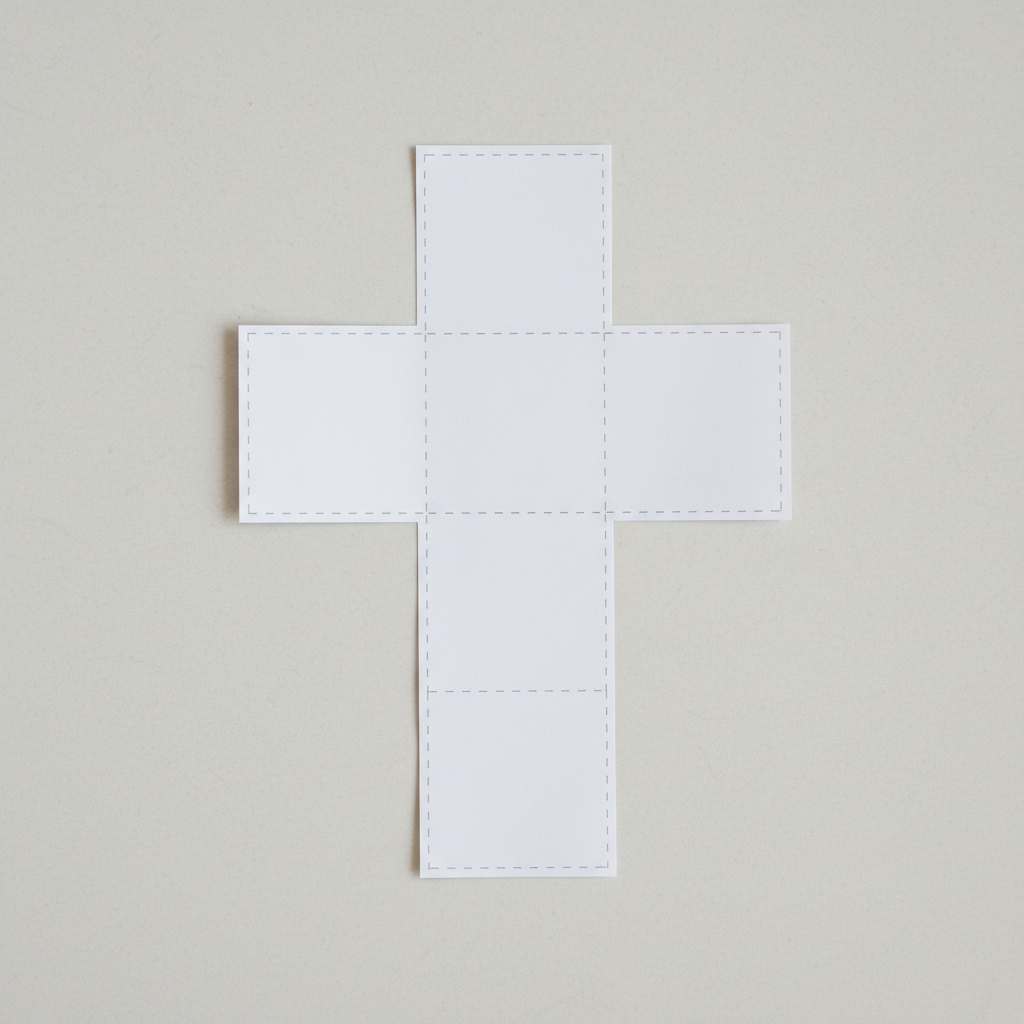
If you were to fold this up, the middle square could be the bottom, the squares to its left and right would be two sides, the square above would be the front, and the square below would be the back. The very top square would be the lid!
Now, let's look at a pattern that *cannot* form a cube:
Why doesn't this last one work? If you try to fold it, you'll see that the squares overlap when you try to make the sides of the cube. You can't have two "lids" or two "bottoms" on a cube!
Practice Your Detective Skills!
Keep practicing by drawing different arrangements of six squares and trying to fold them in your mind. The more you practice, the better you'll become at spotting the nets of a cube!
Keep learning, free
Create a free Syllabax account to unlock practice questions and games for this topic.
Visual Learning Enhanced! 🚀
To help you master this topic, we use Advanced Syllabax AI to generate detailed diagrams and visual models.
Note on Visuals: The AI sometimes makes spelling errors in image labels. Please refer to the lesson text for the correct terminology.