Which Group Has Less?
Watch this topic in 60 seconds
Free preview · Lesson 1
Understanding Which Group Has Less?
Exploring 'Which Group Has Less?' - A Foundational Math Adventure!
Hello, young mathematicians! Today, we're going on an exciting adventure to learn about something called 'less.' Have you ever wondered if you have fewer cookies than your friend, or if there are fewer red cars than blue cars on the street? That's what 'less' is all about! It means a smaller amount or a smaller number.
What Does 'Less' Mean?
Imagine you have two bowls of yummy candy. In one bowl, you have 2 candies. In another bowl, you have 5 candies. Which bowl would you say has 'less' candy? The bowl with 2 candies, right? 'Less' simply means not as many or a smaller number.
Think of it like this: If you have a small stack of blocks and your friend has a tall stack of blocks, you have 'less' blocks than your friend. Your stack is smaller!
Why is 'Less' Important?
Learning about 'less' helps us compare things in the world around us. It's like having a superpower to figure out which group has a smaller amount! This is super helpful when you want to share snacks fairly, count toys, or even when you're looking at different groups of animals in a picture book. It helps you understand numbers better and how they relate to each other.
How Do We Find Which Group Has Less? (The Counting Game!)
Finding the group with 'less' is like playing a super fun counting game. Here are the steps:
Step 1: Count, Count, Count!
First, you need to count how many items are in the first group. Let's say you have a group of red apples. Carefully count each apple, one by one. "One, two, three..."
Then, do the same thing for the second group. Let's say these are green apples. Count them carefully: "One, two, three..."
It's like counting your fingers and then counting your toes! You need a number for each group.
Step 2: Compare the Numbers!
Once you have a number for each group, you just have to look at those two numbers and see which one is smaller. The smaller number belongs to the group that has 'less.' It's like when you look at your two hands and see that one has 3 fingers up and the other has 5 fingers up. Which number is smaller? 3! So, the hand with 3 fingers has less.
Let's look at an example:
- Group A has 3 stars.
- Group B has 7 stars.
Which number is smaller, 3 or 7? Yes, 3 is smaller than 7! So, Group A has less stars.
Let's See It in Action! (Examples and Analogies)
Example 1: The Puppy Parade!
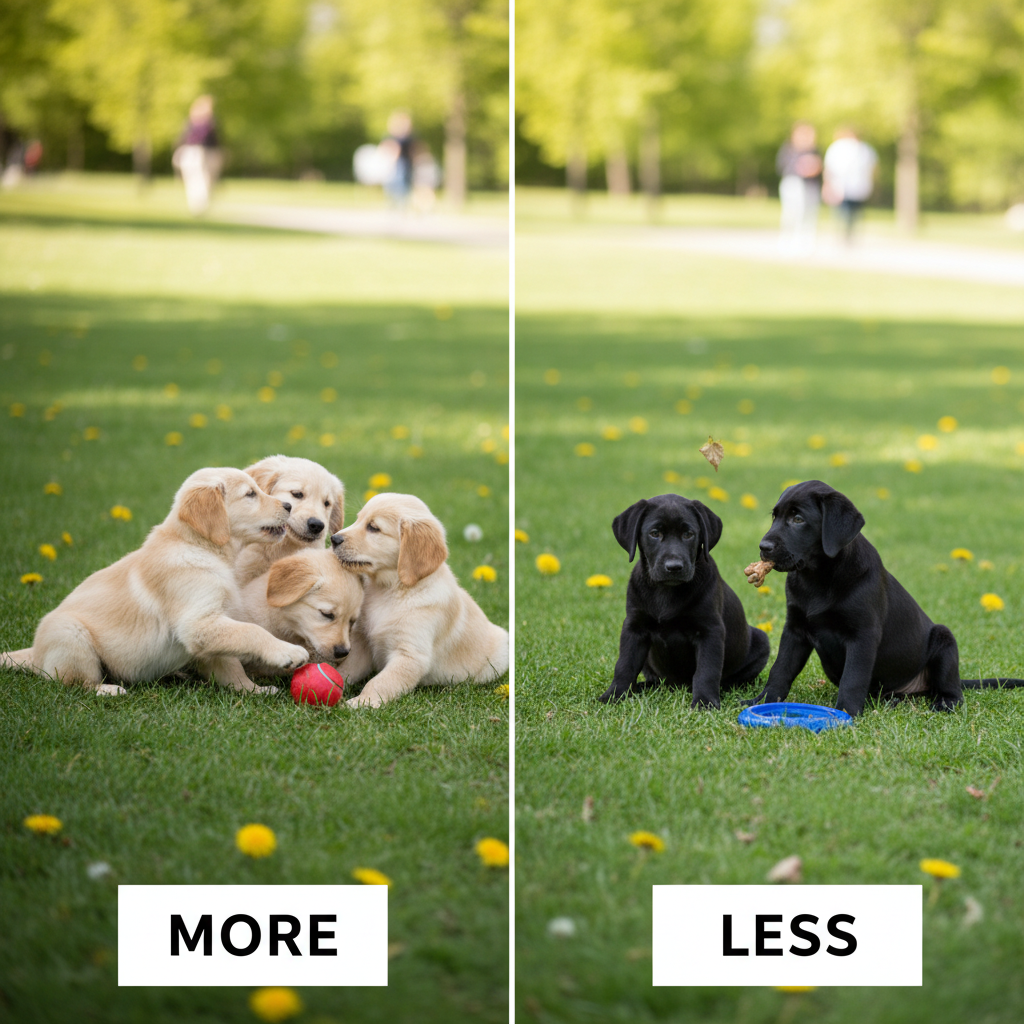
Imagine you see two groups of puppies. In the first group, there are 4 puppies wagging their tails. In the second group, there are 2 puppies playing fetch.
Count them: Group 1 has 4. Group 2 has 2.
Which number is smaller, 4 or 2? That's right, 2 is smaller! So, the group with 2 puppies has less puppies.
 ⚠️ This picture may have spelling mistakes. Trust the words in the lesson.
Example 2: Delicious Donuts!
You have a plate with chocolate donuts and another plate with jelly donuts. There are 5 chocolate donuts and 3 jelly donuts.
Count them: Chocolate has 5. Jelly has 3.
Which number is smaller, 5 or 3? Excellent! 3 is smaller! So, there are less jelly donuts.
This is like comparing how many fingers you have on one hand (5) versus how many toes you have on one foot (5). Oh wait, that's the same! Let's try again. It's like comparing how many fingers you have (5) to how many thumbs you have (1) on one hand. You have less thumbs!
Example 3: Toy Cars vs. Toy Airplanes
In your toy box, you find 6 toy cars and 1 toy airplane.
Count them: Cars = 6. Airplanes = 1.
Which number is smaller, 6 or 1? You got it! 1 is much smaller than 6. So, there is less toy airplanes.
Remember These Simple Tricks!
- Count carefully: Don't rush! Count each item one by one.
- Look for the smaller number: Once you have both numbers, the one that comes first when you count (like 1, 2, 3...) is the smaller number.
- Practice makes perfect: Keep counting and comparing things around you! How many shoes do you have compared to how many socks? How many forks compared to spoons?
Conclusion: You're a 'Less' Expert!
Great job! Now you know how to figure out which group has 'less.' It's all about counting carefully and then comparing the numbers to find the smaller one. This skill will help you every day, from sharing toys to understanding bigger numbers as you grow. Keep practicing, and you'll be a math superstar!
Keep learning, free
Create a free Syllabax account to unlock practice questions and games for this topic.
Visual Learning Enhanced! 🚀
To help you master this topic, we use Advanced Syllabax AI to generate detailed diagrams and visual models.
Note on Visuals: The AI sometimes makes spelling errors in image labels. Please refer to the lesson text for the correct terminology.