Transparent, translucent, opaque objects[PHYSICS]
Watch this topic in 60 seconds
Free preview · Lesson 1
Understanding Transparent, translucent, opaque objects[PHYSICS]
Understanding Light: Transparent, Translucent, and Opaque Objects
Have you ever noticed how some things let you see right through them, while others block light completely? This is all thanks to how objects interact with light. In this lesson, we're going to explore three main ways objects deal with light: being transparent, translucent, or opaque. Think of light as tiny invisible energy balls traveling in straight lines.
What is Light?
Before we dive into the types of objects, let's briefly talk about light. Light is a form of energy that travels very, very fast. We see things because light bounces off them and travels to our eyes. It also travels in straight paths, like a laser beam.
Transparent Objects: Like Looking Through a Clean Window
Imagine a perfectly clean window in your house. You can see everything outside clearly, right? This is because the window is transparent. Transparent objects allow almost all the light that hits them to pass straight through. When light passes through a transparent object, it doesn't get scattered much, so we can see objects on the other side very clearly.
Analogy: Think of a transparent object like a clear, empty swimming pool. You can easily see the bottom of the pool and anything at the bottom because the water is so clear and lets light pass through without much interruption.
Examples of transparent objects:
- Clear glass
- Clean water
- Air
- Some plastics (like a clear plastic wrap)
When light hits a transparent object, most of it goes straight through without bouncing off or getting absorbed. This is why we can see images or objects on the other side so clearly.
Translucent Objects: A Hazy View
Now, what about something like a frosted glass shower door? You can tell someone is behind it, but you can't see their face or details clearly. This is because the shower door is translucent. Translucent objects allow some light to pass through, but they scatter the light in many different directions. This scattering makes it difficult to see objects on the other side clearly.
Analogy: Imagine trying to see through a thick fog. You know there's something out there, maybe a car or a tree, but you can't make out any details. The fog is scattering the light, making it hard to see clearly. This is similar to how translucent objects work.
Examples of translucent objects:
- Frosted glass
- Wax paper
- Thin or cloudy plastic containers
- Some types of thin fabrics
- The thin part of a leaf
When light hits a translucent object, some light passes through, but it bounces around inside the material before coming out the other side. This makes the light appear fuzzy or spread out, and we can't see sharp images.
Opaque Objects: Blocking the Light
Finally, think about a solid wooden door or a brick wall. Can you see through it? No way! These are opaque objects. Opaque objects block light completely. When light hits an opaque object, it is either absorbed by the object or reflected off its surface. None of the light passes through.
Analogy: Imagine a solid, thick blanket. If you shine a flashlight on one side, no light will get to the other side. The blanket is blocking all the light. This is what opaque objects do.
Examples of opaque objects:
- Wood
- Metal
- Rocks
- Most plastics (like a toy car's body)
- Your own body!
When light hits an opaque object, it can't go through. Instead, it either bounces off (which is how we see the color of many objects) or gets absorbed, turning into heat. That's why dark surfaces often feel warmer in the sun – they absorb more light energy.
Comparing the Three
Let's put it all together:
- Transparent: Lets ALL light through. You can see clearly. (Clear window)
- Translucent: Lets SOME light through, but scatters it. You can see fuzzy shapes. (Frosted glass)
- Opaque: Lets NO light through. You can't see anything on the other side. (Brick wall)
It's like a light traffic system:
- Transparent is like a green light – light goes through freely.
- Translucent is like a yellow flashing light – light goes through, but it's a bit chaotic and scattered.
- Opaque is like a red stop sign – light stops dead.
Understanding these terms helps us describe how different materials interact with the world around us, especially with light!
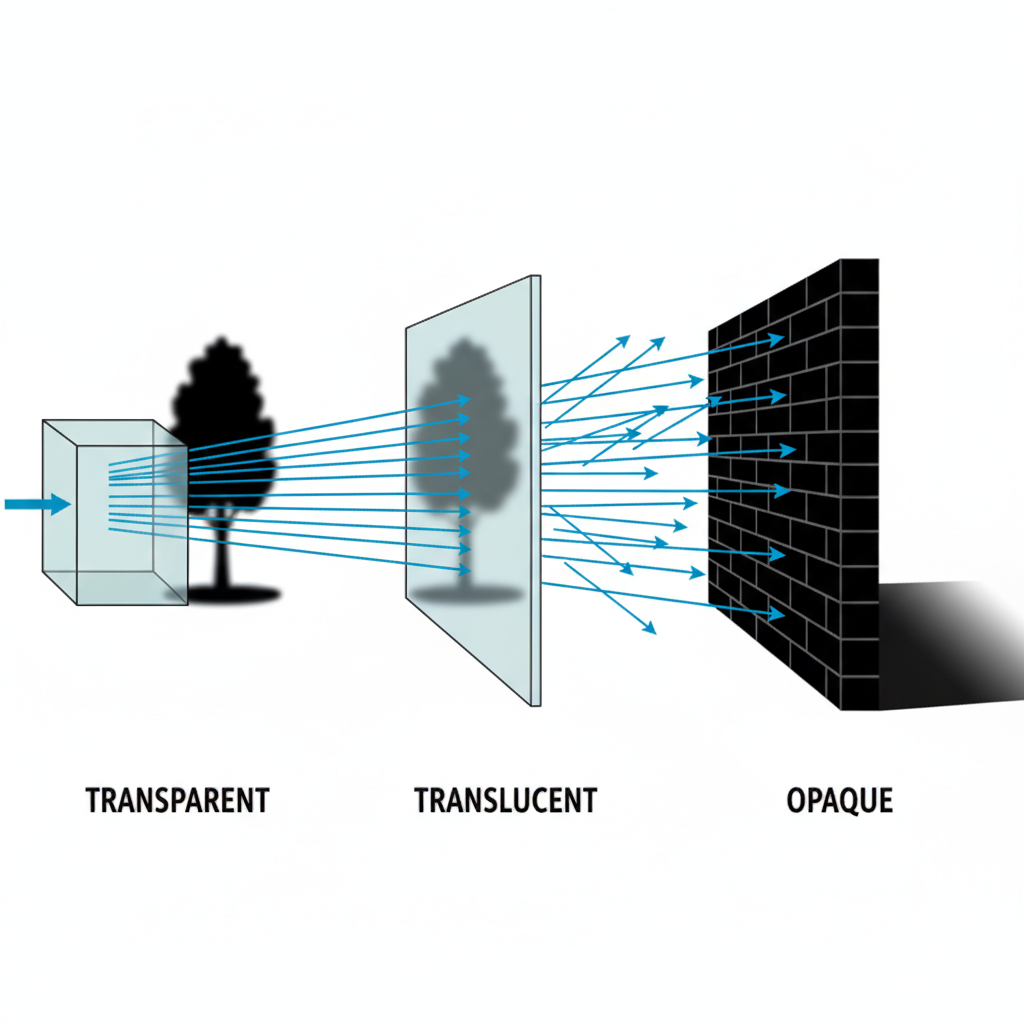 ⚠️ This picture may have spelling mistakes. Trust the words in the lesson.
Keep learning, free
Create a free Syllabax account to unlock practice questions and games for this topic.
Visual Learning Enhanced! 🚀
To help you master this topic, we use Advanced Syllabax AI to generate detailed diagrams and visual models.
Note on Visuals: The AI sometimes makes spelling errors in image labels. Please refer to the lesson text for the correct terminology.